
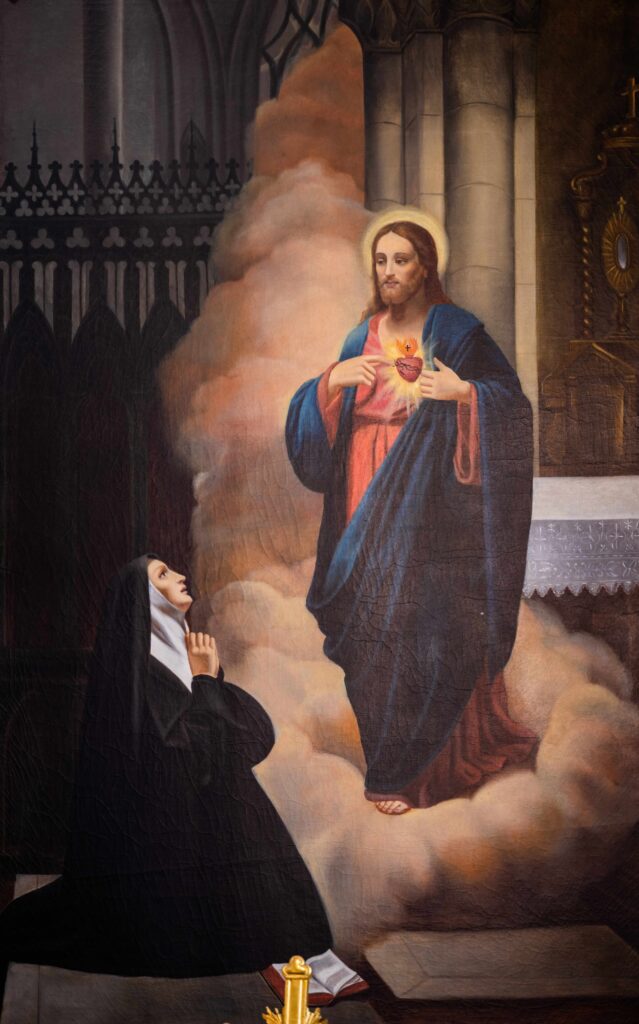
Act of Consecration to the Sacred Heart of Jesus
I give myself and consecrate to the Sacred Heart of our Lord Jesus Christ my person and my life, my actions, pains, and sufferings, so that I may be unwilling to make use of any part of my being other than to honour, love, and glorify the Sacred Heart.
This is my unchanging purpose; namely, to be all His, and to do all things for the love of Him, at the same time renouncing with all my heart whatever is displeasing to Him.
I therefore take You, O Sacred Heart, to be the only object of my love, the guardian of my life, my assurance of salvation, the remedy of my weakness and inconstancy, the atonement for all the faults of my life and my sure refuge at the hour of death.
Be then, O Heart of goodness, my justification before God the Father, and turn away from me the strokes of His righteous anger. O Heart of love, I put all my confidence in You, for I fear everything from my own wickedness and frailty, but I hope for all things from Your goodness and bounty.
Remove from me all that can displease You or resist Your holy will; let Your pure love imprint Your image so deeply upon my heart that I shall never be able to forget You or to be separated from You.
May I obtain from all Your loving kindness the grace of having my name written in Your Heart, for in You I desire to place all my happiness and glory, living and dying in bondage to You.
Amen. – St Margaret Mary Alacoque
Gospel Reading : Matthew 11:25-30
At that time Jesus declared, “I thank thee, Father, Lord of heaven and earth, that thou hast hidden these things from the wise and understanding and revealed them to babes; yea, Father, for such was thy gracious will.
All things have been delivered to me by my Father; and no one knows the Son except the Father, and no one knows the Father except the Son and any one to whom the Son chooses to reveal him.
Come to me, all who labour and are heavy laden, and I will give you rest. Take my yoke upon you, and learn from me; for I am gentle and lowly in heart, and you will find rest for your souls. For my yoke is easy, and my burden is light.”
What do the Fathers say?
St JEROME. He gives thanks that His coming has opened to the Apostles sacraments, which the Scribes and Pharisees knew not, who seemed to themselves wise, and understanding in their own eyes. on the Gospel.
St John CHRYSOSTOM. When He says, The wise, He does not speak of true wisdom, but of that which the Scribes and Pharisees seemed to have by their speech.
He did not say, ‘And have revealed them to the foolish,’ but, to babes, that is, the uneducated, or the simple; teaching us in all things to keep ourselves from pride, and to seek humility.
That it is revealed to the one is matter of joy, that it is hid from the other not of joy, but of sorrow; He does not therefore rejoice on this account, but He rejoices that these have known what the wise have not known.
Pope St GREGORY the Great. Here we have a lesson in humility, that we should not rashly presume to discuss the counsels of heaven concerning the calling of some, and the rejection of others showing that that cannot be unrighteous which is willed by Him that is righteous.
1. “You shall draw waters with joy out of the Savior’s fountain.”(1) These words by which the prophet Isaias, using highly significant imagery, foretold the manifold and abundant gifts of God which the Christian era was to bring forth, come naturally to Our mind when We reflect on the centenary of that year when Our predecessor of immortal memory, Pius IX, gladly yielding to the prayers from the whole Catholic world, ordered the celebration of the feast of the Most Sacred Heart of Jesus in the Universal Church.
2. It is altogether impossible to enumerate the heavenly gifts which devotion to the Sacred Heart of Jesus has poured out on the souls of the faithful, purifying them, offering them heavenly strength, rousing them to the attainment of all virtues. Therefore, recalling those wise words of the Apostle St. James, “Every best gift and every perfect gift is from above, coming down from the Father of Lights,”(2) We are perfectly justified in seeing in this same devotion, which flourishes with increasing fervor throughout the world, a gift without price which our divine Savior the Incarnate Word, as the one Mediator of grace and truth between the heavenly Father and the human race imparted to the Church, His mystical Spouse, in recent centuries when she had to endure such trials and surmount so many difficulties.
3. The Church, rejoicing in this inestimable gift, can show forth a more ardent love of her divine Founder, and can, in a more generous and effective manner, respond to that invitation which St. John the Evangelist relates as having come from Christ Himself: “And on the last and great day of the festivity, Jesus stood and cried out, saying, ‘If any man thirst, let him come to Me, and let him drink that believeth in Me. As the Scripture saith: Out of his heart there shall flow rivers of living waters.’ Now this He said of the Spirit which they should receive who believed in Him.”(3)
4. For those who were listening to Jesus speaking, it certainly was not difficult to relate these words by which He promised the fountain of “living water” destined to spring from His own side, to the words of sacred prophecy of Isaias, Ezechiel and Zacharias, foretelling the Messianic Kingdom, and likewise to the symbolic rock from which, when struck by Moses, water flowed forth in a miraculous manner.(4)
5. Divine Love first takes its origin from the Holy Spirit, Who is the Love in Person of the Father and the Son in the bosom of the most Holy Trinity. Most aptly then does the Apostle of the Gentiles echo, as it were, the words of Jesus Christ, when he ascribes the pouring forth of love in the hearts of believers to this Spirit of Love: “The charity of God is poured forth in our hearts by the Holy Spirit Who is given to us.”(5)
6. Holy Writ declares that between divine charity, which must burn in the souls of Christians, and the Holy Spirit, Who is certainly Love Itself, there exists the closest bond, which clearly shows all of us, venerable brethren, the intimate nature of that worship which must be paid to the Most Sacred Heart of Jesus Christ. If we consider its special nature it is beyond question that this devotion is an act of religion of high order; it demands of us a complete and unreserved determination to devote and consecrate ourselves to the love of the divine Redeemer, Whose wounded Heart is its living token and symbol. It is equally clear, but at a higher level, that this same devotion provides us with a most powerful means of repaying the divine Lord by our own.
7. Indeed it follows that it is only under the impulse of love that the minds of men obey fully and perfectly the rule of the Supreme Being, since the influence of our love draws us close to the divine Will that it becomes as it were completely one with it, according to the saying, “He who is joined to the Lord, is one spirit.”(6)
14. Our predecessor of immortal memory, Leo XIII, declared [it] to be “the most acceptable form of piety?” He had no doubt that in it there was a powerful remedy for the healing of those very evils which today also, and beyond question in a wider and more serious way, bring distress and disquiet to individuals and to the whole human race. “This devotion,” he said, “which We recommend to all, will be profitable to all.” And he added this counsel and encouragement with reference to the devotion to the Sacred Heart of Jesus: “. . .hence those forces of evil which have now for so long a time been taking root and which so fiercely compel us to seek help from Him by Whose strength alone they can be driven away. Who can He be but Jesus Christ, the only begotten Son of God? ‘For there is no other name under heaven given to men whereby we must be saved.'(8) We must have recourse to Him Who is the Way, the Truth, and the Life.”(9)
75. The Sacred Heart of Jesus shares in a most intimate way in the life of the Incarnate Word, and has been thus assumed as a kind of instrument of the Divinity. It is therefore beyond all doubt that, in the carrying out of works of grace and divine omnipotence, His Heart, no less than the other members of His human nature is also a legitimate symbol of that unbounded love.(78)
76. Under the influence of this love, our Savior, by the outpouring of His blood, became wedded to His Church: “By love, He allowed Himself to be espoused to His Church.”(79) Hence, from the wounded Heart of the Redeemer was born the Church, the dispenser of the Blood of the Redemption–whence flows that plentiful stream of Sacramental grace from which the children of the Church drink of eternal life, as we read in the sacred liturgy: “From the pierced Heart, the Church, the Bride of Christ, is born….And He pours forth grace from His Heart.”(80)
77. Concerning the meaning of this symbol, which was known even to the earliest Fathers and ecclesiastical writers, St. Thomas Aquinas, echoing something of their words, writes as follows: “From the side of Christ, there flowed water for cleansing, blood for redeeming. Hence blood is associated with the sacrament of the Eucharist, water with the sacrament of Baptism, which has its cleansing power by virtue of the blood of Christ.”(81)
78. What is here written of the side of Christ, opened by the wound from the soldier, should also be said of the Heart which was certainly reached by the stab of the lance, since the soldier pierced it precisely to make certain that Jesus Christ crucified was really dead. Hence the wound of the most Sacred Heart of Jesus, now that He has completed His mortal life, remains through the course of the ages a striking image of that spontaneous charity by which God gave His only begotten Son for the redemption of men and by which Christ expressed such passionate love for us that He offered Himself as a bleeding victim on Calvary for our sake: “Christ loved us and delivered Himself for us, an oblation and a sacrifice to God for an odor of sweetness.”(82)
79. After our Lord had ascended into heaven with His body adorned with the splendors of eternal glory and took His place by the right hand of the Father, He did not cease to remain with His Spouse, the Church, by means of the burning love with which His Heart beats. For He bears in His hands, feet and side the glorious marks of the wounds which manifest the threefold victory won over the devil, sin, and death.
80. He likewise keeps in His Heart, locked as it were in a most precious shrine, the unlimited treasures of His merits, the fruits of that same threefold triumph, which He generously bestows on the redeemed human race. This is a truth full of consolation, which the Apostle of the Gentiles expresses in these words: “Ascending on high, He led captivity captive; He gave gifts to men. . .He that descended, is the same also that ascended above all the heavens that He might fill all things.”
95. But surely the most distinguished place among those who have fostered this most excellent type of devotion is held by St. Margaret Mary Alacoque who, under the spiritual direction of Blessed Claude de la Colombiere who assisted her work, was on fire with an unusual zeal to see to it that the real meaning of the devotion which had had such extensive developments to the great edification of the faithful should be established and be distinguished from other forms of Christian piety by the special qualities of love and reparation.(98)
96. It is enough to recall the record of that age in which the devotion to the Sacred Heart of Jesus began to develop to understand clearly that its marvelous progress has stemmed from the fact that it entirely agreed with the nature of Christian piety since it was a devotion of love. It must not be said that this devotion has taken its origin from some private revelation of God and has suddenly appeared in the Church; rather, it has blossomed forth of its own accord as a result of that lively faith and burning devotion of men who were endowed with heavenly gifts, and who were drawn towards the adorable Redeemer and His glorious wounds which they saw as irresistible proofs of that unbounded love.
1. Is. 12:3.
2. Jas. 1:17.
3. Jn. 7:37-39. (Translator’s note: In this passage, Pope Pius XII uses the punctuation favored by St. Irenaeus and St. Cyprian and some other ancient authorities. The translation therefore follows this and not the Douay version.)
4. Cfr. Is. 12:3; Ex. 47:1-12; Zach. 13:1; Ex. 17:1-7; Num. 20:7-13; I Cor. 10:4; Apoc. 7:17, 22:1.
5. Rom. 5:15.
6. I Cor. 6:17.
7. Jn. 4:10.
8. Acts 4:12.
9. Encl. “Annum Sacrum,” 25th May, 1899; Acta Leonis, vol. XIX, 1900, pp. 71, 77-79.
79. Sum. Theol., Suppl., q. 42, a. 1. ad 3m: ed. Leon., vol. XII, 1906, p. 31.
80. Hymn at Vespers, Feast of the Most Sacred Heart of Jesus.
81. Sum. Theol. III, q. 66, a. 3m: ed. Leon., vol XII, 1906, p. 65.
82. Eph. 5:2.
98. Cfr. Encl. “Miserentissimus Redemptor”: A.A.S. XX, 1928, pp. 167-168.
Sources:
Bible readings from the Revised Standard Version of the Bible, Second Catholic Edition, copyright © 2006 National Council of the Churches of Christ in the USA
Quotes of the Fathers from Thomas Aquinas’ Catena Aurea Translated by St John Henry Newman
ENCYCLICAL OF POPE PIUS XII HAURIETIS AQUAS ON DEVOTION TO THE SACRED HEART MAY 15 1956
Artwork ex Wikimedia Commons