Gospel Reading :Luke 1:57-66, 80
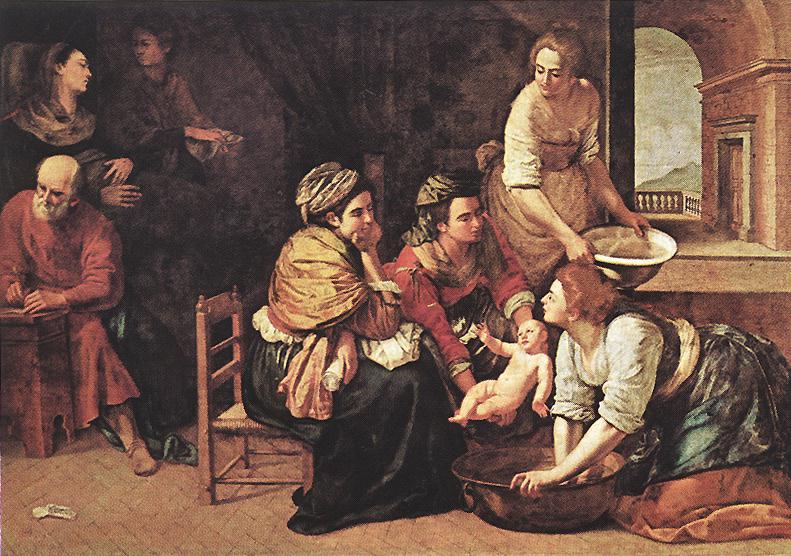
Now the time for Elizabeth to give birth arrived, and she brought forth a son. And her neighbours and relatives heard that the Lord had magnified his mercy with her, and so they congratulated her. And it happened that, on the eighth day, they arrived to circumcise the boy, and they called him by his father’s name, Zechariah. And in response, his mother said: “Not so. Instead, he shall be called John.” And they said to her, “But there is no one among your relatives who is called by that name.”
Then they made signs to his father, as to what he wanted him to be called. And requesting a writing tablet, he wrote, saying: “His name is John.” And they all wondered. Then, at once, his mouth was opened, and his tongue loosened, and he spoke, blessing God.
And fear fell upon all of their neighbors. And all these words were made known throughout all the hill country of Judea. And all those who heard it stored it up in their heart, saying: “What do you think this boy will be?”
And indeed, the hand of the Lord was with him. And the child grew, and he was strengthened in spirit. And he was in the wilderness, until the day of his manifestation to Israel.
What do the Fathers say?
St John CHRYSOSTOM. And for this reason the Lord kept back the delivery of Elisabeth, that her joy might be increased, and that her fame be greater.
For they who had known her barrenness were made the witnesses of the Divine grace, and no one seeing the child departed in silence, but gave praise to God.
The rite of circumcision was first delivered to Abraham as a sign of distinction, that the race of the Patriarch might be preserved in unmixed purity, and so might be able to obtain the promises. But now that the promise of the covenant is fulfilled, the sign attached to it is removed. So then through Christ circumcision ceased, and baptism came in its place.
St AMBROSE. The holy Evangelist has especially remarked, that many thought the child should be called after his father Zechariah, in order that we might understand, not that any name of his kinsfolk was displeasing to his mother, but that the same word had been communicated to her by the Holy Spirit, which had been foretold by the Angel to Zechariah. And in truth, being dumb, Zechariah was unable to mention his son’s name to his wife, but Elisabeth obtained by prophecy what she had not learnt from her husband. Marvel not that the woman pronounced the name which she had never heard, seeing the Holy Spirit who imparted it to the Angel revealed it to her; nor could she be ignorant of the forerunner of the Lord, who had prophesied of Christ.
And so that you might consider that the name belongs not to the family, but to the Prophet. Zechariah also is questioned, and signs made to him, But since unbelief had so bereft him of speech, he spoke by his hand-writing, His name is John; that is, we give no name to him who has received his name from God.
The Venerable BEDE. Now allegorically, the celebration of John’s birth was the beginning of the grace of the New Covenant. His neighbours and kinsfolk had rather give him the name of his father than that of John. For the Jews, chose rather to follow the righteousness which is of the Law, than receive the grace of faith.
But the name of John, (i. e. the grace of God,) his mother in word, his father in writing, suffice to announce.
St THEOPHYLACT. As at the silence of Zechariah the people marvelled, so likewise when he spoke. Hence it is said, And fear came upon all; that from these two circumstances all might believe there was something great in the child that was born. But all these things were ordained, to the end that he who was to bear witness of Christ might also be esteemed trustworthy. Hence it follows, And all they that heard them laid them up in their heart.
The Venerable BEDE. For forerunning signs prepare the way for the forerunner of the truth, and the future prophet is recommended by auspices sent before him; hence it follows, For the hand of the Lord was with him.
Sources:
Bible readings from the Revised Standard Version of the Bible, Second Catholic Edition, copyright © 2006 National Council of the Churches of Christ in the USA
Quotes of the Fathers from Thomas Aquinas’ Catena Aurea Translated by St John Henry Newman
Artwork ex Wikimedia Commons