Memorial of the Dedication of the Basilica of Saint Mary Major in Rome
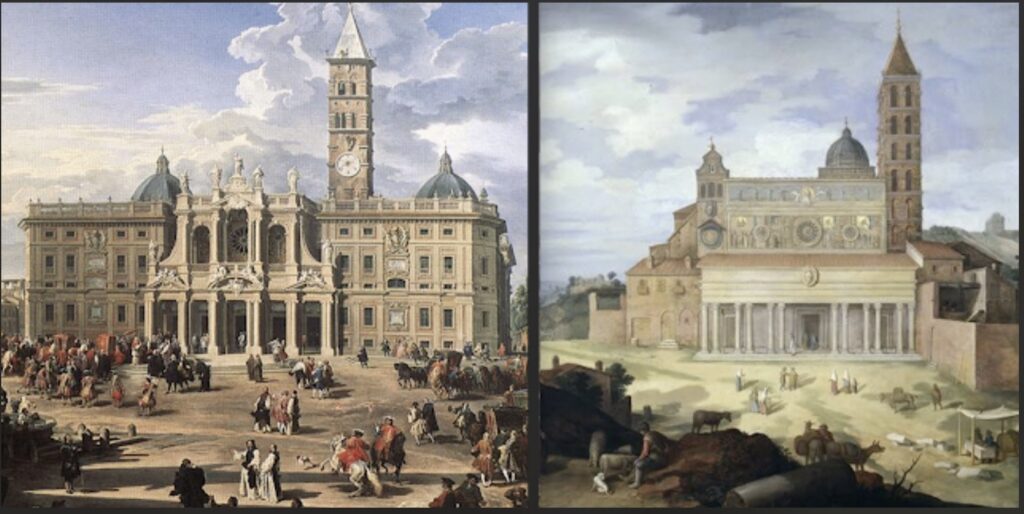
The Miracle of the Snow (August 5, 352 AD)
On the night of August 4–5, 352 AD, a wealthy Roman patrician named John and his wife (who had no heirs) prayed to Mary to direct how to spend their fortune.
That same night, the Virgin Mary appeared in a dream to both the couple and Pope Liberius, instructing them to build a church where they found fresh snow the next morning.
On the hot summer morning of August 5, 352 AD, snow miraculously fell on the summit of the Esquiline Hill. Pope Liberius traced the perimeter of the church in the snow, leading to the construction of the original Liberian Basilica.
Official Historical Consecration (c. 432–440 AD)
The current basilica was consecrated by Pope Sixtus III around 432–440 AD.
Following the Council of Ephesus in 431 AD, which solemnly proclaimed the Virgin Mary as Theotokos , Pope Sixtus III rebuilt and dedicated the grand basilica to Mary as a monument to this dogmatic declaration. It remains the oldest church in the West dedicated to the Blessed Virgin Mary.
Gospel Reading for the Memorial : Luke 11:27-28
Gospel Reading for the feria : Matthew 15:21-28
And Jesus went away from there and withdrew to the district of Tyre and Sidon.
And behold, a Canaanite woman from that region came out and cried, “Have mercy on me, O Lord, Son of David; my daughter is severely possessed by a demon.”
But he did not answer her a word. And his disciples came and begged him, saying, “Send her away, for she is crying after us.”
He answered, “I was sent only to the lost sheep of the house of Israel.”
But she came and knelt before him, saying, “Lord, help me.”
And he answered, “It is not fair to take the children’s bread and throw it to the dogs.”
She said, “Yes, Lord, yet even the dogs eat the crumbs that fall from their master’s table.”
Then Jesus answered her, “O woman, great is your faith! Be it done for you as you desire.”
And her daughter was healed instantly.
What do the Fathers say?
St REMIGIUS. Tyre and Sidon were Gentile towns, for Tyre was the metropolis of the Chananæans, and Sidon the boundary of the Chananæans, towards the north.
St John CHRYSOSTOM. If any should ask, how it is that He bade His disciples go not into the way of the Gentiles, and yet now Himself walks this way; we will answer, first, that that precept which He had given His disciples was not obligatory on Him; secondly, that He went not to preach, as Mark even says, that He purposely concealed Himself.
The Evangelist says that she was a Chananæan, to show the power of Christ’s presence. For this nation, which had been driven out that they might not corrupt the Jews, now showed themselves wiser than the Jews, leaving their own borders that they might go to Christ. And when she came to Him, she asked only for mercy.
GLOSSA Ordinaria. (ap. Anselm of Laon) The great faith of this Chananæan woman is herein showed. She believes Him to be God, in that she calls Him Lord; and man, in that she calls Him Son of David.
She claims nothing of her own desert, but craves only God’s mercy. And she says not, Have mercy on my daughter, but Have mercy on me; because the affliction of the daughter is the affliction of the mother. And the more to excite His compassion, she declares to Him the whole of her grief, My daughter is sore vexed by a demon; thus unfolding to the Physician the wound, and the extent and nature of the disease.
St JEROME.Our Lord does not interact with her so that He might not seem to contravene His own decision,- Go not into the way of the Gentiles. For He reserved the complete salvation of the Gentiles for the season of His passion and resurrection.
The disciples, who are as yet ignorant of the mysteries of God or moved by compassion, beg for this Chananæan, woman; or perhaps they were just seeking to be rid of her insistent begging.
He says that He is not sent to the Gentiles, but that He is sent first to Israel, so that when they would not receive the Gospel, the passing over to the Gentiles might have just cause.
Note how perseveringly this Chananæan, woman calls Him first Son of David, then Lord, and lastly came and worshipped him, as God.
Wonderfully are shown the faith, patience, and humility of this woman;
faith, that she believed that her daughter could be healed;
patience, that although overlooked so many times , she yet perseveres in her prayers;
humility, that she compares herself not even to the dogs, but to the puppies.
I know, she says, that I do not deserve the children’s bread, and that I cannot have whole meat, nor sit at the table with the master of the house, but I am content with that which is left for the puppies, that through humble fragments I may come to the fulness of the perfect bread.
Sources:
Bible readings from the Revised Standard Version of the Bible, Second Catholic Edition, copyright © 2006 National Council of the Churches of Christ in the USA
Quotes of the Fathers from :
Thomas Aquinas’ Catena Aurea Translated by St John Henry Newman
Artwork ex Wikimedia Commons