Gospel Reading : Luke 4:38-44
And he arose and left the synagogue, and entered Simon’s house. Now Simon’s mother-in-law was ill with a high fever, and they besought him for her.
And he stood over her and rebuked the fever, and it left her; and immediately she rose and served them.
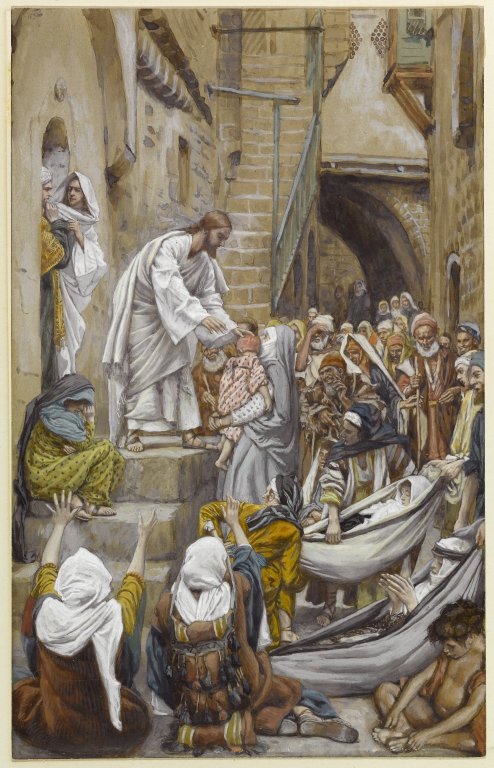
Now when the sun was setting, all those who had any that were sick with various diseases brought them to him; and he laid his hands on every one of them and healed them.
And demons also came out of many, crying, “You are the Son of God!” But he rebuked them, and would not allow them to speak, because they knew that he was the Christ.
And when it was day he departed and went into a lonely place. And the people sought him and came to him, and would have kept him from leaving them; but he said to them, “I must preach the good news of the kingdom of God to the other cities also; for I was sent for this purpose.”
And he was preaching in the synagogues of Judea.
What do the Fathers say?
St CYRIL OF ALEXANDRIA. Now see how Christ abides in the house of a poor man, suffering poverty of His own will for our sakes, that we might learn to visit the poor, and despise not the destitute and needy.
The Venerable BEDE. At one time at the request of others, at another of his own accord, our Saviour cures the sick, showing that He is far aloof from the passions of sinners, and ever grants the prayer of the faithful, and what they in themselves little understand He either makes intelligible, or forgives their not understanding it.
St John CHRYSOSTOM. For since the disease was curable, He showed His power by the manner of the cure, doing what art could never do. For after the allaying of the fever, the patient needs much time before being restored to his former health, but at this time all took place at once.
St CYRIL OF ALEXANDRIA. Let us therefore receive Jesus. For when He has visited us, we carry Him in our heart and mind; He will then extinguish the flames of our unlicensed pleasures, and will make us whole, so that we minister unto Him, that is, do things well-pleasing to Him.
Although as God He was able to drive away diseases by His word, He nevertheless touches them, showing that His flesh was powerful to apply remedies, since it was the flesh of God; for as fire, when applied to a brazen vessel, imprints on it the effect of its own heat, so the omnipotent Word of God, when He united to Himself in real assumption a living virgin temple, endued with understanding, implanted in it a participation of His own power.
May He also touch us, nay rather may we touch Him, that He may deliver us from the infirmities of our souls as well as the assaults of the evil spirit and pride!
The Venerable BEDE. The devils confess the Son of God, they knew him to be Christ; for when the devil saw Him distressed by fasting, he perceived Him to be truly man, but when he prevailed not in his trial he doubted whether or not He were the Son of God, but now by the power of Christ’s miracles he either perceived or suspected Him to be the Son of God.
He did not then persuade the Jews to crucify Him because he thought Him not to be Christ or the Son of God, but because he did not foresee that by this death he himself would be condemned. Of this mystery hidden from the world the Apostle says, that none of the princes of this world knew, for if they had known they would never have crucified the Lord of Glory. (1 Cor. 2:8.)
St John CHRYSOSTOM. Mark the humility of Christ, who would not let the unclean spirits make Him manifest. For it was not fit that they should usurp the glory of the Apostolical office, nor did it become the mysteries of Christ to be made public by impure tongues.
When he had bestowed sufficient favour upon the people by miracles, it was necessary for Him to depart. For miracles are always thought greater when the worker is gone, since they themselves are then the more heeded, and have in their turn a voice.
The Pharisees indeed, seeing how that the miracles themselves published His fame, were offended at His power. But the multitudes sought him, not indeed any of the chief priests, or scribes, but all those who had not been blackened with the dark stain of malice, and preserved their consciences unhurt.
Sources:
Bible readings from the Revised Standard Version of the Bible, Second Catholic Edition, copyright © 2006 National Council of the Churches of Christ in the USA
Quotes of the Fathers from :
Thomas Aquinas’ Catena Aurea Translated by St John Henry Newman
Artwork ex Wikimedia Commons