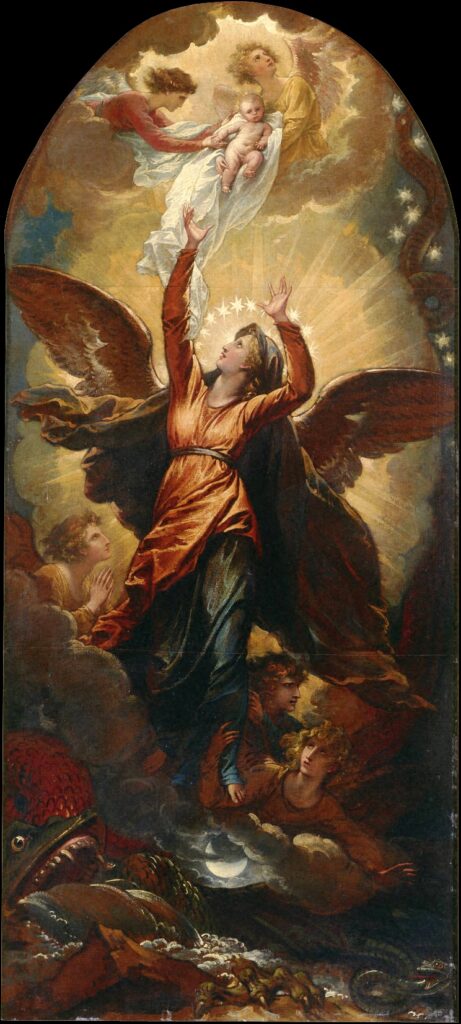
“A great sign appeared in heaven: A woman clothed with the sun, and the moon under her feet, and on her head a crown of twelve stars:”
– John the Evangelist Revelation 12:1
The Woman Clothed with the Sun Fleeth from the Persecution of the Dragon.Benjamin West, 1738–1820 – Princeton University Art Museum
Gospel Reading : John 21:20-25
Peter turned and saw following them the disciple whom Jesus loved, who had lain close to his breast at the supper and had said, “Lord, who is it that is going to betray you?” When Peter saw him, he said to Jesus, “Lord, what about this man?”
Jesus said to him, “If it is my will that he remain until I come, what is that to you? Follow me!”
The saying spread abroad among the brethren that this disciple was not to die; yet Jesus did not say to him that he was not to die, but, “If it is my will that he remain until I come, what is that to you?”
This is the disciple who is bearing witness to these things, and who has written these things; and we know that his testimony is true.
But there are also many other things which Jesus did; were every one of them to be written, I suppose that the world itself could not contain the books that would be written.
What do the fathers say?
St AUGUSTINE. Some think that the reason why John was loved more than the rest, was, because he had lived in perfect chastity from his youth.
St John CHRYSOSTOM. Peter now shows what confidence he had after his denial. For he who at the supper dared not ask the question himself, but gave his question to John to ask, has the superintendence over his brethren committed to him, and he now asks questions himself of his Master concerning others.
Our Lord then having foretold such great things of him, and committed the world to him, and prophesied his martyrdom, and made known his greater love, Peter wishing to have John admitted to a share of this calling, says, And what shall this man do? as if to say, Will he not go the same way with us? For Peter had great love for John, as appears from the Gospels and Acts of the Apostles, which give many proofs of their close friendship. So Peter does John the same turn, that John had done him; thinking that he wanted to ask about himself, but was afraid, he puts the question for him. However, our Lord says, If it is my will that he remain until I come, what is that to you? as if to say, Attend to the work committed to you, and do it: If it is my will that he remain here, what is that to you?
St THEOPHYLACT. Some have understood, Till I come, to mean, Till I come to punish the Jews who have crucified Me, and strike them with the Roman rod. For they say that this Apostle lived up to the time of Vespasian, who took Jerusalem, and dwelt near it when it was taken. Or, Till I come, i. e. till I give him the commission to preach, for to you I commit now the pontificate of the world: and in this follow Me, but let him remain till I come and call him, as I call you now.
St John CHRYSOSTOM. John appeals to his own knowledge of these events, having been witness of them: This is the disciple which testifies of these things. When we assert any undoubted fact in common life, we do not withhold our testimony: much less would he, who wrote by the inspiration of the Holy Spirit. (Acts 2:32) John is the only one who appeals to his own testimony; and he does so, because he was the last who wrote. And for this reason he often mentions Christ’s love for him, i. e. to show the motive which led him to write, and to give weight to his history. And we know that his testimony is true. He was present at every event, even at the crucifixion, when our Lord committed His mother to him; circumstances which both show Christ’s love, and his own importance as a witness. But if any believe not, let him consider what follows: And there are also many other things which Jesus did. If, when there were so many things to relate, I have not said so much as the other, and have selected often reproaches and derision in preference to other things, it is evident that I have not written partially. One who wants to show another off to advantage does the very contrary, and omits the dishonourable parts.
St AUGUSTINE. If they should be written every one, I suppose that even the world itself could not contain the books that should be written; meaning not the world had not space for them, but that the capacity of readers was not large enough to hold them.
Although sometimes words themselves may exceed the truth, and yet the thing they express be true; a mode of speech which is used not to explain an obscure and doubtful, but to magnify or estimate a plain, thing: nor does it involve any departure from the path of truth; inasmuch as the excess of the word over the truth is evidently only a figure of speech, and not a deception. This way of speaking the Greeks call hyperbole, and it is found in other parts of Scripture.
Sources:
Bible readings from the Revised Standard Version of the Bible, Second Catholic Edition, copyright © 2006 National Council of the Churches of Christ in the USA
Quotes of the Fathers from Thomas Aquinas’ Catena Aurea Translated by St John Henry Newman
Artwork ex Wikimedia Commons