
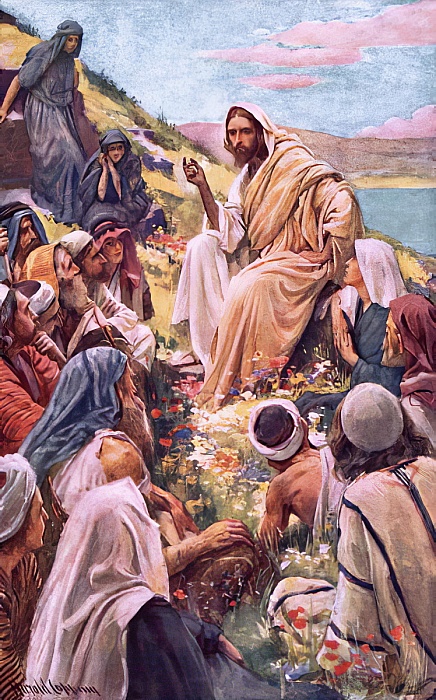
Gospel Reading : Matthew 5:17-19
Do not think that I am come to destroy the law, or the prophets. I am not come to destroy, but to fulfil. For amen I say unto you, till heaven and earth pass, one jot, or one tittle shall not pass of the law, till all be fulfilled. He therefore that shall break one of these least commandments, and shall so teach men, shall be called the least in the kingdom of heaven. But he that shall do and teach, he shall be called great in the kingdom of heaven.
What do the Fathers say?
St AUGUSTINE. Even for them who were under grace, it was hard in this mortal life to fulfil the Law.
He being made a Priest by the sacrifice of His flesh, obtained for us this indulgence, even in this fulfilling the Law, that where through our infirmity we could not, we should be strengthened through His perfection, of whom as our head we all are members. For so I think must be taken these words, to fulfil the Law, by adding to it, that is, such things as either contribute to the explanation of the old glosses, or to enable to keep them. For the Lord has showed us that even a wicked motion of the thoughts to the wrong of a brother is to be accounted a kind of murder. The Lord also teaches us, that it is better to keep near to the truth without swearing, than with a true oath to come near to blasphemy.
The fulfilment of the Law is love, which the Lord has given in sending His Holy Spirit. The Law is fulfilled either when the things there commanded are done, or when the things there prophesied come to pass.
In the Old Testament were figures of things to come, which, when the things themselves were brought in by Christ, ought to have been taken away, that in that very taking away the Law and the Prophets might be fulfilled wherein it was written that God gave a New Testament.
The Catholics are not in any difficulty on account of this chapter as though they did not observe the Law and the Prophets; for they do cherish love to God and their neighbour, on which hang all the Law and the Prophets.
And whatever in the Law and the Prophets was foreshown, whether in things done, in the celebration of sacramental rites, or in forms of speech, all these they know to be fulfilled in Christ and the Church.
He then who says, that unless Christ had destroyed the Law and the Prophets, the Mosaic rites would have continued along with the Christian ordinances, may further affirm, that unless Christ had destroyed the Law and the Prophets, He would yet be only promised as to be born, to suffer, to rise again.
But inasmuch as He did not destroy, but rather fulfil them, His birth, passion, and resurrection, are now no more promised as things future, which were signified by the Sacraments of the Law; but He is preached as already born, crucified, and risen, which are signified by the Sacraments now celebrated by Christians. It is clear the same things which the Prophetic ordinance had held forth as promises, the Evangelic ordinance points to as completed.
Which was the Law and which the Prophets, that Christ came not to subvert but to fulfil, is manifest, to wit, the Law given by Moses.
We affirm that the Law of Moses was both well suited to its temporary purpose, and was now not subverted, but fulfilled by Christ, This was not understood by those who continued in such obstinate error, that they compelled the Gentiles to Judaize—those heretics, I mean, who were called Nazarenes.
Sources:
Bible readings from the Revised Standard Version of the Bible, Second Catholic Edition, copyright © 2006 National Council of the Churches of Christ in the USA
Quotes of the Fathers from Thomas Aquinas’ Catena Aurea Translated by St John Henry Newman
Artwork ex Wikimedia Commons