Gospel Reading : Matthew 17:1-9
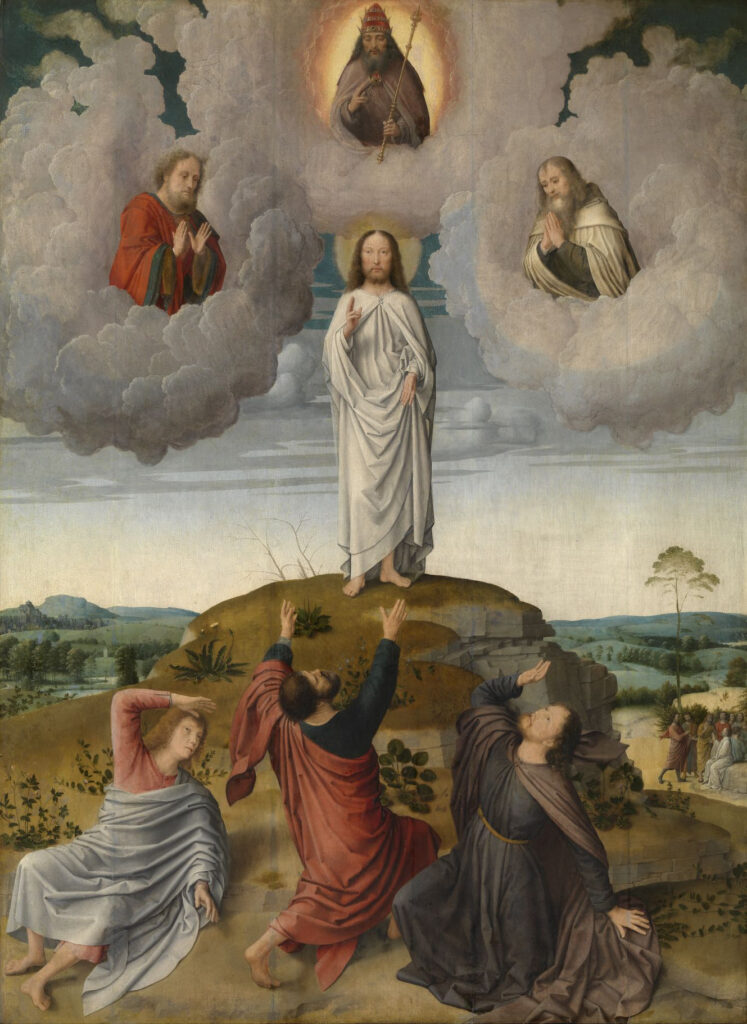
And after six days Jesus took with him Peter and James and John his brother, and led them up a high mountain apart.
And he was transfigured before them, and his face shone like the sun, and his garments became white as light.
And behold, there appeared to them Moses and Elijah, talking with him.
And Peter said to Jesus, “Lord, it is well that we are here; if you wish, I will make three booths here, one for you and one for Moses and one for Elijah.”[
He was still speaking, when lo, a bright cloud overshadowed them, and a voice from the cloud said, “This is my beloved Son, with whom I am well pleased; listen to him.”
When the disciples heard this, they fell on their faces, and were filled with awe. But Jesus came and touched them, saying, “Rise, and have no fear.” And when they lifted up their eyes, they saw no one but Jesus only.
And as they were coming down the mountain, Jesus commanded them, “Tell no one the vision, until the Son of man is raised from the dead.”
What do the Fathers say?
St REMIGIUS. In this Transfiguration undergone on the mount, the Lord fulfilled within six days the promise made to His disciples, that they should have a sight of His glory.
ORIGEN. Because in six days this whole visible world was made; so he who is above all the things of this world, may ascend into the high mountain, and there see the glory of the Word of God.
St John CHRYSOSTOM. He took these three because He set them before others. But observe how Matthew does not conceal who were preferred to himself; John, also when he records the pre-eminent praise given to Peter. For the company of Apostles was free from jealousy and vain glory.
St REMIGIUS. When the Lord was about to show His disciples the glory of His brightness, He took them up into a high mountain apart. Herein teaching, that it is necessary for all who seek to contemplate God, that they should not grovel in weak pleasures, but by love of things above should be ever raising themselves towards heavenly things; and to show His disciples that they should not look for the glory of the divine brightness in the gulph of the present world, but in the kingdom of the heavenly blessedness. He leads them apart, because the saints are separated from the wicked by their whole soul and devotion of their faith, and shall be utterly separated in the future; because many are called, but few chosen.
St JEROME. As He is to appear in the time of the Judgment, such was He now seen of the Apostles. Let no-one suppose that He lost His former form and lineaments, or laid aside His bodily reality, taking upon Him a spiritual or ethereal Body.
How His transfiguration was accomplished, the Evangelist shows, saying, “and his face shone like the sun, and his garments became white as light”.
His face is said to shine, and His garments described to become white, this does not take away substance, but confers glory.
ORIGEN. Mystically; When any one has passed the six days he beholds Jesus transfigured before the eyes of his heart. For the Word of God has various forms, appearing to each man according as He knows that it will be expedient for him; and He shows Himself to no -one in a manner beyond his capacity; hence He was transfigured, before them. For Jesus, in the Gospels, is merely understood by those who do not climb by means of exalting works and words upon the high mountain of wisdom; but to them that do climb up thus, He is no longer known according to the flesh, but is understood to be God the Word.
Before these then who have been made sons of God, Jesus is transfigured, and He is shown to them as the Sun of righteousness.
St HILARY. That Moses and Elijah only out of the whole number of the saints stood with Christ, means, that Christ, in His kingdom, is between the Law and the Prophets; for He shall judge Israel in the presence of the same by whom He was preached to them.
Sources:
Bible readings from the Revised Standard Version of the Bible, Second Catholic Edition, copyright © 2006 National Council of the Churches of Christ in the USA
Quotes of the Fathers from :
Thomas Aquinas’ Catena Aurea Translated by St John Henry Newman
Artwork ex Wikimedia Commons