
Gospel Reading : Mark 6:17-29
For Herod had sent and seized John, and bound him in prison for the sake of Herodias, his brother Philip’s wife; because he had married her. For John said to Herod, “It is not lawful for you to have your brother’s wife.” And Herodias, had a grudge against him, and wanted to kill him. But she could not, for Herod feared John, knowing that he was a righteous and holy man, and kept him safe. When he heard him, he was much perplexed; and yet he heard him gladly.
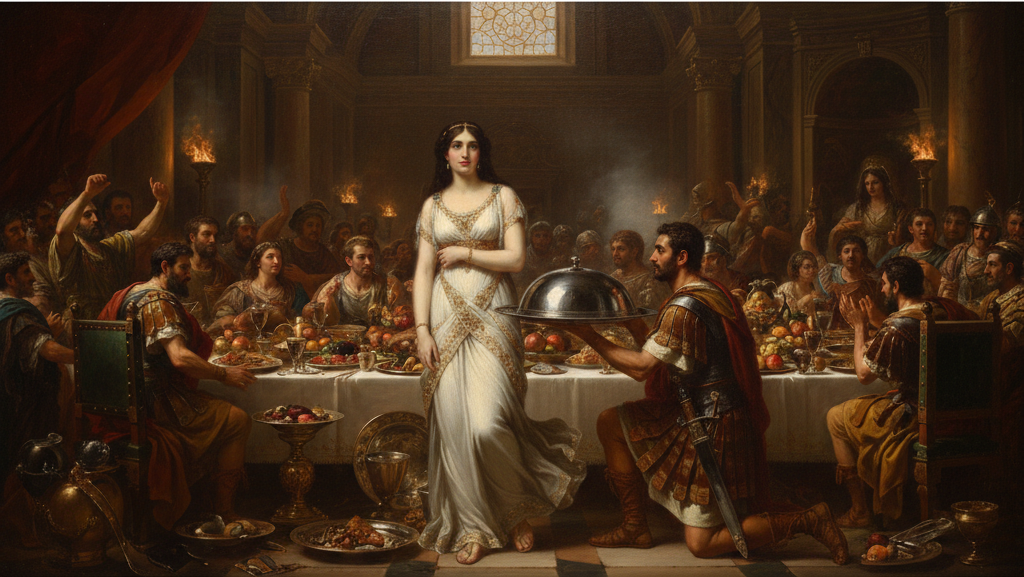
But an opportunity came when Herod on his birthday gave a banquet for his courtiers and officers and the leading men of Galilee. For when Herodias,’ daughter came in and danced, she pleased Herod and his guests; and the king said to the girl, “Ask me for whatever you wish, and I will grant it.” And he vowed to her, “Whatever you ask me, I will give you, even half of my kingdom.”
And she went out, and said to her mother, “What shall I ask?” And she said, “The head of John the baptizer.” And she came in immediately with haste to the king, and asked, saying, “I want you to give me at once the head of John the Baptist on a platter.”
And the king was exceedingly sorry; but because of his oaths and his guests he did not want to break his word to her. And immediately the king sent a soldier of the guard and gave orders to bring his head. He went and beheaded him in the prison and brought his head on a platter, and gave it to the girl; and the girl gave it to her mother.
When his disciples heard of it, they came and took his body, and laid it in a tomb.
What do the Fathers say?
The Venerable BEDE. Ancient history relates, that Philip, the son of Herod the great, under whom the Lord fled into Egypt, the brother of this Herod, under whom Christ suffered, married Herodias, the daughter of king Aretas; But after certain disagreements had arisen with his son-in-law king Aretas had taken his daughter away, and, to the grief of her former husband, had given her in marriage to his enemy;
Therefore John the Baptist rebukes Herod and Herodias for contracting an unlawful union, because it was not allowed for a man to marry his brother’s wife during his lifetime.
St THEOPHYLACT. Although The law also commanded a brother to marry his brother’s wife, if he died without children; in this case there was a daughter, which made the second marriage criminal.
The Venerable BEDE. The only men whom we read of, as celebrating their birthdays with festive joys are Herod and Pharaoh, but each, with an evil presage, stained his birthday with blood; Herod, however, with so much the greater wickedness, as he slew the holy and guiltless teacher of truth, and that, by the wish, and at the instance of a dancer.
His oath does not excuse his murder, for perchance his reason for swearing was, that he might find an opportunity for slaying, and if she had demanded the death of his father and mother, he surely would not have granted it.
It is usual with Scripture, that the historian should relate events as they were then believed by all. So now Herod is said to be exceeding sorry, for so the guests thought, since the hypocrite bore sadness on his face, when he had joy in his heart; and he excuses his wickedness by his oath, that he might be impious under pretence of piety.
And for the sakes of those who sat with him, he wishes to make all partakers in his guilt, that a bloody feast might be set before luxurious and impure guests.
Now Herod was not ashamed to bring before his guests the head of a murdered man; but we do not read of such an act of madness in Pharaoh.
From both examples, however, it is proved to be more useful, often to call to mind the coming day of our death, by fear and by living chastely, than to celebrate the day of our birth with luxury. For man is born in the world to toil, but the elect pass by death out of the world to repose.
Pope St GREGORY the Great. I cannot, without the greatest wonder, reflect that he, who was filled even in his mother’s womb with the spirit of prophecy, and who was the greatest that had arisen amongst those born of women, is sent into prison by wicked men, is beheaded for the dancing of a girl, and though a man of so great austerity, meets death through such a foul instrument.
Are we to suppose that there was something evil in his life, to be wiped away by so ignominious a death? When, however, could he commit a sin even in his eating, whose food was only locusts and wild honey? How could he offend in his conversation, who never quitted the wilderness?
How is it that Almighty God so despises in this life those whom He has so sublimely chosen before all ages, if it be not for the reason, which is plain to the piety of the faithful, that He thus sinks them into the lowest place, because He sees how He is rewarding them in the highest, and outwardly He throws them down amongst things despised, because inwardly He draws them up even to incomprehensible things.
Let each then infer from this what they shall suffer, whom He rejects, if He so grieves those whom he loves.
Sources:
Bible readings from the Revised Standard Version of the Bible, Second Catholic Edition, copyright © 2006 National Council of the Churches of Christ in the USA
Quotes of the Fathers from :
Thomas Aquinas’ Catena Aurea Translated by St John Henry Newman
Artwork: AI Generated