
17 September
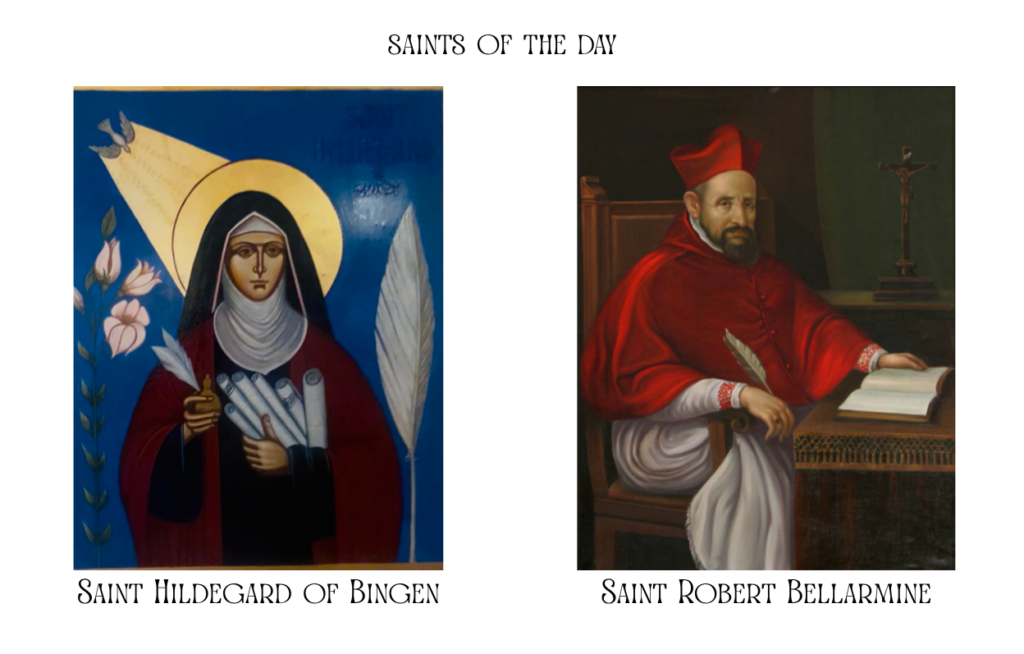
Saints of the day :Saint Hildegard of Bingen,
Saint Robert Bellarmine
Gospel Reading : Luke 7:36-50
One of the Pharisees asked him to eat with him, and he went into the Pharisee’s house, and sat at table. And behold, a woman of the city, who was a sinner, when she learned that he was sitting at table in the Pharisee’s house, brought an alabaster flask of ointment, and standing behind him at his feet, weeping, she began to wet his feet with her tears, and wiped them with the hair of her head, and kissed his feet, and anointed them with the ointment.
Now when the Pharisee who had invited him saw it, he said to himself, “If this man were a prophet, he would have known who and what sort of woman this is who is touching him, for she is a sinner.”
And Jesus answering said to him, “Simon, I have something to say to you.” And he answered, “What is it, Teacher?”
“A certain creditor had two debtors; one owed five hundred denarii, and the other fifty. When they could not pay, he forgave them both. Now which of them will love him more?” Simon answered, “The one, I suppose, to whom he forgave more.” And he said to him, “You have judged rightly.”
Then turning toward the woman he said to Simon, “Do you see this woman? I entered your house, you gave me no water for my feet, but she has wet my feet with her tears and wiped them with her hair.
You gave me no kiss, but from the time I came in she has not ceased to kiss my feet. You did not anoint my head with oil, but she has anointed my feet with ointment. Therefore I tell you, her sins, which are many, are forgiven, for she loved much; but he who is forgiven little, loves little.”
And he said to her, “Your sins are forgiven.”
Then those who were at table with him began to say among themselves, “Who is this, who even forgives sins?”
And he said to the woman, “Your faith has saved you; go in peace.”
What do the Fathers say?
St Hildegard of Bingen. “She came as a vessel of dishonor and departed a vessel of gold. For in pouring out the tears of her eyes upon the feet of the Lord, she washed away the foulness of her past life, and in touching Him, she was rendered radiant by divine Wisdom, filling the entire house with the sweet fragrance of compunction.”
Saint Robert Bellarmine. We have a clear example (of perfect contrition)in this sinful woman of Luke 7, who approached the feet of the Lord not out of fear of punishment, but out of an extraordinary fervour of charity, and washed His feet with her tears; of whom the Lord accordingly pronounced: ‘Her many sins are forgiven, for she loved much.’ For this is the true force and nature of perfect contrition, which arises from the love of God above all things and immediately wipes away sins.
St GREGORY OF NYSSA. This account is full of precious instruction. For there are very many who justify themselves, being puffed up with the dreamings of an idle fancy, who before the time of judgment comes, separate themselves as lambs from the herds, not willing even to join in eating with the many, but keep the middle path in life. St. Luke, the physician of souls rather than of bodies, represents therefore our Lord and Saviour most mercifully visiting others, And he went into the Pharisees’ house, and sat down to meat. Not that He should share any of his faults, but might impart somewhat of His own righteousness.
But to mark her own unworthiness, she stands behind with downcast eyes, and with her hair thrown about embraces His feet, and washing them with her tears, betokened a mind distressed at her state, and imploring pardon.
Pope St GREGORY the Great. For this woman, beholding the spots of her shame, ran to wash them at the fountain of mercy, and blushed not at seeing the guests, for since she was courageously ashamed of herself within, she thought there was nothing which could shame her from without. Observe with what sorrow she is wrung who is not ashamed to weep even in the midst of a feast!
For her eyes which once coveted after earthly things, she was now wearing out with penitential weeping. She once displayed her hair for the setting off of her face, she now wiped her tears with her hair. She once uttered proud things with her mouth, but kissing the feet of the Lord, she impressed her lips on the footsteps of her Redeemer. She once used ointment for the perfume of her body; what she had unworthily applied to herself, she now laudably offered to God.
As many enjoyments as she had in herself, so many offerings did she devise out of herself. She converts the number of her faults into the same number of virtues, that as much of her might wholly serve God in her penitence, as had despised God in her sin.
But the Pharisee beholding these things despises them, and finds fault, not only with the woman who was a sinner, but with the Lord who received her, as it follows, Now when the Pharisee who had bidden him saw it, he spake within himself, saying, This man, if he were a prophet, would have known who and what manner of woman this is which toucheth him. We see the Pharisee really proud in himself, and hypocritically righteous, blaming the sick woman for her sickness, the physician for his aid. The woman surely if she had come to the feet of the Pharisee would have departed with the heel lifted up against her. For he would have thought that he was polluted by another’s sin, not having sufficient of his own real righteousness to fill him.
The Physician was between two sick persons, but the one preserved her faculties in the fever, the other lost his mental perception. For she wept at what she had done; but the Pharisee, elated with a false sense of righteousness, overrated the vigour of his own health.
St John CHRYSOSTOM. Thus the harlot became then more honourable than the virgins. For no sooner was she inflamed with penitence, than she burst forth in love for Christ. And these things indeed which have been spoken of were done outwardly, but those which her mind pondered within itself, were much more fervent. God alone beheld them.
Sources:
Bible readings from the Revised Standard Version of the Bible, Second Catholic Edition, copyright © 2006 National Council of the Churches of Christ in the USA
Quotes of the Fathers from :
Thomas Aquinas’ Catena Aurea Translated by St John Henry Newman
Saint Hildegard of Bingen – Homiliae in Evangelia
Saint Robert Bellarmine – Disputationes de Controversiis Christianae Fidei
Artwork ex Wikimedia Commons