
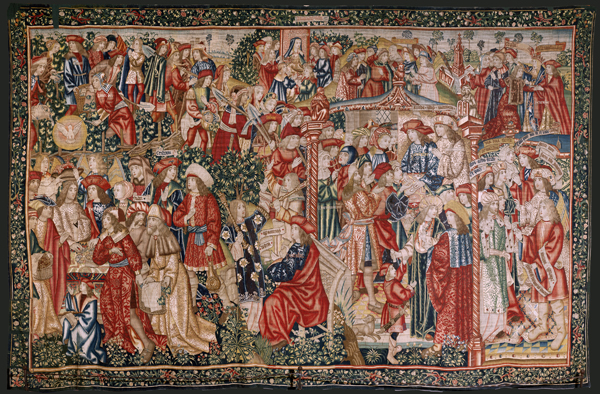
Gospel Reading : Matthew 20:1-16
“For the kingdom of heaven is like a householder who went out early in the morning to hire labourers for his vineyard.
After agreeing with the labourers for a denarius a day, he sent them into his vineyard.
And going out about the third hour he saw others standing idle in the market place; and to them he said, ‘You go into the vineyard too, and whatever is right I will give you.’ So they went.
Going out again about the sixth hour and the ninth hour, he did the same. And about the eleventh hour he went out and found others standing; and he said to them, ‘Why do you stand here idle all day?’ They said to him, ‘Because no one has hired us.’ He said to them, ‘You go into the vineyard too.’
And when evening came, the owner of the vineyard said to his steward, ‘Call the labourers and pay them their wages, beginning with the last, up to the first.’
And when those hired about the eleventh hour came, each of them received a denarius.
Now when the first came, they thought they would receive more; but each of them also received a denarius. And on receiving it they grumbled at the householder, saying, ‘These last worked only one hour, and you have made them equal to us who have borne the burden of the day and the scorching heat.’ But he replied to one of them, ‘Friend, I am doing you no wrong; did you not agree with me for a denarius? Take what belongs to you, and go; I choose to give to this last as I give to you. Am I not allowed to do what I choose with what belongs to me? Or do you begrudge my generosity?’
So the last will be first, and the first last.”
What do the Fathers say?
Pope St GREGORY the Great. The morning is that age of the world which was from Adam and Noah, and therefore it is said, Who went out early in the morning to hire labourers into his vineyard. The terms of their hiring He adds, He agreed with the labourers for a denarius a day.
The third hour is the period from Noah to Abraham; of which it is said, And he went out about the third hour; and saw others standing in the market-place idle.
He that lives to himself, and feeds on the delights of the flesh, is rightly accused as idle, forasmuch as he does not seek the fruit of godly labour.
The sixth hour is that from Abraham to Moses, the ninth that from Moses to the coming of the Lord.
PSEUDO-CHRYSOSTOM. These two hours are coupled together, because in the sixth and ninth it was that He called the generation of the Jews, and multiplied to publish His testaments among men, whereas the appointed time of salvation now drew nigh.
Pope St GREGORY the Great. The eleventh hour is that from the coming of the Lord to the end of the world. The labourer in the morning, at the third, sixth, and ninth hours, denotes the ancient Hebrew people, which in its elect from the very beginning of the world, while it zealously and with right faith served the Lord, ceased not to labour in the husbandry of the vineyard. But at the eleventh hour the Gentiles are called. For they who through so many ages of the world had neglected to labour for their living, were they who had stood the whole day idle. But consider their answer; They say unto him, Because no man hath hired us; for neither Patriarch nor Prophet had come to them. And what is it to say, No man has hired us, but to say, None has preached to us the way of life.
PSEUDO-CHRYSOSTOM. For what is our hiring, and the wages of that hiring? The promise of eternal life; for the Gentiles knew neither God, nor God’s promises.
Pope St GREGORY the Great. They get alike a denarius who have wrought since the eleventh hour, (for they sought it with their whole soul,) and who have wrought since the first. They, that is, who were called from the beginning of the world have alike received the reward of eternal happiness, with those who come to the Lord at the end of the world.
PSEUDO-CHRYSOSTOM. Consider, He gives the reward not the next morning, but in the evening. Thus the judgment shall take place while this world is still standing, and each man shall receive that which is due to him. This is on two accounts. Firstly, because the happiness of the world to come is to be itself the reward of righteousness; so the award is made before, and not in that world. Secondly, that sinners may not behold the blessedness of that day.
And this not with injustice. For he who was born in the first period of the world, lived no longer than the determined time of his life, and what harm was it to him, though the world continued after his leaving it? And they that shall be born towards its close will not live less than the days that are numbered to them. And how does it cut their labour shorter, that the world is speedily ended, when they have accomplished their thread of life before?
Moreover it is not of man to be born sooner or later, but of the power of God. Therefore he that is born first cannot claim to himself a higher place, nor ought he to be held in contempt that was born later.
And when they had received it, they murmured against the goodman of the house, saying. We have borne the burden and heat of the day. – But if this we have said be true, that both first and last have lived their own time, and neither more nor less; and that each man’s death is his consummation, what means this that they say?
Because to know that the end of the world is at hand is of great force to make us do righteousness. Wherefore Christ in His love to us said, The kingdom of heaven shall draw nigh. (Matt. 4:2.)
Whereas it was a weakening of them to know that the duration of the world was to be yet long. So that though they did not indeed live through the whole of time, they seem in a manner to have borne its weight.
Or, by the burden of the day is meant the burdensome precepts of the Law; and the heat may be that consuming temptation to error which evil spirits contrived for them, stirring them to imitate the Gentiles; from all which things the Gentiles were exempt, believing on Christ, and by compendiousness of grace being saved completely.
Pope St GREGORY the Great. Or; To bear the burden and heat of the day, is to be wearied through a life of long duration with the heats of the flesh. But it may be asked, How can they be said to murmur, when they are called to the kingdom of heaven? For none who murmurs shall receive the kingdom, and none who receives that can murmur.
Or because the old fathers down to the Lord’s coming, notwithstanding their righteous lives, were not brought to the kingdom, this murmur is theirs. But we who have come at the eleventh hour, do not murmur after our labours, forasmuch as having come into this world after the coming of the Mediator, we are brought to the kingdom as soon as ever we depart out of the body.
Sources:
Bible readings from the Revised Standard Version of the Bible, Second Catholic Edition, copyright © 2006 National Council of the Churches of Christ in the USA
Quotes of the Fathers from :
Thomas Aquinas’ Catena Aurea Translated by St John Henry Newman
Artwork ex Wikimedia Commons