
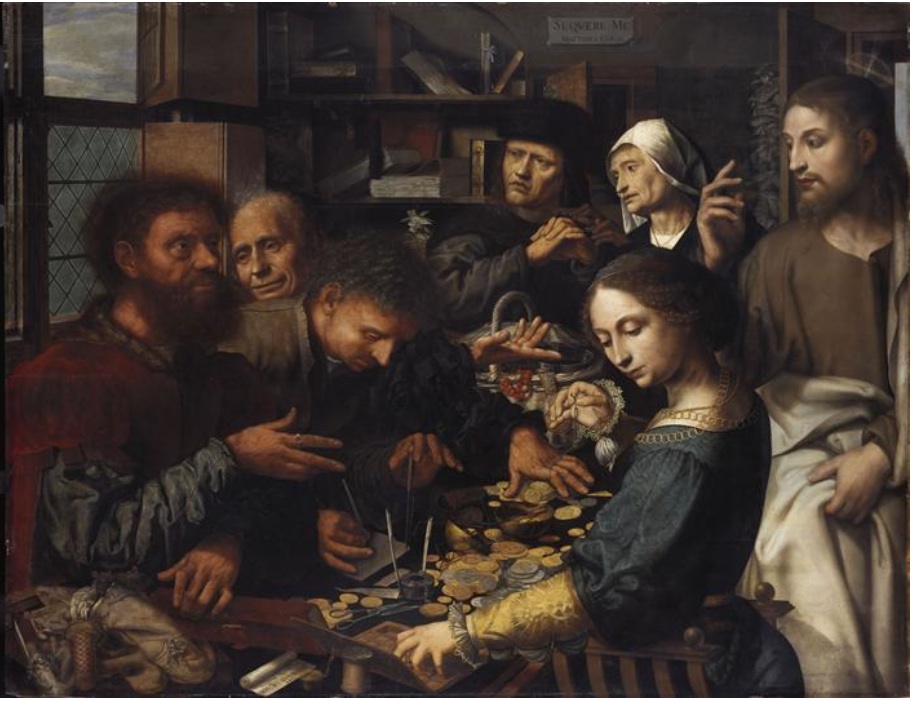
Gospel Reading : Matthew 9:9-13
As Jesus passed on from there, he saw a man called Matthew sitting at the tax office; and he said to him, “Follow me.” And he rose and followed him.
And as he sat at table in the house, behold, many tax collectors and sinners came and sat down with Jesus and his disciples. And when the Pharisees saw this, they said to his disciples, “Why does your teacher eat with tax collectors and sinners?”
But when he heard it, he said, “Those who are well have no need of a physician, but those who are sick.
Go and learn what this means, ‘I desire mercy, and not sacrifice.’ For I came not to call the righteous, but sinners.”
What do the Fathers say?
St JEROME. The other Evangelists from respect to Matthew have not called him by his common name, but say here, Levi, Matthew himself, calls himself both Matthew and Tax collector, to show the readers that none need despair of salvation who turn to better things, seeing that he from a Tax collector became an Apostle.
St REMIGIUS. He esteems lightly human dangers which might accrue to him from his masters for leaving his accounts in disorder, he arose, and followed him. And because he relinquished earthly gain, therefore of right was he made the dispenser of the Lord’s talents.
St John CHRYSOSTOM. But why did He not call him at the same time with Peter and John and the others? Because he was then still in a hardened state, but after many miracles, and great fame of Christ, when He who knows the inmost secrets of the heart, perceived him more disposed to obedience, then He called him.
Why is it then that nothing is said of the rest of the Apostles how or when they were called, but only of Peter, Andrew, James, John, and Matthew? Because these were in the most alien and lowly stations, for nothing can be more disreputable than the office of Tax collector, nothing more abject than that of fisherman.
ANSELM of Laon. As a meet return for the heavenly mercy, Matthew prepared a great feast for Christ in his house, bestowing his temporal goods on Him of whom he looked to receive everlasting goods.
And a beautiful omen of the future, that he that was to be an Apostle and doctor of the Gentiles, at his first conversion draws after him a great multitude of sinners to salvation, already performing by his example what he was shortly to perform by word.
St JEROME. But they had seen the Tax Collector turning from sins to better things, and finding place of repentance, and on this account they do not despair of salvation.
St John CHRYSOSTOM. Thus they came near to our Redeemer, and that not only to converse with Him, but to sit at meat with Him; for so not only by disputing, or healing, or convincing His enemies, but by eating with them, He oftentimes healed such as were ill-disposed, by this teaching us, that all times, and all actions, may be made means to our advantage.
St RABANUS. The Pharisees are here in a twofold error; firstly, they esteemed themselves righteous, though in their pride they had departed far from righteousness; secondly, they charged with unrighteousness those who by recovering themselves from sin were drawing near to righteousness.
St JEROME. For they , the tax collectors and sinners do not come to Jesus while they remain in their original condition of sin, as the Pharisees and Scribes complain, but in penitence, as what follows proves; But Jesus hearing said, “Those who are well have no need of a physician, but those who are sick.”
St RABANUS. He calls Himself a physician, because by a wonderful kind of medicine He was wounded for our iniquities that He might heal the wound of our sin. By the sick, He means those who, tied by the consciousness of their frailty, and seeing that they are not justified by the Law, submit themselves in penitence to the grace of God.
He warns them, that by deeds of mercy they should seek for themselves the rewards of the mercy that is above, He says, Go; that is, from the rashness of foolish fault-finding to a more careful meditation of Holy Scripture, which highly commends mercy, and proposes to them as a guide His own example of mercy, saying, I came not to call the righteous but sinners.
In the call of Matthew and the tax collectors is figured the faith of the Gentiles who are now spiritually refreshed by the Lord;
Matthew signifies the man intent on temporal gain; Jesus sees him, when He looks on him with the eyes of mercy. For the penitent is taken out of the mass of the perishing, and by God’s grace given to the Church.
Sources:
Bible readings from the Revised Standard Version of the Bible, Second Catholic Edition, copyright © 2006 National Council of the Churches of Christ in the USA
Quotes of the Fathers from :
Thomas Aquinas’ Catena Aurea Translated by St John Henry Newman
Artwork ex Wikimedia Commons