
God has created me to do him some definite service; He has committed some work to me which he has not committed to another. I have my mission; I never may know it in this life, but I shall be told it in the next. I have a part in a great work; I am a link in a chain, a bond of connection between persons. He has not created me for naught. I shall do good, I shall do His work; I shall be an angel of peace, a preacher of truth in my own place, while not intending it, if I do but keep His commandments and serve Him in my calling.
– Saint John Henry Newman
Gospel Reading : Matthew 13:47-52
“Again, the kingdom of heaven is like a net which was thrown into the sea and gathered fish of every kind; when it was full, men drew it ashore and sat down and sorted the good into vessels but threw away the bad.
So it will be at the close of the age. The angels will come out and separate the evil from the righteous, and throw them into the furnace of fire; there men will weep and gnash their teeth.
“Have you understood all this?” They said to him, “Yes.”
And he said to them, “Therefore every scribe who has been trained for the kingdom of heaven is like a householder who brings out of his treasure what is new and what is old.”
What do the Fathers say?
Pope St GREGORY the Great. The Holy Church is likened to a net, because it is given into the hands of fishers, and by it each man is drawn into the heavenly kingdom out of the waves of this present world, that he should not be drowned in the depth of eternal death.
This net gathers of every kind of fishes, because the wise and the foolish, the free and the slave, the rich and the poor, the strong and the weak, are called to forgiveness of sin; it is then fully filled when in the end of all things the sum of the human race is completed.
For as the sea signifies the world, so the sea shore signifies the end of the world; and as the good are gathered into vessels, but the bad cast away, so each man is received into eternal abodes, while the reprobate having lost the light of the inward kingdom are cast forth into outer darkness. Now the net of faith holds good and bad mingled together in one; but the shore shall discover what the net of the Church has brought to land.
But if by things new and old in this passage we understand the two Testaments, we deny Abraham to have been learned, who although he knew indeed some deeds of the Old Testament, yet had not read the words. Neither Moses may we compare to a learned householder, for although he composed the Old Testament, yet had he not the words of the New. But what is here said may be understood as meant not of those who had been, but of such as might hereafter be in the Church, who then bring forth things new and old when they speak the preachings of both Testaments, in their words and in their lives.
Otherwise; The things old are, that the human race for its sin should suffer in eternal punishment; the things new, that they should be converted and live in the kingdom. First, He brought forward a comparison of the kingdom to a treasure found and a pearl of price; and after that, narrated the punishment of hell in the burning of the wicked, and then concluded with Therefore every Scribe, &c. as if He had said, He is a learned preacher in the Church who knows to bring forth things new concerning the sweetness of the kingdom, and to speak things old concerning the terror of punishment; that at least punishment may deter those whom rewards do not excite.
St HILARY. Speaking to His disciples, He calls them Scribes on account of their knowledge, because they understood the things that He brought forward, both new and old, that is from the Law and from the Gospels; both being of the same householder, and both treasures of the same owner. He compares them to Himself under the figure of a householder, because they had received doctrine of things both new and old out of His treasury of the Holy Spirit.
St John Henry NEWMAN. It is the property of a living idea to be ever growing, yet ever remaining the same… like the householder in the Gospel, bringing forth out of his treasure things new and old.
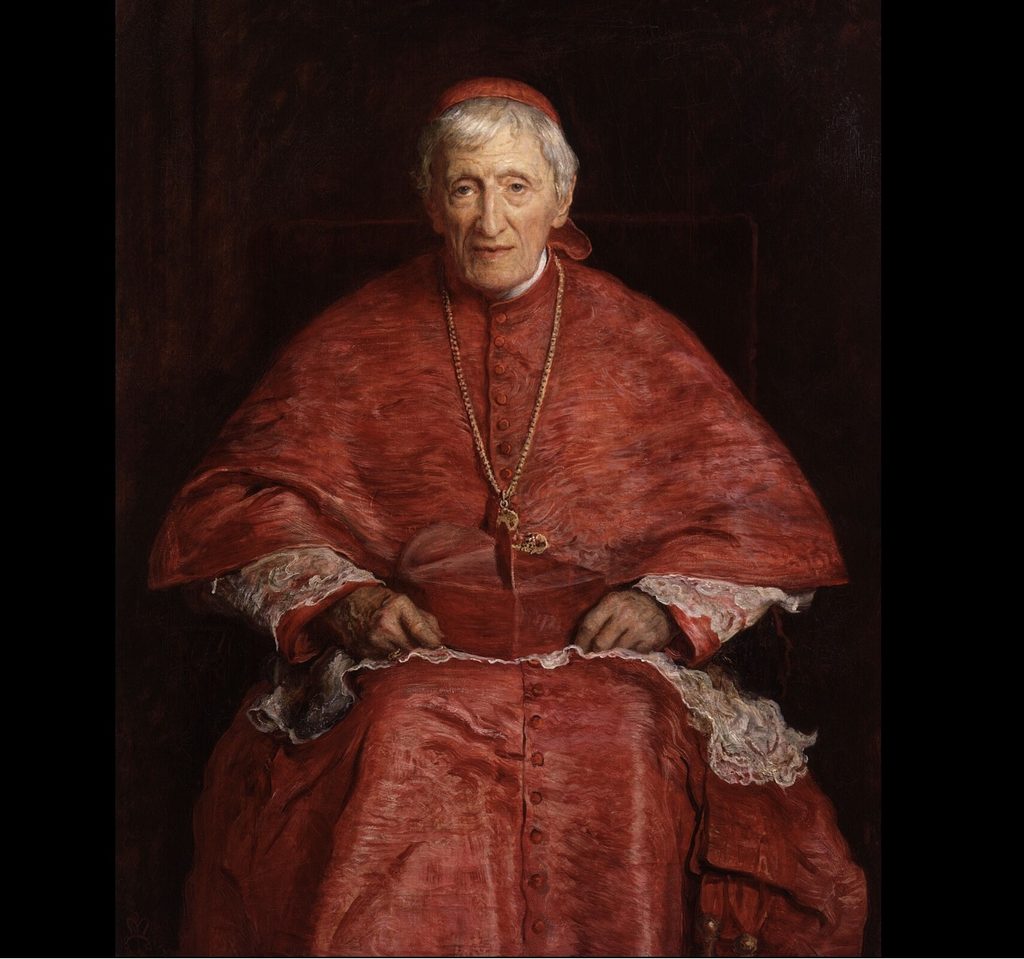
Saint John Henry Newman
Saint John Henry Newman (1801–1890) was an English theologian, scholar, priest, and cardinal whose intellectual and spiritual journey made him one of the most influential religious figures of the 19th century.
Early Life and the Oxford Movement
Born in London on February 21, 1801, Newman was educated at Trinity College, Oxford, and became a Fellow of Oriel College in 1822. Ordained an Anglican priest in 1824, he became Vicar of St. Mary the Virgin in Oxford in 1828, where his brilliant preaching drew widespread attention.
During the 1830s, Newman emerged as a leader of the Oxford Movement (or Tractarianism), a movement within the Church of England that sought to restore its Catholic heritage, apostolic succession, and traditional liturgy through the publication of the Tracts for the Times.
Conversion to Catholicism
St John Henry Newman’s theological study of the early Church Fathers gradually convinced him that the Roman Catholic Church was the true continuation of the historic Church. In 1841, after his Tract 90 sparked intense controversy by arguing that the Anglican Thirty-Nine Articles were compatible with Catholic doctrine, he withdrew to Littlemore for prayer and study.
On October 9, 1845, St John Henry Newman was formally received into the Roman Catholic Church by Blessed Dominic Barberi. His conversion was a major cultural and religious event in Victorian Britain.
Catholic Ministry and Major Writings
After studying in Rome, St John Henry Newman was ordained a Catholic priest in 1847 and introduced the Congregation of the Oratory of St. Philip Neri to England, establishing the Birmingham Oratory, where he lived for most of his remaining life. In 1854, at the invitation of the Irish bishops, he served as the founding rector of the Catholic University of Ireland in Dublin.
St John Henry Newman was a prolific author whose major works include:
- An Essay on the Development of Christian Doctrine (1845): Formulated how Church doctrines deepen and expand in understanding over time while retaining their original identity.
- The Idea of a University (1852): A foundational text on liberal education, advocating for holistic intellectual growth.
- Apologia Pro Vita Sua (1864): His spiritual autobiography, written in response to attacks on his honesty, which won him broad public respect across Britain.
- The Grammar of Assent (1870): A philosophical defense of the rationality of religious belief.
Cardinalate and Canonization
In 1879, Pope Leo XIII created St John Henry Newman a Cardinal, granting him the cardinalate even though he was not a bishop. St John Henry Newman selected the motto Cor ad cor loquitur (“Heart speaks unto heart”).
St John Henry Newman died at the Birmingham Oratory on August 11, 1890. He was beatified by Pope Benedict XVI in 2010 and canonized as a saint by Pope Francis on October 13, 2019.
Saint John Henry Newman’s feast day is celebrated on October 9 because it is the anniversary of his reception into full communion with the Roman Catholic Church in 1845.
When Pope Benedict XVI beatified St John Henry Newman in 2010 at Cofton Park in Rednal, Birmingham, England, he selected October 9 to mark the single most pivotal turning point of his spiritual journey: the day he was received into the Catholic Church by Blessed Dominic Barberi at Littlemore.
Saint John Henry Newman was declared the 38th Doctor of the Church on November 1, 2025 (the Solemnity of All Saints) by Pope Leo XIV.
Sources:
Bible readings from the Revised Standard Version of the Bible, Second Catholic Edition, copyright © 2006 National Council of the Churches of Christ in the USA
Quotes of the Fathers from Thomas Aquinas’ Catena Aurea Translated by St John Henry Newman
Biographical details of Saint John Henry Newman from Catholic Encyclopaedia
Quotes by Saint John Henry Newman ex Newman Reader
Artwork ex Wikimedia Commons