Gospel Reading : Luke 12:35-38
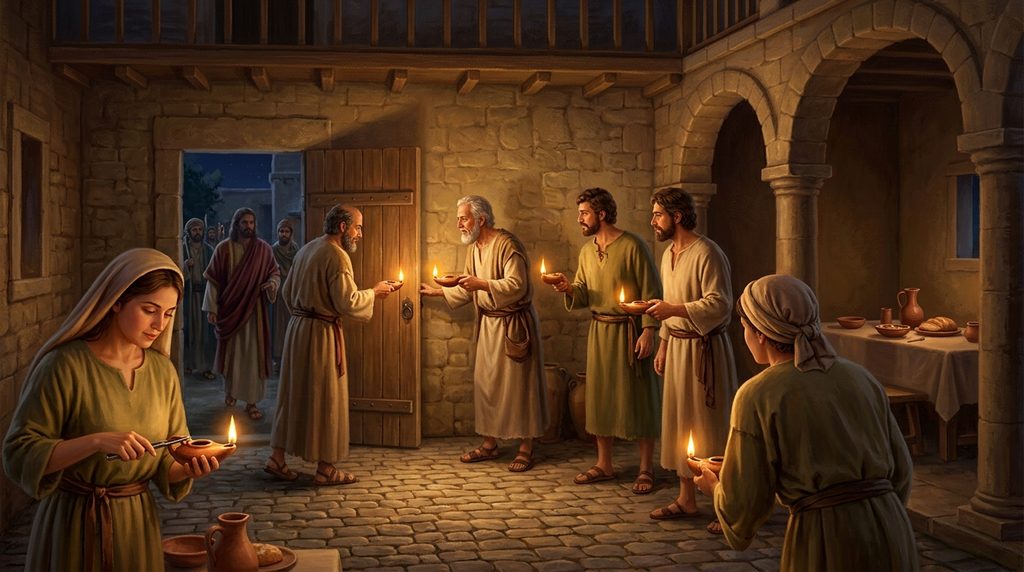
Let your loins be girded and your lamps burning, and be like men who are waiting for their master to come home from the marriage feast, so that they may open to him at once when he comes and knocks.
Blessed are those servants whom the master finds awake when he comes; truly, I say to you, he will gird himself and have them sit at table, and he will come and serve them. If he comes in the second watch, or in the third, and finds them so, blessed are those servants!
What do the Fathers say?
St PETER CHRYSOLOGUS. He commands us to gird our loins by the belt of purity, and to bind our whole body in the zone of virtue, that we may go forth quickly and expeditiously to meet our Lord at His coming.
St THEOPHYLACT. Our Lord having taught His disciples moderation, taking from them all care and conceit of this life, now leads them on to serve and obey, saying, Let your loins be girded, that is, always ready to do the work of your Lord, and your lamps burning, that is, do not lead a life in darkness, but have with you the light of reason, showing you what to do and what to avoid. For this world is the night, but they have their loins girded, who follow a practical or active life.
For such is the condition of servants who must have with them also lamps burning; that is, the gift of discernment, that the active man may be able to distinguish not only what he ought to do, but in what way; otherwise men rush down the precipice of pride.
But we must observe, that He first orders our loins to be girded, secondly, our lamps to be burning. For first indeed comes action, then reflection, which is an enlightening of the mind. Let us then strive to exercise the virtues, that we may have two lamps burning, that is, the conception of the mind ever shining forth in the soul, by which we are ourselves enlightened, and learning, whereby we enlighten others.
Pope St GREGORY the Great. For He comes when He hastens to judgment, but He knocks, when already by the pain of sickness He denotes that death is at hand; to whom we immediately open if we receive Him with love. For he who trembles to depart from the body, has no wish to open to the Judge knocking, and dreads to see that Judge whom he remembers to have despised.
But he who rests secure concerning his hope and works, immediately opens to Him that knocks; for when he is aware of the time of death drawing near, he grows joyful, because of the glory of his reward; and hence it is added, Blessed are those servants whom the master finds awake when he comes
He watches who keeps the eyes of his mind open to behold the true light; who by his works maintains that which he beholds, who drives from himself the darkness of sloth and carelessness.
St THEOPHYLACT. Or, THe Lord will gird Himself, in that He imparts not the whole fulness of blessings, but confines it within a certain measure. For who can comprehend God how great He is? The Seraphims are said to veil their countenance, because of the excellence of the Divine brightness.
It follows, and will have them sit at table; for as a man sitting down causes his whole body to rest, so in the future coming the Saints will have complete rest; for here they have not rest for the body, but there together with their souls their spiritual bodies partaking of immortality will rejoice in perfect rest.
Pope St GREGORY the Great. The first watch then is the earliest time of our life, that is, childhood, the second youth and manhood, but the third represents old age. He then who is unwilling to watch in the first, let him keep even the second. And he who is unwilling in the second, let him not lose the remedies of the third watch, that he who has neglected conversion in childhood, may at least in the time of youth or old age recover himself.
St CYRIL OF ALEXANDRIA. Of the first watch, however, he makes no mention, for childhood is not punished by God, but obtains pardon; but the second and third age owe obedience to God, and the leading of an honest life according to His will.
Sources:
Bible readings from the Revised Standard Version of the Bible, Second Catholic Edition, copyright © 2006 National Council of the Churches of Christ in the USA
Quotes of the Fathers from
Thomas Aquinas’ Catena Aurea Translated by St John Henry Newman
Artwork AI generated