Gospel Reading : Luke 13:18-21
He said therefore, “What is the kingdom of God like? And to what shall I compare it?
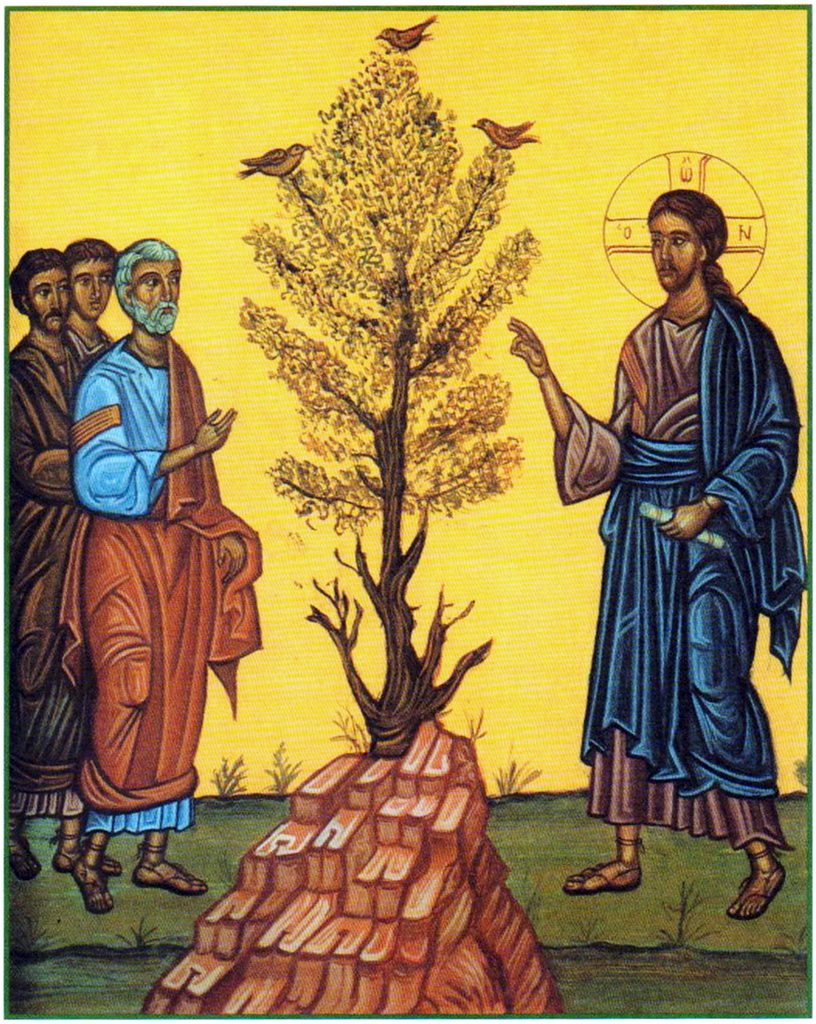
It is like a grain of mustard seed which a man took and sowed in his garden; and it grew and became a tree, and the birds of the air made nests in its branches.”
And again he said, “To what shall I compare the kingdom of God? It is like leaven which a woman took and hid in three measures of meal, till it was all leavened.”
What do the Fathers say?
St AMBROSE. In another place, a grain of mustard seed is introduced where it is compared to faith. If then the mustard seed is the kingdom of God, and faith is as the grain of mustard seed; faith is truly the kingdom of heaven, which is within us. (Luke 17:21.) A grain of mustard seed is indeed a mean and trifling thing, but as soon as it is crushed, it pours forth its power. And faith at first seems simple, but when it is buffeted by adversity, pours forth the grace of its virtue.
The martyrs are grains of mustard seed. They have about them the sweet odour of faith, but it is hidden. Persecution comes; they are smitten by the sword; and to the farthest boundaries of the whole world they have scattered the seeds of their martyrdom.
The Lord Himself also is a grain of mustard seed; He wished to be bruised that we might see that we are a sweet savour of Christ. (2 Cor. 2:15.) He wishes to be sown as a grain of mustard seed, which when a man takes he puts it into his garden. For Christ was taken and buried in a garden, where also He rose again and became a tree. For our Lord is a grain when He is buried in the earth, a tree when He is lifted up into the heaven. He is also a tree overshadowing the world,
And the fowls of the air rested in his branches; that is, the heavenly powers and they whoever (for their spiritual deeds) have been thought worthy to fly forth. Peter is a branch, Paul is a branch, into whose arms, by certain hidden ways of disputation, we who were a far off now fly, having taken up the wings of the virtues.
Sow then Christ in your garden; a garden is truly a place full of flowers, wherein the grace of your work may blossom, and the manifold odour of your different virtues be breathed forth. Wherever is the fruit of the seed, there is Christ.
St CYRIL OF ALEXANDRIA. Or else; The kingdom of God is the Gospel, through which we gain the power of reigning with Christ. As then the mustard seed is surpassed in size by the seeds of other herbs, yet so increases as to become the shelter of many birds; so also the life-giving doctrine was at first in the possession only of a few, but afterwards spread itself abroad.
The Venerable BEDE. Now the man, is Christ, the garden, His Church, to be cultivated by His discipline. He is well said to have taken the grain, because the gifts which He together with the Father gave to us from His divinity, He took from His humanity. But the preaching of the Gospel grew and was disseminated throughout the whole world. It grows also in the mind of every believer, for no one is suddenly made perfect. But in its growth, not like the grass, (which soon withers,) but it rises up like the trees. The branches of this tree are the manifold doctrines, on which the chaste souls, soaring upwards on the wings of virtue, build and repose.
St THEOPHYLACT. Or, any man receiving a grain of mustard seed, that is, the word of the Gospel, and sowing it in the garden of his soul, makes it a great tree, so as to bring forth branches, and the birds of the air (that is, they who soar above the earth) rest in the branches, (that is, in sublime contemplation.) For Paul received the instruction of Ananias (Acts 9:17.) as it were a small grain, but planting it in his garden, he brought forth many good doctrines, in which they dwell who have high heavenly thoughts.
He next likens the kingdom of God to leaven
St AMBROSE. Many think Christ is the leaven, Christ (according to the Fathers) shone forth above others equal in body, but unapproachable in excellence. The Holy Church therefore represents the type of the woman, of whom it is added, which a woman took and hid in three measures of meal, till it was all leavened.”
But we are the meal of the woman which hide the Lord Jesus in the secrets of our hearts, until the heat of heavenly wisdom penetrates our innermost recesses. And since He says it was hid in three measures, it seems fitting that we should believe the Son of God to have been hid in the Law, veiled in the Prophets, manifested in the preaching of the Gospel. Here however I am invited to proceed farther, because our Lord Himself has taught us, that the leaven is the spiritual teaching of the Church. Now the Church sanctifies with its spiritual leaven the man who is renewed in body, soul, and spirit, seeing that these three are united in a certain equal measure of desire, and there breathes forth a complete harmony of the will. If then in this life the three measures abide in the same person until they are leavened and become one, there will be hereafter an incorruptible communion with them that love Christ.
St THEOPHYLACT. Or, for the woman you must understand the soul; but the three measures, its three parts, the reasoning part, the affections, and the desires. If then any one has hidden in these three the word of God, he will make the whole spiritual, so as not by his reason to lie in argument, nor by his anger or desire to be transported beyond control, but to be conformed to the word of God.
The Venerable BEDE. Or, by the leaven He speaks of love, which kindles and stirs up the heart; the woman, that is, the Church, hides the leaven of love in three measures, because she bids us love God with all our hearts, all our minds, and all our strength. And this until the whole is leavened, that is, until love moves the whole soul into the perfection of itself, which begins here, but will be completed hereafter.
Sources:
Bible readings from the Revised Standard Version of the Bible, Second Catholic Edition, copyright © 2006 National Council of the Churches of Christ in the USA
Quotes of the Fathers from
Thomas Aquinas’ Catena Aurea Translated by St John Henry Newman
Artwork ex Wikimedia Commons