Didymus the Blind (c. 313–398 AD) was a renowned Christian theologian and the last great head of the Catechetical School of Alexandria. Despite losing his sight at the age of four, he became one of the most learned scholars of the 4th century, mastering grammar, rhetoric, philosophy, and mathematics.
“He who could not see the light of the sun became the greatest defender of the Light of the Spirit.”
Early Life: Born around 313 AD in Alexandria. At the age of four, he suffered from a severe eye infection or disease—often described as ophthalmia—which left him completely blind. Because this happened before he could even begin formal schooling, he technically never learned to read in the traditional sense.
According to Palladius : “This was not necessary for he had nature’s teacher —his own conscience —strongly developed. He was adorned with such a gift of knowledge, that, so it was said, the passage of scripture was fulfilled in him : “ The Lord maketh the blind wise.” For he interpreted the Old and New Testament word by word, and such attention did he pay to doctrine, setting out his exposition of it subtly yet surely, that he surpassed all the ancients in knowledge.“
The name Didymus is Greek for “Twin” (the equivalent of the Hebrew Thomas). Some scholars speculate he may have been a twin, though no record of a sibling survives.
A “Progenitor of Braille” : The most fascinating part of his early life is how he educated himself despite his poverty and disability. Long before modern systems like Braille, Didymus devised a method to learn: He used tablets with the alphabet deeply engraved into the wood. By running his fingers over the grooves, he mastered the shapes of letters and words.
Acoustic Learning: He attended lectures at the Catechetical School and hired readers to read scriptures and philosophical texts to him. His contemporaries, including his student St. Jerome, were astonished that he could quote entire books of the Bible and complex philosophical arguments from memory after hearing them only once.
The “Seer” of Alexandria: His rise from a poor, blind child to the head of the most prestigious school in the Christian world was seen by his peers as a literal miracle—a fulfillment of the verse “The Lord opens the eyes of the blind.”
Because of his profound spiritual insight despite his physical blindness, he was often called “Didymus the Seer.” He was a contemporary of St. Athanasius and a teacher to St. Jerome and Rufinus.
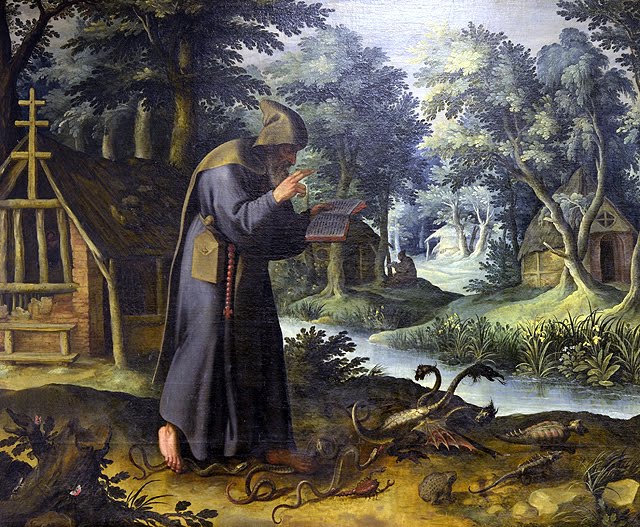
There is a famous story that St. Anthony of the Desert visited Didymus. Seeing the great scholar’s distress over his blindness, Anthony gave him this enduring comfort:
“Do not be sad, Didymus, that you have lost the eyes with which mice and flies can see; but rejoice that you possess the eyes which the angels have, with which God is seen, and His light is apprehended.”
While he was highly respected during his life, Didymus was later associated with some of the controversial teachings of Origen, such as Origen’s belief in the pre-existence of souls and the eventual salvation of all, he was condemned at the Second Council of Constantinople in 553 AD. This led to the loss of many of his original Greek writings, though works like On the Holy Spirit survived through St. Jerome’s Latin translation.
Sources:
St Jerome : Illustrious men
Didymus : On the Holy Spirit
Catholic Encyclopedia
Palladius :The Lausiac History