
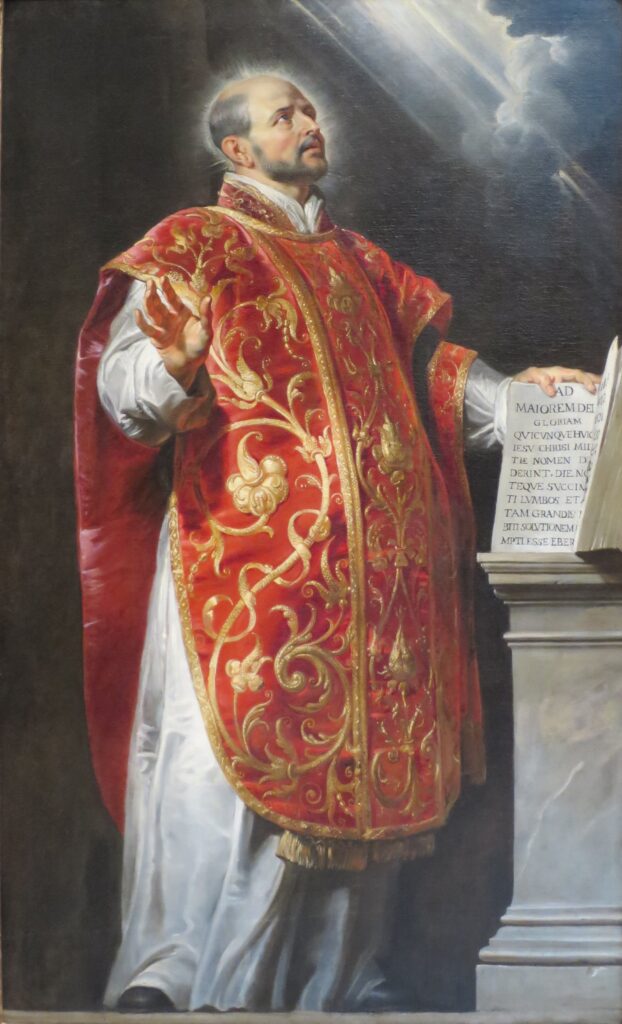
“Take, Lord, and receive all my liberty, my memory, my understanding, and my entire will, all I have and call my own. You have given all to me. To you, Lord, I return it. Everything is yours; do with it what you will. Give me only your love and your grace, that is enough for me.”
– St Ignatius of Loyola
Gospel Reading : Luke 14:25-33
Now great multitudes accompanied him; and he turned and said to them, “If any one comes to me and does not hate his own father and mother and wife and children and brothers and sisters, yes, and even his own life, he cannot be my disciple.
Whoever does not bear his own cross and come after me, cannot be my disciple.
For which of you, desiring to build a tower, does not first sit down and count the cost, whether he has enough to complete it? Otherwise, when he has laid a foundation, and is not able to finish, all who see it begin to mock him, saying, ‘This man began to build, and was not able to finish.’
Or what king, going to encounter another king in war, will not sit down first and take counsel whether he is able with ten thousand to meet him who comes against him with twenty thousand? And if not, while the other is yet a great way off, he sends an embassy and asks terms of peace.
So therefore, whoever of you does not renounce all that he has cannot be my disciple.
What do the Fathers say?
Pope St GREGORY the Great.
The mind is kindled, when it hears of heavenly rewards, and already desires to be there, where it hopes to enjoy them without ceasing; but great rewards cannot be reached except by great labours.
But it may be asked, how are we supposed to hate our parents and our relations in the flesh, who are commanded to love even our enemies?
but if we weigh the force of the command we are able to do both, by rightly distinguishing them so as both to love those who are united to us by the bond of the flesh, and whom we acknowledge our relations, and by not hating and avoiding to know those whom we find our enemies in the way of God.
Now to show that this hatred towards relations proceeds not from inclination or passion, but from love, our Lord adds, and his own life also.
For then we rightly hate our own soul when we indulge not its carnal desires, when we subdue its appetites, and wrestle against its pleasures.
In two ways we bear our Lord’s cross, either when by abstinence we afflict our bodies, or when through compassion of our neighbour we think all his necessities our own. But because some exercise abstinence of the flesh not for God’s sake but for vain-glory, and show compassion, not spiritually but carnally, it is rightly added, And, come after me. For to bear His cross and come after the Lord, is to use abstinence of the flesh, or compassion to our neighbour, from the desire of an eternal gain.
Bible readings from the Revised Standard Version of the Bible, Second Catholic Edition, copyright © 2006 National Council of the Churches of Christ in the USA
Quotes of the Fathers from :
Thomas Aquinas’ Catena Aurea Translated by St John Henry Newman
Artwork ex Wikimedia Commons