
Saint of the Day : 31 July
Saint Ignatius of Loyola (c. October 23, 1491 – July 31, 1556) was a Basque soldier, Catholic theologian, and mystic who co-founded the Society of Jesus (the Jesuits). A central figure in the Catholic Reformation, his transformation from a vain courtier to a spiritual master shaped modern Christian spirituality, higher education, and global missionary work.
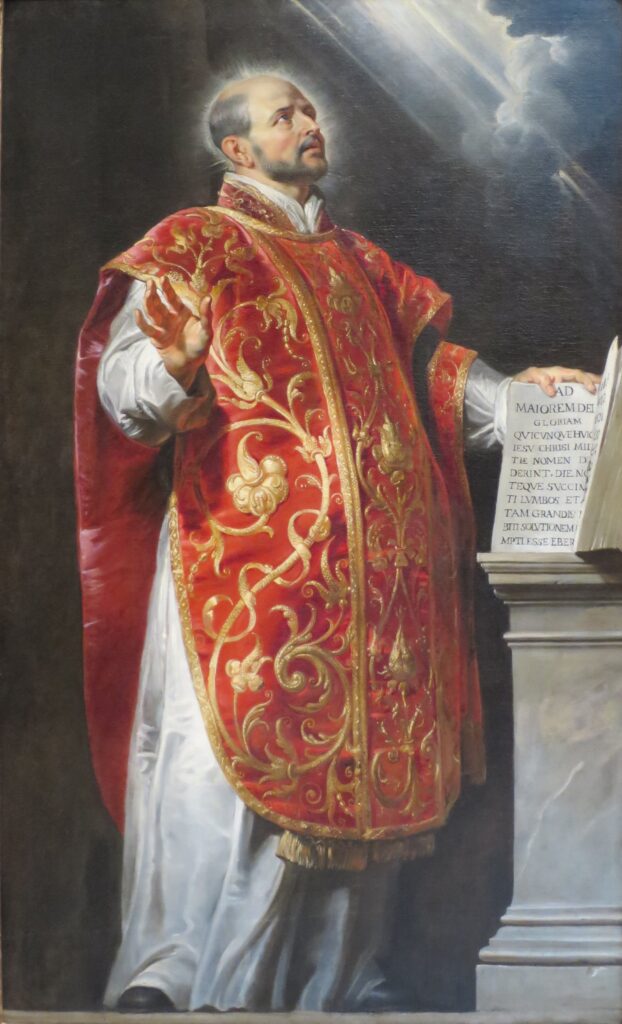
Early Life: The Aspiring Knight (1491–1520)
Born Íñigo López de Oñaz y Loyola in the ancestral castle of Loyola in Azpeitia, Spain, he was the youngest of 13 children born to Don Beltrán Yañez de Oñez y Loyola and Marina Saenz de Lieona y Balda, minor Basque nobility. Orphaned at a young age, he was sent to serve as a page in the household of Juan Velázquez de Cuéllar, the treasurer to King Ferdinand.
As a young man, Íñigo was captivated by the ideals of chivalry, courtly romance, and military glory. He spent his youth as a courtier and soldier, known for his pride, stylish dress, duel-fighting, and worldly ambitions.
In 1517, he entered the service of the Duke of Nájera, participating in military campaigns across northern Spain.
The Cannonball and Conversion (1521)
The turning point of Íñigo’s life occurred on May 20, 1521, at the Battle of Pamplona. While defending the city’s fortress against French forces, a cannonball shattered his right leg and severely damaged his left calf. Impressed by his bravery, the French troops treated his wounds and carried him back to his family home in Loyola.
During a long, agonizing recovery that required his leg to be re-broken and reset, Íñigo asked for romantic tales of chivalry to pass the time. Finding none in the house, he was instead given a translation of the Life of Christ by Ludolph of Saxony and a collection of the lives of the saints.
As he read, he noticed a distinct internal shift:
- Thoughts of worldliness and chivalric exploits left him briefly exhilarated, but ultimately feeling empty, dry, and restless.
- Thoughts of imitating saints like St. Francis of Assisi and St. Dominic left him feeling deep, lasting peace, joy, and consolation.
This realization marked his awakening to discernment of spirits—the foundational principle of what would become Ignatian spirituality.
Pilgrimage, Manresa, and the Spiritual Exercises (1522–1527)
Once recovered, Íñigo abandoned his worldly career. In March 1522, he made a pilgrimage to the Benedictine monastery at Montserrat. There, he confessed his past life, hung his sword before an altar of the Virgin Mary, gave away his fine clothes to a beggar, and dressed in sackcloth.
He then spent nearly a year living as an ascetic in the small town of Manresa, sleeping in a cave, fasting, and praying seven hours a day. During this intense period of spiritual struggle and mystical visions, he began writing notes on his inner experiences. These notes formed the core of the Spiritual Exercises, a structured month-long retreat program designed to help individuals overcome disordered attachments and discern God’s will.
After a brief, fruitless pilgrimage to the Holy Land in 1523—where Franciscan authorities ordered him to leave due to political instability—Íñigo recognized that to help others effectively, he needed a comprehensive education.
Studies and the Founding of the Jesuits (1524–1540)
Starting at age 33, Íñigo sat in classrooms alongside young children to learn Latin grammar. He went on to study philosophy and theology at the universities of Alcalá and Salamanca. His enthusiasm for guiding others through informal spiritual conversations raised the suspicions of the Spanish Inquisition, leading to several brief detentions and prohibitions against preaching without formal qualifications.
In 1528, he moved to the University of Paris to complete his master’s degree. It was in Paris that he began using the Latinized form of his name: Ignatius.
At the University of Paris, Ignatius gathered a small group of brilliant roomates and fellow students:
- Francis Xavier (St)
- Peter Faber (St)
- Diego Laínez
- Alfonso Salmerón
- Nicolás Bobadilla
- Simão Rodrigues
On August 15, 1534, in a chapel in Montmartre, Paris, the seven companions took private vows of poverty, chastity, and a promise to go to Jerusalem, or place themselves at the disposal of the Pope if travel to the Holy Land proved impossible.
When war with the Ottoman Empire blocked travel to Jerusalem, the companions traveled to Rome. On September 27, 1540, Pope Paul III officially sanctioned the new religious order with the papal bull Regimini Militantis Ecclesiae, establishing the Society of Jesus. Ignatius was unanimously elected as its first Superior General.
Superior General and Administrative Legacy (1541–1556)
Ignatius spent the final 15 years of his life in Rome managing the rapidly growing order:
- Constitutions: He authored the Constitutions of the Society of Jesus, emphasizing mobility, obedience to the Pope for global missions, and flexibility over communal chanting of the divine office.
- Education: Recognizing the need for intellectual defense of Catholic doctrine during the Protestant Reformation, the Jesuits established a vast network of free schools, colleges, and seminaries across Europe.
- Global Missions: He dispatched missionaries across the globe, most notably sending St. Francis Xavier to Asia.
- Social Works: He founded homes for former prostitutes (Casa Santa Marta) and orphanages in Rome.
By the time of his death, the Society of Jesus had grown from seven members to over 1,000 Jesuits operating dozens of colleges and missions worldwide.
Death and Canonization
Ignatius suffered from chronic stomach ailments and fever throughout his later years, likely stemming from his intense penances in Manresa. He died quietly in Rome on July 31, 1556, at the age of 64.
- Beatified: July 27, 1609, by Pope Paul V
- Canonized: March 12, 1622, by Pope Gregory XV (alongside St. Francis Xavier and St. Teresa of Ávila)
- Feast Day: July 31
- Patronage: Patron saint of spiritual retreats, retreatants, soldiers, and the Basque Country.
Catholic Encyclopædia
Spiritual Exercises of St Ignatius
Autobiography of St Ignatius
Wikipedia