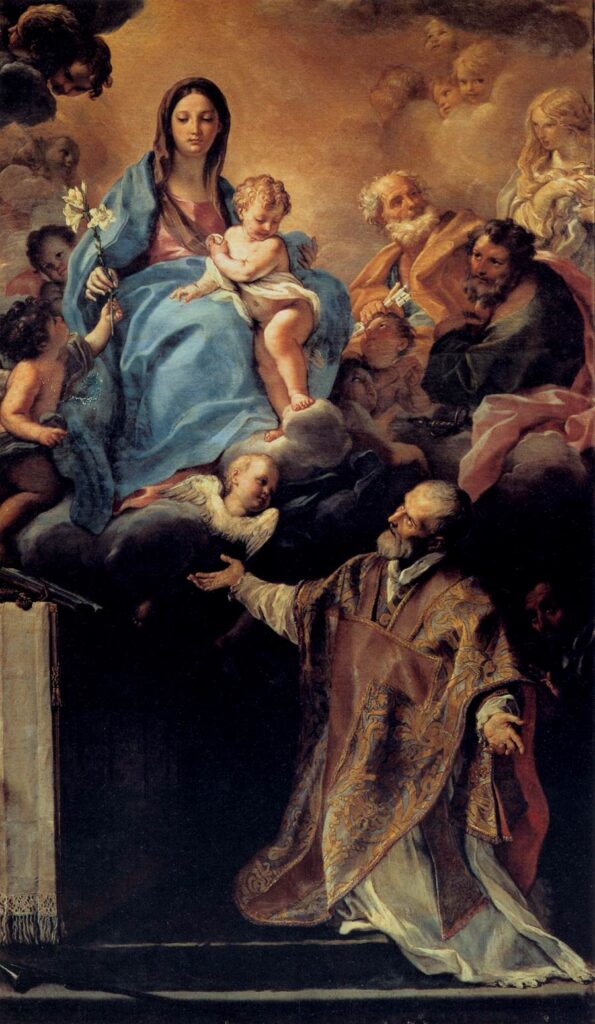
“Immaculate Virgin, thou hast to save me. Grant that I may always remember thee; and thou, do thou never forget me. The happy day, when I shall go to behold thy beauty in paradise, seems a thousand years off. So much do I long to praise and love thee more than I can now do, my Mother, my Queen, my beloved, most beautiful, most sweet, most pure, Immaculate Mary.” – St Philip Neri
Gospel Reading :John 17:20-26
“I do not pray for these only, but also for those who believe in me through their word, that they may all be one; even as thou, Father, art in me, and I in thee, that they also may be in us, so that the world may believe that thou hast sent me.
The glory which thou hast given me I have given to them, that they may be one even as we are one, I in them and thou in me, that they may become perfectly one, so that the world may know that thou hast sent me and hast loved them even as thou hast loved me.
Father, I desire that they also, whom thou hast given me, may be with me where I am, to behold my glory which thou hast given me in thy love for me before the foundation of the world.
O righteous Father, the world has not known thee, but I have known thee; and these know that thou hast sent me. I made known to them thy name, and I will make it known, that the love with which thou hast loved me may be in them, and I in them.”
What do the Fathers say?
St AUGUSTINE. All, i. e. not only those who were then alive, but those who were to be born; not those only who heard the Apostles themselves, but us who were born long after their death. We have all believed in Christ through their word: for they first heard that word from Christ, and then preached it to others, and so it has come down, and will go down to all posterity.
St HILARY. And the unity he speaks of is recommended by the great example of unity: As Thou, Father, art in Me, and I in Thee, that they also may be one in Us, i. e. that as the Father is in the Son, and the Son in the Father, so, after the likeness of this unity, all may be one in the Father and in the Son.
St AUGUSTINE. In ourselves we cannot be one, severed from each other by diverse pleasures, and lusts, and the pollution of sin, from which we must be cleansed by a Mediator, in order to be one in Him.
St John CHRYSOSTOM. For there is no scandal so great as division, whereas unity amongst believers is a great argument for believing; as He said at the beginning of His discourse, By this shall all men know that you are My disciples, if you have love one to another. For if they quarrel, they will not be looked on as the disciples of a peacemaking Master.
St AUGUSTINE. Then our Saviour, Who, by praying to the Father, showed Himself to be man, now shows that, being God with the Father, He does what He prays for: And the glory which You gave Me, I have given them. What glory, but immortality, which human nature was about to receive in Him?
For that which was to be by unchangeable predestination, though future, He expresses by the past tense. That glory of immortality, which He says was given Him by the Father, we must understand He gave Himself also. For when the Son is silent of His own cooperation in the Father’s work, He shows His humility: when He is silent of the Father’s cooperation in His work, He shows His equality. In this way here He neither disconnects Himself with the Father’s work, when He says, The glory which Thou gavest Me, nor the Father with His work, when He says, I have given them. But as He was pleased by prayer to the Father to obtain that all might be one, so now He is pleased to effect the same by His own gift; for He continues, That all may be one, even as We are one.
What is it to know Him, but eternal life, which He gave not to a condemned but to a reconciled world?
For this reason the world has not known Thee; because Thou art just, and hast punished them with this ignorance of Thee, in reward for their misdeeds. And for this reason the reconciled world knows Thee, because Thou art merciful, and hast vouchsafed this knowledge, not in consequence of their merits, but of thy grace.
It follows: But I have known Thee. He is God the fountain of grace by nature, man of the Holy Spirit and Virgin by grace ineffable.
Then because the grace of God is through Jesus Christ, He says, And they have known Me, i. e. the reconciled world have known Me, by grace, forasmuch as Thou hast sent Me. And I have made known Thy name to them by faith, and will make it known by sight: that the love wherewith Thou hast loved Me may be in them. (2 Tim. 4:7) The Apostle uses a like phrase, I have fought a good fight, by a good fight being the more common form. The love wherewith the Father loveth the Son in us, can only be in us because we are His members, and we are loved in Him when He is loved wholly, i. e. both head and body. And therefore He adds, And I in them; He is in us, as in His temple, we in Him as our Head.
Sources:
Bible readings from the Revised Standard Version of the Bible, Second Catholic Edition, copyright © 2006 National Council of the Churches of Christ in the USA
Quotes of the Fathers from Thomas Aquinas’ Catena Aurea Translated by St John Henry Newman
Artwork ex Wikimedia Commons