Gospel Reading : Matthew 14:22-33
Then he made the disciples get into the boat and go before him to the other side, while he dismissed the crowds.
And after he had dismissed the crowds, he went up into the hills by himself to pray. When evening came, he was there alone, but the boat by this time was many furlongs distant from the land, beaten by the waves; for the wind was against them. And in the fourth watch of the night he came to them, walking on the sea.
But when the disciples saw him walking on the sea, they were terrified, saying, “It is a ghost!” And they cried out for fear. But immediately he spoke to them, saying, “Take heart, it is I; have no fear.”
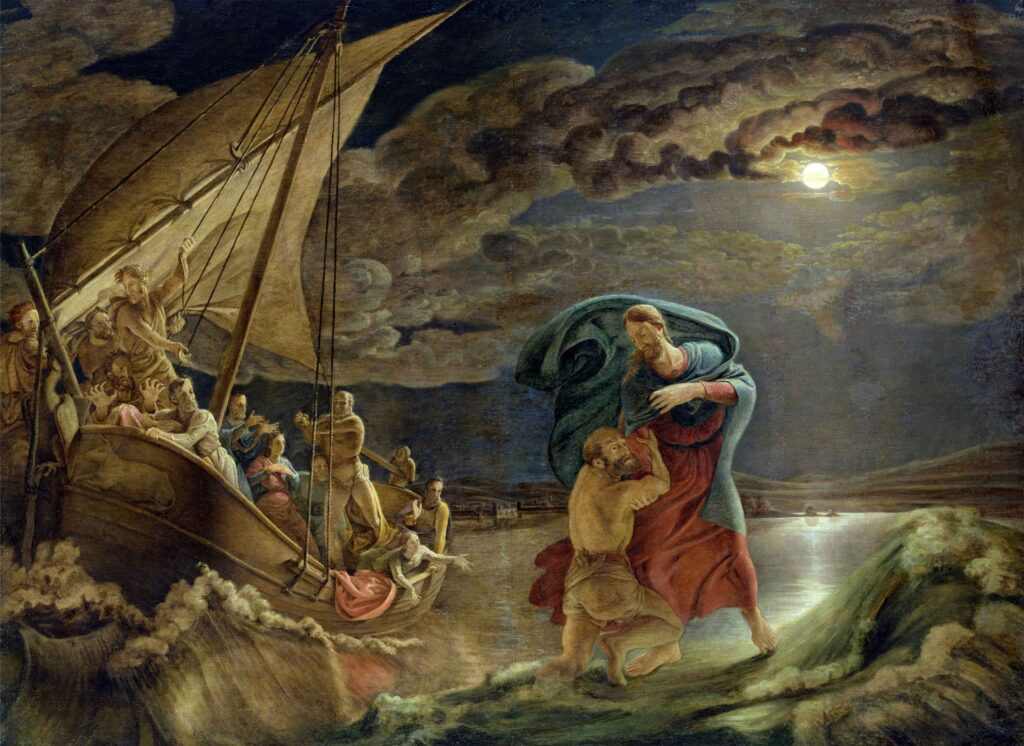
And Peter answered him, “Lord, if it is you, bid me come to you on the water.” He said, “Come.” So Peter got out of the boat and walked on the water and came to Jesus; but when he saw the wind, he was afraid, and beginning to sink he cried out, “Lord, save me.”
Jesus immediately reached out his hand and caught him, saying to him, “O man of little faith, why did you doubt?”
And when they got into the boat, the wind ceased. And those in the boat worshiped him, saying, “Truly you are the Son of God.”
What do the Fathers say?
St John CHRYSOSTOM. It should be observed, that when the Lord works a great miracle, He sends the multitudes away, teaching us thereby never to pursue the praise of the multitude, nor to attract them to us. And when he had sent the multitude away, he went up into a mountain apart to pray; showing us that solitude is good, when we have need to pray to God. For this also He goes into the desert, and there spends the night in prayer, to teach us that for prayer we should seek stillness both in time and place.
St JEROME. That He withdraws to pray alone, you should refer not to Him who fed five thousand on five loaves, but to Him who on hearing of the death of John withdrew into the desert; not that we would separate the Lord’s person into two parts, but that His actions are divided between the God and the man.
St John CHRYSOSTOM. Again, the disciples suffer shipwreck, as they had done before; but then they had Him in the boat, but now they are alone. Thus gradually He leads them to higher things, and instructs them to endure all manfully.
He suffers them to be tossed the whole night, exciting their hearts by fear, and inspiring them with greater desire and more lasting recollection of Him; for this reason He did not stand by them immediately, but as it follows, in the fourth watch of the night he came to them walking upon the sea.
Christ then did not reveal Himself to His disciples until they cried out; for the more intense their fear, the more did they rejoice in His presence.
St JEROME. On every occasion Peter is found to be the one of the most ardent faith. And with the same zeal as ever, so now, while the others are silent, he believes that by the will of his Master he will be able to do that which by nature he cannot do; whence it follows, And Peter answered him, “Lord, if it is you, bid me come to you on the water.”
St John CHRYSOSTOM. See how great Peter’s warmth, how great his faith. He said simply Bid me; he believes not only that Christ can Himself walk on the sea, but that He can lead others also and this, so great a thing, he asks not from ostentation, but from love. For he did not say, Bid me walk upon the waters, but, Bid me come to you.
And it seems that Christ, having already shown in the first miracle that He has power over the sea, now leads them to a more powerful sign; He said to him, Come. So Peter got out of the boat and walked on the water and came to Jesus.
Peter overcame that which was greater, the waves, but is troubled by the lesser, the blowing wind, for it follows, But seeing the wind boisterous, he was afraid. Such is human nature, in great trials ofenttimes holding itself aright, and in lesser falling into fault.
He bade not the winds to cease, but stretched forth His hand and caught him, because his faith was required. For when our own means fail, then those which are of God stand. Then to show that not the strength of the tempest, but the smallness of his faith worked the danger, He said to him, “O man of little faith, why did you doubt?” which shows that not even the wind would have been able to hurt him, if his faith had been firm.
Sources:
Bible readings from the Revised Standard Version of the Bible, Second Catholic Edition, copyright © 2006 National Council of the Churches of Christ in the USA
Quotes of the Fathers from :
Thomas Aquinas’ Catena Aurea Translated by St John Henry Newman
Artwork ex Wikimedia Commons