- Background: Born Antonio Ghislieri in 1504 in the tiny village of Bosco Marengo (near Alessandria, Italy), his early life was defined by poverty and physical labor.
- The Family Trade: His family were former nobles who had fallen on hard times and were reduced to poverty. As a young boy, Antonio worked as a shepherd. Later, as Pope, he used this shepherd’s instinct to guard the Church against what he saw as the “wolves” of corruption and heresy.
- The Thirst for Learning: While watching the sheep, he was known to be intensely prayerful and studious. However, his parents were too poor to pay for any schooling. A wealthy neighbour noticed the young shepherd’s intelligence and piety. He offered to pay for Antonio to go to school alongside his own son.
- The Dominican Call: At the age of 14, Antonio encountered two Dominican friars passing through his town. He was so struck by their life of poverty and study that he followed them to the monastery at Voghera.
- The Habit: He entered the Order of Preachers (Dominicans), In the eyes of the Church at that time, 14 was the “age of reason.” It was the moment a boy became a man in the eyes of the law. This means that he chose the monastery the moment he became an adult. He took the name Michael, the Archangel—the warrior who guards the Truth—which, was the perfect foreshadowing of his future as the Inquisitor.
- The Papacy: Pius V was elected on January 7, 1566, and crowned on his 62nd birthday, January 17, Into a world that felt like it was literally falling apart from both the inside and the outside.
The Council of Trent:
The Council of Trent had officially closed in 1563, just three years earlier. It had produced massive folders of decrees on how to fix the Church’s corruption, but they were just words on paper.
- The Problem: The previous Pope, Pius IV, was a member of the powerful Medici family. While he approved the Council, he lived like a typical Renaissance prince. The Church was full of “career” bishops who lived in luxury in Rome instead of in their dioceses.
- The Need: The Cardinals knew that if the next Pope didn’t actually implement the reforms, the Catholic Church might simply dissolve. They needed a “True Believer” who wasn’t a politician.
The External Crisis: The “Red Apple” of Rome
The Ottoman Empire, under Suleiman the Magnificent (and later Selim II), was at the peak of its power.
- The Threat: The Turks were advancing across the Mediterranean and through Hungary toward Vienna. They called Rome the “Red Apple”—their ultimate prize.
- The Disunity: Europe was too busy fighting itself to unite. France was flirting with Protestantism, and Spain was focused on its own empire. There was no “Defender of the West” until Pius V stepped in.
The Religious Crisis: The Spread of Protestantism
By 1566, the Reformation was no longer just a small protest; it was a revolution.
- The Church needed a “forensic” clear-headed leader who could define exactly what it meant to be Catholic, leaving no room for ambiguity.
The election of Antonio Ghislieri (Pius V) was a shock to the Roman system.
- The Medici Veto: He was the most hated Cardinal by the previous Pope because he had constantly criticized the Vatican’s luxury.
- The Borromeo Factor: St. Charles Borromeo, despite being the nephew of the previous pope, convinced the Cardinals that they needed the holiest man, not the most popular one.
- The Reaction: When the news of his election hit the streets, the people of Rome were actually terrified. They knew that a “Holy Inquisitor” would not tolerate the city’s vice (prostitution, gambling, and corrupt priests).
The Pontificate:
He commenced his pontificate as he meant to continue; most Popes, upon election, were expected to throw open the doors of the treasury and shower the city with coins and favours to celebrate their “Glorious Reign.” Pius V did the exact opposite. He realized that the Church could not preach poverty to the world while the Vatican lived in excess.
- His first official act was to cancel the traditional coronation banquet.He took the thousands of gold scudi meant for the feast and distributed them directly to the poor, the sick, and the “shame-faced” needy (impoverished families too proud to beg).
- The “Clean House” Policy: He then ordered that all the “extras” in the Papal household—the court jesters, the luxury guards, and the hangers-on—be sent home. He told his staff: “We are not here to live like princes, but to die like apostles.”
- The Decree of Residency: This was perhaps his most revolutionary act. He ordered all Bishops and Cardinals who were currently living in luxury in Rome to return to their own dioceses within 30 days.
- He was famously austere, wearing his white Dominican habit even as Pope—which is why every Pope since then wears white today.
The Achievements
Pope Pius V’s three massive achievements during his Pontificate:
- Moral Reform: He cleared the streets of crime, fought corruption in the clergy, and lived like a monk in the Vatican, eating simple meals and spending hours in prayer.
2. The Council of Trent: He implemented the reforms of this council, which defined Catholic teaching against the Protestant Reformation. He published the first Roman Catechism and a standard Missal that remained largely unchanged for 400 years.
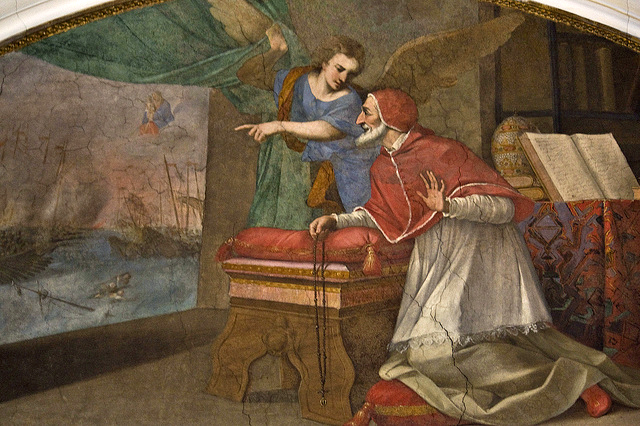
3. The Battle of Lepanto (1571): He organized a “Holy League” of European ships to stop the Ottoman Empire’s naval advance. He attributed the miraculous victory to the Rosary, establishing the feast day we still celebrate in October.
Pope St. Pius V died on May 1, 1572, at the age of 68, just seven months after the miraculous victory at Lepanto,
The Final Pilgrimage: Even as he was dying, the Pope remained a shepherd.
- A few weeks before he died, he insisted on making a final visit to the Seven Pilgrim Churches of Rome on foot, despite being in agony.
- He stopped at the Scala Santa (the Holy Stairs) and climbed them on his knees, a final act that mirrored the washing of the feet.
When he died, he was buried in his simple white Dominican habit.
- The Tomb: his body was eventually moved to the magnificent tomb in Santa Maria Maggiore. When his tomb was opened years later for his beatification, his body was found to be incorrupt. Today, you can still see his remains in the Basilica, clad in white with a silver mask covering his face.