Virgin and Doctor of the Church
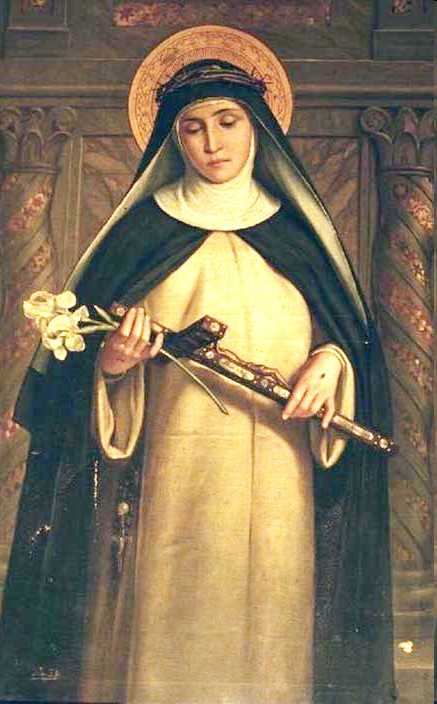
Catherine di Giacomo Benincasa
- Birth: Born Catherine di Giacomo Benincasa on March 25, 1347, in Siena, Italy. She was the 25th child born to Lapa and Giacomo Benincasa, a wool dyer.
- The Vision: At age 6, while walking with her brother Stefano, she looked up at the Church of San Domenico and saw Christ seated on a throne, dressed in pontifical vestments and smiling at her. She always saw the Pope as the “Sweet Christ on Earth”.
- The Secret Vow : At age 7, she privately dedicated her virginity to God.
- Marriage: Her family tried to force her to marry at age 15, but in an act of defiance she cut off her hair.
- The Third Order:(1363–1367) After she refused marriage she became a “Mantellata”—a lay member of the Dominican Third Order. She lived in total silence and solitude in a small room (a small, windowless space) in her father’s house; which you can still visit in Siena today.
- The Vow of Silence: She resolved to speak to no one except her confessor.
In a house with 24 siblings and a constant stream of customers, this was a radical act of “internal boundary setting.” - The Bed of Prayer: She slept on a wooden board with a stone for a pillow. She slept for about 30 minutes every four hours, spending the rest of the night in prayer.
- The Bread of Life: During this time, she began her lifelong habit of extreme fasting, eventually reaching a point where she lived almost entirely on the Eucharist.
- The “Invisible” Work: She performed the most menial tasks for her family—cooking, cleaning, and carrying water—but did so in total mental seclusion. As she told her confessor ,“I have found a cell within my soul from which I never need to depart.”
She later told her followers: “Make a cell in your mind, and you will never be alone.”
- The Vow of Silence: She resolved to speak to no one except her confessor.
- The end of silence came during the Carnival of 1366. While the rest of Siena was feasting, Catherine had a vision that changed her from a hermit to an activist.
She saw Christ, accompanied by the Virgin Mary and a heavenly court, placing a ring on her finger.
Immediately after this, the “Voice” told her:
“Now you must go out. You have been hidden long enough. You must carry the fire of my love to the world.” - The Lepers and the Plague: she started in the hospitals of Siena, specifically Santa Maria della Scala. She sought out the patients everyone else was afraid to touch. There are accounts of her kissing the sores of lepers to overcome her own physical revulsion.
- For the first twenty years of her life, Catherine was essentially illiterate. Once she came out of her three-year silence, she felt a burning desire to read the Divine Office so she could participate more fully in the life of the Dominican Order. Her confessor, Raymond of Capua, records that one morning, after praying for help, she suddenly found she could read perfectly. It wasn’t a slow progression; it was an “unlocking.”
- The Secretaries: She began to attract a diverse group of followers—nobles, artists, priests, and poets—who called her “Mamma.”
Since she was still technically illiterate at this point, this group became her “human printing press,” transcribing the hundreds of letters she began to fire off to political and religious leaders. - The Conflict Resolution: She became a famous “peacemaker,” traveling between warring Italian city-states (like Florence and Siena) to settle blood feuds that had lasted generations
- The Plague (1374): When the Black Death decimated Siena, Catherine didn’t hide. She became an angel of mercy, burying the dead with her own hands and caring for those whom even the doctors abandoned.
- The Avignon Trip (1376): The Popes had moved to Avignon , France, in 1309 effectively abandoning Rome. Catherine wrote blistering letters to Pope Gregory XI, and in 1376, she traveled to France to meet him. She told him that the “stench of the court in Avignon” had reached Siena. Famously telling him to “be a man” (sia uomo) and return to the See of Peter in Rome, to protect his flock. Because of her, the Papacy returned to Rome in 1377.
- The Dialogue: Her masterpiece, The Dialogue of Divine Providence, was dictated while she was in ecstasy. In 1378, as Europe descended into the chaos of the Great Schism, Catherine entered a different world. In a series of trances, she dictated 167 chapters of pure spiritual fire. She called it her ‘Dialogue’—a forensic map of the human soul, proving that even when the world is falling apart, the Bridge of Love remains standing. In it, she describes Christ as a Bridge between Heaven and Earth—
“I have shown thee the Bridge… It is built of the stones of true and real virtues. These stones were not placed before the Passion of My Son, for the Way was not yet built.
But after the Word was made flesh, He became the Way, the Truth, and the Life.
This Bridge is walled with Mercy… and the stones are cemented with the Blood of the Lamb.
On this Bridge is a hostelry, where the Bread of Life is given to the travellers, lest they faint from hunger.
He is the Shepherd who not only leads but becomes the very road we walk upon.” - The Stigmata: In 1375, she received the stigmata in Pisa. She prayed that they would be invisible so as not to draw attention to herself. They only became visible on her body after she died.
- In her later years, she could eat no food at all. Her body literally rejected everything except the Eucharist. Modern medical historians often label this Anorexia Mirabilis (miraculous lack of appetite).
- Even after she could read, Catherine continued to dictate her letters to secretaries. She famously stated that her “hand did not know how to move the pen.” However, this changed during a period of intense prayer in the autumn of 1377.
While staying at the fortress of Rocca d’Orcia, she was in a state of deep contemplation. She claimed that the Holy Spirit “guided her hand.” - The Final Struggle: She spent her last months in an “agony” of prayer for the unity of the Church, which was then splitting in the Great Schism. Shortly after Gregory XI died in Rome, the Cardinals met to elect a successor.
The Roman Choice: Under pressure from the Roman mobs (who shouted “We want a Roman!”), the Cardinals elected Urban VI, who was incredibly harsh and hot-tempered.
The Rival: The French Cardinals hated him, fled Rome, and declared his election “invalid” because they were “under duress.”
They elected their own Pope, Clement VII, who moved back to Avignon.
Catherine didn’t just sit back; she entered the fray with a ferocity that defines her legacy. - She Picked a Side: She backed the Roman Pope, Urban VI, even though she often wrote him letters telling him to “mitigate his temper” with the “oil of humility.” She argued that a Body (the Church) cannot have two heads.
- The Letters: She wrote to the Kings and Cardinals of Europe, essentially saying: “You have turned the garden of the Church into a field of blood.”
She spent her final breaths trying to knit the Body of Christ back together, dying of a broken heart because the Bridge she loved was being torn down by the men who were supposed to build it. (The Schism didn’t actually end until 1417 (the Council of Constance), nearly 40 years after Catherine died.) - Death: She died in Rome at the age of 33 on April 29, 1380.
- When they opened her tomb in 1383 (three years after her death), her body was found incorrupt. For her followers, this was the final proof that the “Bread of Life” she lived on had actually transformed her physical makeup.
- She is buried under the High Altar in the Santa Maria sopra Minerva Basilica in Rome.
- The Legacy: She was declared a Doctor of the Church in 1970—one of the first women ever given that title; the others being St Theresa of Ávila, St Thérèse of Liseux and St Hildegard of Blingen.
Quotes from Catherine of Siena, The Dialogue, trans. Suzanne Noffke (New York: Paulist Press, 1980),