
Saint Gennaro
Martyrdom (305 AD)
According to early hagiographical tradition, during the time of Emperor Diocletian’s persecutions, San Gennaro visited imprisoned Christian clergy, Sossius and Proculus, . Arrested alongside his companions, he was condemned by the Roman governor. They were thrown into a fiery furnace, but the flames would not touch them, they were then exposed to wild beasts in the amphitheatre at Pozzuoli (the animals reportedly refused to harm them) , they were then beheaded near the Solfatara crater.
The body of St. Gennaro was brought to Naples, and there honourably interred in the church, where his holy blood is kept unto this day in a phial of glass, collected at his martyrdom by a woman named Eusebia. When placed near his head, the blood becomes liquid and bubbles up as though it were fresh.
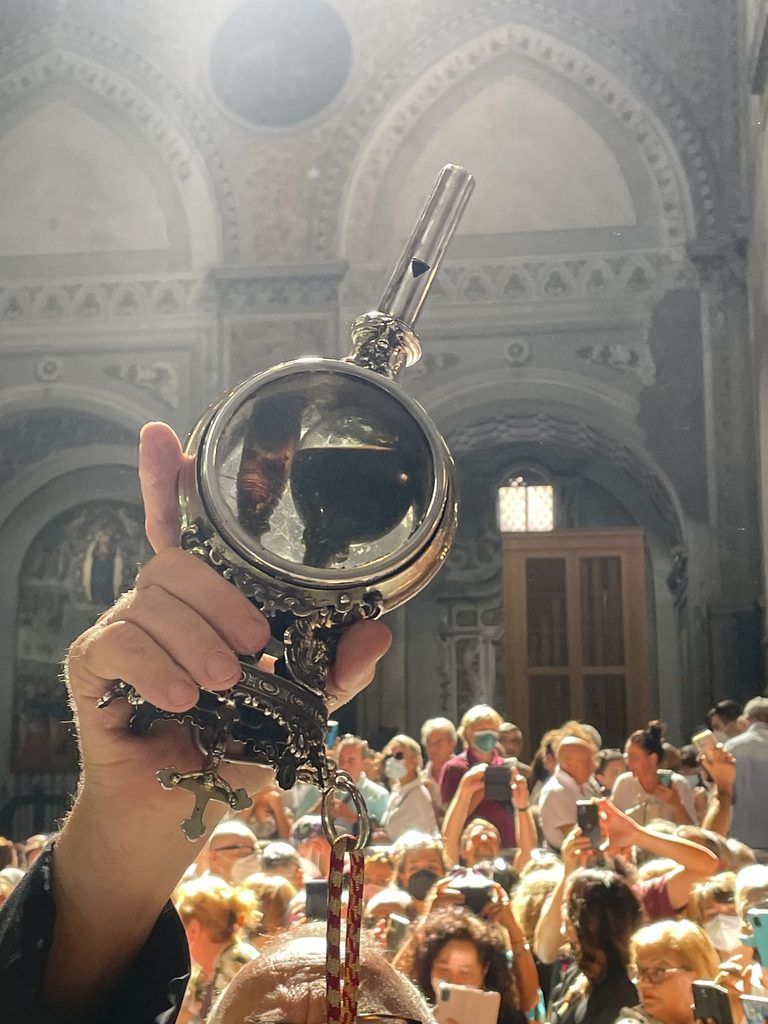
The Phenomenon: During public liturgical expositions, the solid mass repeatedly liquefies, changes colour, and alters in volume. This occurs three times a year:
- September 19: His feast day, commemorating his martyrdom circa in 305AD.
- December 16: Commemorating his stopping the devastating 1631 eruption of Mount Vesuvius.
- Saturday before the First Sunday of May: Commemorating the translation of his relics to Naples.
Mount Vesuvius erupted violently on December 16, 1631, after nearly five centuries of relative dormancy, launching a 28-kilometer ash column and sending lethal pyroclastic flows toward the Bay of Naples, killing thousands in outlying villages. An estimated 3,000 to 6,000 people lost their lives.
The Timeline of the Eruption
- The Warning Signs: For several weeks leading up to the disaster, the region experienced sharp earthquakes, rumbling sounds, and a noticeable drying or muddying of local water wells.
- December 16 (The Explosion): At dawn, a massive explosion tore open a fissure on the western side of the volcano. A giant ash column shot roughly 13 kilometers (8 miles) into the sky, blocking out the sun and raining heavy ash and stones across Southern Italy.
- December 17 (The Collapse): The high-pressure eruption column became too heavy and collapsed. This sent a series of devastating pyroclastic flows racing down the slopes. At the same time, torrential rains mixed with the fresh volcanic ash, creating massive, boiling mudflows called lahars.
- Towns Destroyed: The pyroclastic flows and lahars wiped out numerous coastal and slope communities, including Portici, Torre del Greco, Torre dell’Annunziata, and Resina (built over ancient Herculaneum).
- The Tsunami: The sheer force of the volcanic earthquakes and collapsing material triggered a tsunami in the Gulf of Naples. Waves crashed ashore three times, smashing boats and flooding coastal areas.
- A Permanent Shift: The eruption was so massive that it physically lowered the height of Vesuvius’s summit cone. It also marked a major geological shift; for the next three centuries, Vesuvius transitioned into an almost constantly active phase until its last eruption in 1944.
The Miracle
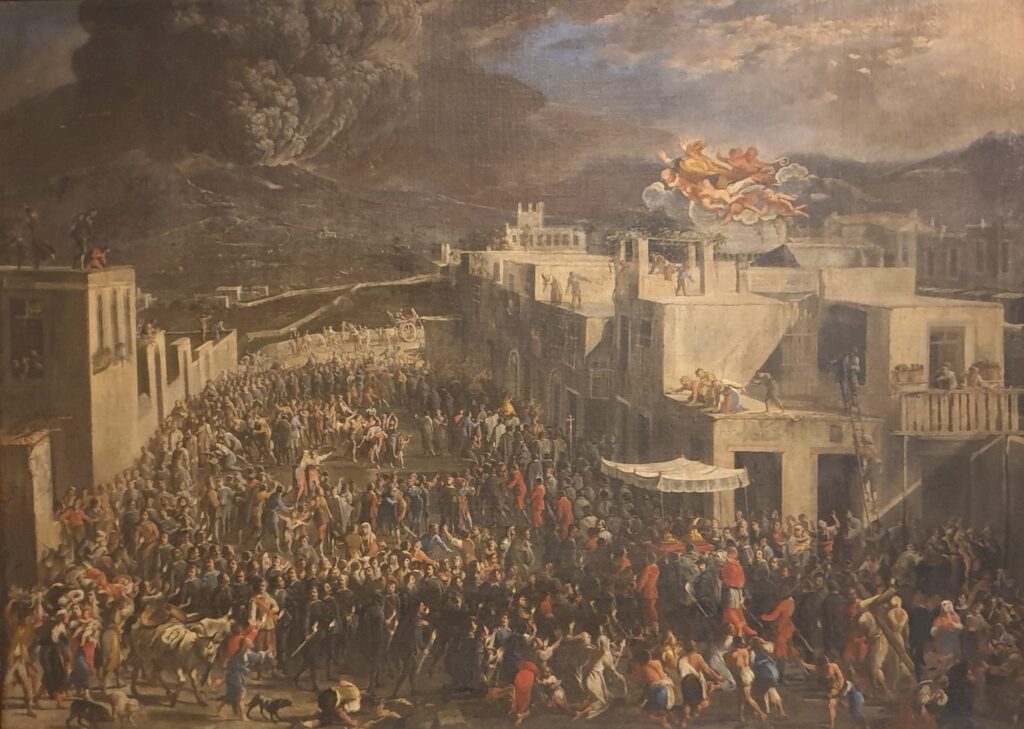
As ash rained down and tremors shook the capital, Cardinal-Archbishop Francesco Boncompagni and the Spanish Viceroy (Manuel de Acevedo y Zúñiga, Count of Monterrey) organized an emergency penitential procession on December 17–18. Carrying the reliquary bust and the glass phials of San Gennaro’s blood from the Cathedral of Santa Maria Assunta toward the eastern city boundary at Ponte della Maddalena, the clergy exposed the relics directly toward the smoking volcano.
According to contemporary chronicles, the moment the reliquary was raised facing the mountain, a divine apparition of the martyr appeared in the sky extending his right arm toward the crater. The winds shifted, the lava diverted away from the city gates into the sea, and the eruption rapidly subsided.
Throughout Neapolitan history, there are several famous recorded instances when the blood of Saint Gennaro failed to liquefy, followed by major historical disasters, wars, or epidemics:
- 1527 (The Plague of Naples): The blood remained solid, and Naples was subsequently struck by a devastating plague outbreak that killed tens of thousands of residents.
- 1538 (Eruption of Monte Nuovo): The failure of the liquefaction coincided with the sudden volcanic eruption in the Phlegraean Fields near Naples that formed the Monte Nuovo cinder cone.
- September 1939 (Outbreak of World War II): The blood failed to liquefy during the September feast, coinciding with Nazi Germany’s invasion of Poland and the formal outbreak of World War II.
- September 1943 (Occupation and Bombing of Naples): The blood remained solid during the Allied invasion of Italy, leading into the Nazi occupation of Naples, heavy air raids, and the violent “Four Days of Naples” uprising.
- 1973 (Cholera Outbreak): The miracle failed to occur shortly before Naples suffered a major cholera epidemic, one of the last significant outbreaks of the disease in Western Europe.
- September 1980 (The Irpinia Earthquake): The blood failed to liquefy during the September 19 feast. Two months later, on November 23, 1980, the massive Irpinia earthquake struck southern Italy, killing nearly 2,500 people and leaving 250,000 homeless.
- December 2020 (COVID-19 Pandemic): On December 16, 2020, the blood remained solid despite multiple rounds of prayer, which locals interpreted as a reflection of the ongoing devastation and economic toll of the global pandemic.
However, Post-2020 –
- Annual Feast Days (September 19): The miracle occurred normally on his official feast day in 2021, 2022, 2023, 2024, and 2025. In September 2023, the abbot announced that the blood completely liquefied almost immediately upon being removed from the cathedral safe.
- Winter Celebrations (December 16): Unlike the December 2020 non-liquefaction, subsequent winter feasts—including December 16, 2025—saw full liquefaction confirmed inside the Royal Chapel of the Treasury.
- Spring Feasts (May): The May anniversary commemorating the translation of his relics from Pozzuoli to Naples has routinely witnessed full or progressive liquefaction.
Sources:
Catholic Encyclopaedia
Wikipedia
Artwork : Wikimedia Commons