
Saint of the Day – 6 June
Saint Norbert of Xanten (c. 1075–1134) was one of the most dynamic and influential figures of the 12th-century church reform movement. A contemporary and close friend of Saint Bernard of Clairvaux, Norbert transformed from a wealthy, pleasure-seeking courtier into a wandering barefoot preacher, ultimately founding the Premonstratensian Order (commonly known as the Norbertines).
His life is defined by a dramatic conversion, a commitment to radical evangelical poverty, and a fierce defense of the Eucharist.
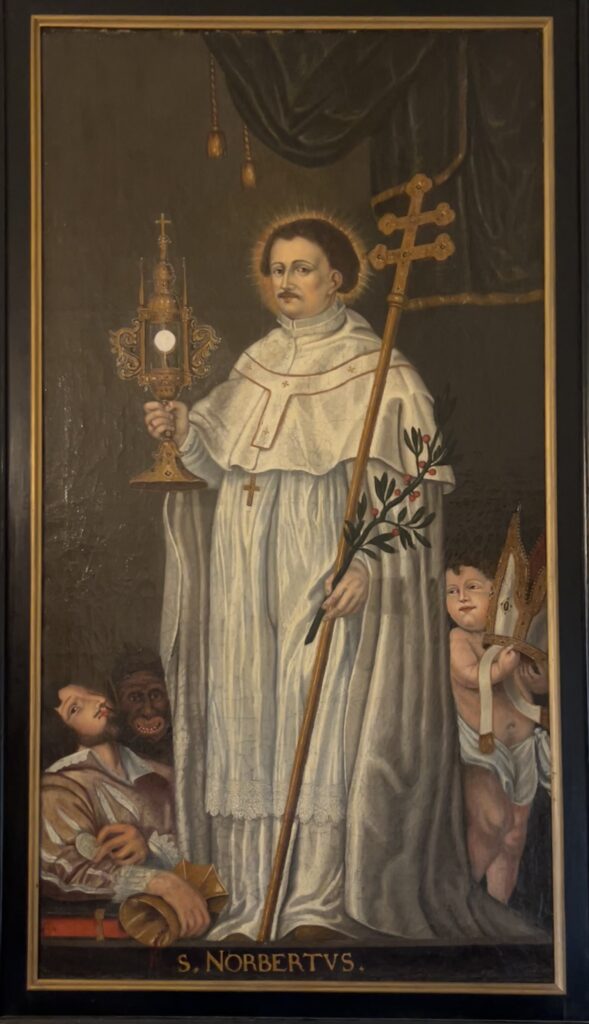
The Conversion: A Sudden Bolt of Lightning
Born into the high nobility in Xanten (near the Dutch-German border), Norbert spent his early adulthood enjoying a life of extreme luxury, privilege, and secular ambition. As a canon of the collegiate church of Xanten and a high-ranking courtier to Holy Roman Emperor Henry V, he actively avoided ordination to the priesthood so he could continue pursuing worldly pleasures.
The grand, superficial world Norbert built for himself came to a sudden, violent end in 1115 when he was around 40 years old.
While riding his horse through a meadow across the countryside to a tournament or gathering, a sudden, freak summer storm caught him completely exposed. A massive bolt of lightning split the air, striking the ground directly in front of his horse’s hooves. The terrified animal reared up, throwing Norbert violently to the ground. He lay there unconscious in the mud and rain for an hour.
When he finally opened his eyes, the shock of nearly dying shattered his secular ambitions. Looking into the stormy sky, he uttered the exact words of the persecutor Saul on the road to Damascus: “Lord, what would you have me do?” An inner voice replied: “Turn from evil and do good; seek peace and pursue it.”
Radical Poverty and Wandering Preacher
He immediately left the imperial court, returned to Xanten, gave away his fine silken robes, distributed his inheritance to the poor, and finally sought ordination to the priesthood, he walked barefoot through France and Germany, preaching repentance and peace.
He sought to bridge a major divide in the medieval church: he wanted to combine the rigorous, cloistered communal life of a monk with the active, outward-facing parish ministry of a diocesan priest.
Founding the Norbertines at Prémontré (1121)
In 1120, the Bishop of Laon granted Norbert a remote, marshy valley in the forest of Coucy called Prémontré (meaning “the meadow shown” by God). Here, on Christmas Day in 1121, Norbert and a small band of companions officially founded the Canons Regular of Prémontré.
- The Rule: They adopted the Rule of Saint Augustine, but infused it with severe white habits (made of undyed wool) to symbolize purity and penance.
- The Mission: Unlike traditional monks who remained isolated from society, Norbert’s white canons served local parishes, ran hospitals, and traveled to preach, while returning to the abbey for communal prayer and the Divine Office.
The order spread with astonishing speed across Europe, particularly in Flanders, Germany, and France.
The Triumph of Antwerp and Eucharistic Devotion
Norbert is widely revered as a “Defender of the Eucharist.” In 1124, the citizens of Antwerp begged him to come to their city to combat the “Tanchelmist heresy.” A charismatic preacher named Tanchelm had swept through Flanders, violently denouncing the sacraments, the hierarchy, and the Real Presence of Christ in the Holy Eucharist.
Norbert’s eloquent preaching, deep humility, and public Eucharistic processions completely turned the tide. He restored orthodox faith to Antwerp, exposed Tanchelm’s errors, and famously recovered the desecrated, hidden sacred hosts from local houses. Because of this triumph, he is traditionally recognized as an early apostle of Eucharistic adoration.
Later Years: Archbishop of Magdeburg
In 1126, Pope Honorius II appointed Norbert as the Archbishop of Magdeburg (in eastern Germany). As archbishop, he brought his uncompromising zeal for reform to a corrupt diocese, surviving several assassination attempts by disgruntled local nobles and lax clergy who resented his strict enforcement of clerical celibacy and church discipline.
He spent his final years acting as a vital peacemaker and political advisor to both the Pope and Holy Roman Emperor Lothair II. He died in Magdeburg on June 6, 1134, and was canonized by Pope Gregory XIII in 1582.
Sources:
Catholic Encyclopaedia
Wikipedia