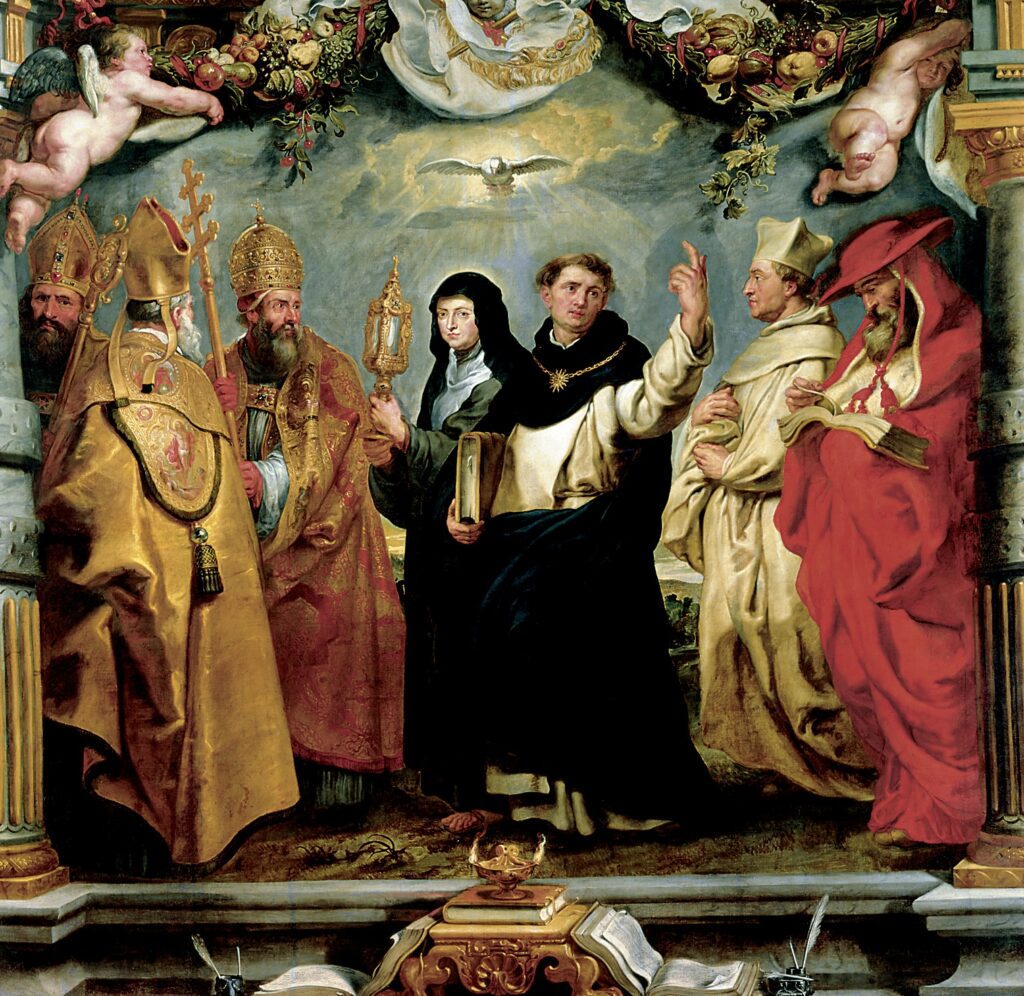
– by Peter Paul Rubens (c.1625)
Lauda Sion – Thomas Aquinas
| LAUDA Sion Salvatorem, lauda ducem et pastorem, in hymnis et canticis. Quantum potes, tantum aude: quia maior omni laude, nec laudare sufficis. | ZION, to Thy Saviour sing, to Thy Shepherd and Thy King! Let the air with praises ring! All thou canst, proclaim with mirth, far higher is His worth than the glory words may wing. |
| Laudis thema specialis, panis vivus et vitalis hodie proponitur. Quem in sacrae mensa cenae, turbae fratrum duodenae datum non ambigitur. | Lo! before our eyes and living is the Sacred Bread life-giving, theme of canticle and hymn. We profess this Bread from heaven to the Twelve by Christ was given, for our faith rest firm in Him. |
| Sit laus plena, sit sonora, sit iucunda, sit decora mentis iubilatio. Dies enim solemnis agitur, in qua mensae prima recolitur huius institutio. | Let us form a joyful chorus, may our lauds ascend sonorous, bursting from each loving breast. For we solemnly record how the Table of the Lord with the Lamb’s own gift was blest. |
| In hac mensa novi Regis, novum Pascha novae legis, phase vetus terminat. Vetustatem novitas, umbram fugat veritas, noctem lux eliminat. | On this altar of the King this new Paschal Offering brings an end to ancient rite. Shadows flee that truth may stay, oldness to the new gives way, and the night’s darkness to the light. |
| Quod in coena Christus gessit, faciendum hoc expressit in sui memoriam. Docti sacris institutis, panem, vinum in salutis consecramus hostiam. | What at Supper Christ completed He ordained to be repeated, in His memory Divine. Wherefore now, with adoration, we, the Host of our salvation, consecrate from bread and wine. |
| Dogma datur christianis, quod in carnem transit panis, et vinum in sanguinem. Quod non capis, quod non vides, animosa firmat fides, praeter rerum ordinem. | Words a nature’s course derange, that in Flesh the bread may change and the wine in Christ’s own Blood. Does it pass thy comprehending? Faith, the law of light transcending, leaps to things not understood. |
| Sub diversis speciebus, signis tantum, et non rebus, latent res eximiae. Caro cibus, sanguis potus: manet tamen Christus totus sub utraque specie. | Here beneath these signs are hidden priceless things, to sense forbidden; signs, not things, are all we see. Flesh from bread, and Blood from wine, yet is Christ in either sign, all entire confessed to be. |
| A sumente non concisus, non confractus, non divisus: integer accipitur. Sumit unus, sumunt mille: quantum isti, tantum ille: nec sumptus consumitur. | And whoe’er of Him partakes, severs not, nor rends, nor breaks: all entire, their Lord receive. Whether one or thousand eat, all receive the selfsame meat, nor do less for others leave. |
| Sumunt boni, sumunt mali: sorte tamen inaequali, vitae vel interitus. Mors est malis, vita bonis: vide paris sumptionis quam sit dispar exitus. | Both the wicked and the good eat of this celestial Food: but with ends how opposite! With this most substantial Bread, unto life or death they’re fed, in a difference infinite. |
| Fracto demum sacramento, ne vacilles, sed memento tantum esse sub fragmento, quantum toto tegitur. Nulla rei fit scissura: signi tantum fit fractura, qua nec status, nec statura signati minuitur. | Nor a single doubt retain, when they break the Host in twain, but that in each part remain what was in the whole before; For the outward sign alone may some change have undergone, while the Signified stays one, and the same forevermore. |
| Ecce Panis Angelorum, factus cibus viatorum: vere panis filiorum, non mittendus canibus. In figuris praesignatur, cum Isaac immolatur, agnus Paschae deputatur, datur manna patribus. | Hail! Bread of the Angels, broken, for us pilgrims food, and token of the promise by Christ spoken, children’s meat, to dogs denied! Shown in Isaac’s dedication, in the Manna’s preparation, in the Paschal immolation, in old types pre-signified. |
| Bone pastor, panis vere, Iesu, nostri miserere: Tu nos pasce, nos tuere, Tu nos bona fac videre in terra viventium. Tu qui cuncta scis et vales, qui nos pascis hic mortales: tuos ibi commensales, coheredes et sodales fac sanctorum civium. Amen. Alleluia. | Jesus, Shepherd mild and meek, shield the poor, support the weak; help all who Thy pardon sue, placing all their trust in You: fill them with Your healing grace! Source of all we have or know, feed and lead us here below. grant that with Your Saints above, sitting at the feast of love we may see You face to face. Amen. Alleluia. |
The Gospel Reading: John 6:51-58
I am the living bread which came down from heaven; if any one eats of this bread, he will live for ever; and the bread which I shall give for the life of the world is my flesh.”
The Jews then disputed among themselves, saying, “How can this man give us his flesh to eat?”
So Jesus said to them, “Truly, truly, I say to you, unless you eat the flesh of the Son of man and drink his blood, you have no life in you; he who eats my flesh and drinks my blood has eternal life, and I will raise him up at the last day.
For my flesh is food indeed, and my blood is drink indeed. He who eats my flesh and drinks my blood abides in me, and I in him.
As the living Father sent me, and I live because of the Father, so he who eats me will live because of me. This is the bread which came down from heaven, not such as the fathers ate and died; he who eats this bread will live for ever.”
What do the Fathers say?
The Venerable BEDE. This bread our Lord gave, when He delivered to His disciples the mystery of His Body and Blood, and offered Himself to God the Father on the altar of the cross for the life of the world, i. e. for mankind.
St THEOPHYLACT. Note that the bread which is taken by us in the mysteries, is not only the sign of Christ’s flesh, but is itself the very flesh of Christ; for He does not say, The bread which I will give, is the sign of My flesh, but, is My flesh. The bread is by a mystical benediction conveyed in unutterable words, and by the indwelling of the Holy Spirit, transmuted into the flesh of Christ.
And it is not simply the flesh of man, but of God: and it makes man divine, by inebriating him, as it were, with divinity.
St AUGUSTINE. And so that they might not understand him to speak of this life, He adds, Has eternal life. This then he has not who does not eat that flesh, nor drink that blood. Temporal life men may have without Him, the eternal they cannot.
Our Lord has chosen for the types of His body and blood, things which become one out of many. Bread is a quantity of grains united into one mass, wine a quantity of grapes squeezed together. Then He explains what it means to eat His body and drink His blood: He that eats My flesh, and drinks My blood, dwells in Me, and I in him. So then to partake of that meat and that drink, is to dwell in Christ and Christ in you. He that does not dwell in Christ, and in whom Christ does not dwell, neither eats His flesh, nor drinks His blood.
Sources:
Bible readings from the Revised Standard Version of the Bible, Second Catholic Edition, copyright © 2006 National Council of the Churches of Christ in the USA
Quotes of the Fathers from Thomas Aquinas’ Catena Aurea Translated by St John Henry Newman
Artwork ex Wikimedia Commons