Gospel Reading: John 3:16-18
For God so loved the world that he gave his only Son, that whoever believes in him should not perish but have eternal life.
For God sent the Son into the world, not to condemn the world, but that the world might be saved through him.
He who believes in him is not condemned; he who does not believe is condemned already, because he has not believed in the name of the only Son of God.
What do the Fathers say?
TERTULLIAN Explains the Trinity: (Excerpts from Against Praexes)
We, however, as we indeed always have done (and more especially since we have been better instructed by the Paraclete, who leads men indeed into all truth), believe that there is one only God, but under the following dispensation, or οἰκονομία, as it is called, that this one only God has also a Son, His Word, who proceeded from Himself, by whom all things were made, and without whom nothing was made. Him we believe to have been sent by the Father into the Virgin, and to have been born of her — being both Man and God, the Son of Man and the Son of God, and to have been called by the name of Jesus Christ; we believe Him to have suffered, died, and been buried, according to the Scriptures, and, after He had been raised again by the Father and taken back to heaven, to be sitting at the right hand of the Father, and that He will come to judge the quick and the dead; who sent also from heaven from the Father, according to His own promise, the Holy Ghost, the Paraclete, the sanctifier of the faith of those who believe in the Father, and in the Son, and in the Holy Ghost. That this rule of faith has come down to us from the beginning of the gospel.
All are of One, by unity (that is) of substance; while the mystery of the dispensation is still guarded, which distributes the Unity into a Trinity, placing in their order the three Persons—the Father, the Son, and the Holy Spirit: three, however, not in condition, but in degree; not in substance, but in form; not in power, but in aspect; yet of one substance, and of one condition, and of one power, because He is one God, from whom these degrees and forms and aspects are reckoned, under the name of the Father, and of the Son, and of the Holy Spirit. (Chapter 2)
But as for me, who derive the Son from no other source but from the substance of the Father, and (represent Him) as doing nothing without the Father’s will, and as having received all power from the Father, how can I be possibly destroying the Monarchy from the faith, when I preserve it in the Son just as it was committed to Him by the Father? The same remark (I wish also to be formally) made by me with respect to the third degree in the Godhead, because I believe the Spirit to proceed from no other source than from the Father through the Son. (Chapter 4)
For before all things God was alone — being in Himself and for Himself universe, and space, and all things. Moreover, He was alone, because there was nothing external to Him but Himself. Yet even not then was He alone; for He had with Him that which He possessed in Himself, that is to say, His own Reason. For God is rational, and Reason was first in Him; and so all things were from Himself. This Reason is His own Thought (or Consciousness) which the Greeks call λόγος, by which term we also designate Word or Discourse and therefore it is now usual with our people, owing to the mere simple interpretation of the term, to say that the Word was in the beginning with God; although it would be more suitable to regard Reason as the more ancient; because God had not Word from the beginning, but He had Reason even before the beginning; because also Word itself consists of Reason, which it thus proves to have been the prior existence as being its own substance. Not that this distinction is of any practical moment.
For although God had not yet sent out His Word, He still had Him within Himself, both in company with and included within His very Reason, as He silently planned and arranged within Himself everything which He was afterwards about to utter through His Word. Now, while He was thus planning and arranging with His own Reason, He was actually causing that to become Word which He was dealing with in the way of Word or Discourse.
And that you may the more readily understand this, consider first of all, from your own self, who are made in the image and likeness of God, Genesis 1:26 for what purpose it is that you also possess reason in yourself, who are a rational creature, as being not only made by a rational Artificer, but actually animated out of His substance. Observe, then, that when you are silently conversing with yourself, this very process is carried on within you by your reason, which meets you with a word at every movement of your thought, at every impulse of your conception. Whatever you think, there is a word; whatever you conceive, there is reason. You must needs speak it in your mind; and while you are speaking, you admit speech as an interlocutor with you, involved in which there is this very reason, whereby, while in thought you are holding converse with your word, you are (by reciprocal action) producing thought by means of that converse with your word.
Thus, in a certain sense, the word is a second person within you, through which in thinking you utter speech, and through which also, (by reciprocity of process,) in uttering speech you generate thought. The word is itself a different thing from yourself.
Now how much more fully is all this transacted in God, whose image and likeness even you are regarded as being, inasmuch as He has reason within Himself even while He is silent.(Chapter 5)
What can be better entitled to the name of Wisdom than the Reason or the Word of God? Listen therefore to Wisdom herself, constituted in the character of a Second Person:
At the first the Lord created me as the beginning of His ways, with a view to His own works, before He made the earth, before the mountains were settled; moreover, before all the hills did He beget me; Proverbs 8:22-25
that is to say, He created and generated me in His own intelligence. Then, again, observe the distinction between them implied in the companionship of Wisdom with the Lord. When He prepared the heaven, says Wisdom, I was present with Him; and when He made His strong places upon the winds, which are the clouds above; and when He secured the fountains, (and all things) which are beneath the sky, I was by, arranging all things with Him; I was by, in whom He delighted; and daily, too, did I rejoice in His presence. Proverbs 8:27-30
Now, as soon as it pleased God to put forth into their respective substances and forms the things which He had planned and ordered within Himself, in conjunction with His Wisdom’s Reason and Word, He first put forth the Word Himself, having within Him His own inseparable Reason and Wisdom, in order that all things might be made through Him through whom they had been planned and disposed, yea, and already made, so far forth as (they were) in the mind and intelligence of God. This, however, was still wanting to them, that they should also be openly known, and kept permanently in their proper forms and substances. (Chapter 6)
Then, therefore, does the Word also Himself assume His own form and glorious garb, His own sound and vocal utterance, when God says, Let there be light. Genesis 1:3 This is the perfect nativity of the Word, when He proceeds forth from God — formed by Him first to devise and think out all things under the name of Wisdom — The Lord created or formed me as the beginning of His ways; Proverbs 8:22 then afterward begotten, to carry all into effect — When He prepared the heaven, I was present with Him. Thus does He make Him equal to Him: for by proceeding from Himself He became His first-begotten Son, because begotten before all things; Colossians 1:15 and His only-begotten also, because alone begotten of God, in a way peculiar to Himself, from the womb of His own heart — even as the Father Himself testifies: My heart, says He, has emitted my most excellent Word. The Father took pleasure evermore in Him, who equally rejoiced with a reciprocal gladness in the Father’s presence: You are my Son, today have I begotten You; even before the morning star did I beget You. The Son likewise acknowledges the Father, speaking in His own person, under the name of Wisdom: The Lord formed Me as the beginning of His ways, with a view to His own works; before all the hills did He beget Me.
For if indeed Wisdom in this passage seems to say that She was created by the Lord with a view to His works, and to accomplish His ways, yet proof is given in another Scripture that all things were made by the Word, and without Him was there nothing made; John 1:3 as, again, in another place (it is said), By His word were the heavens established, and all the powers thereof by His Spirit — that is to say, by the Spirit (or Divine Nature) which was in the Word: thus is it evident that it is one and the same power which is in one place described under the name of Wisdom, and in another passage under the appellation of the Word, which was initiated for the works of God Proverbs 8:22 which strengthened the heavens; by which all things were made, John 1:3 and without which nothing was made. John 1:3. (Chapter 7)
Do you then, (you ask,) grant that the Word is a certain substance, constructed by the Spirit and the communication of Wisdom? Certainly I do. But you will not allow Him to be really a substantive being, by having a substance of His own; in such a way that He may be regarded as an objective thing and a person, and so be able (as being constituted second to God the Father,) to make two, the Father and the Son, God and the Word.
For you will say, what is a word, but a voice and sound of the mouth, and (as the grammarians teach) air when struck against, intelligible to the ear, but for the rest a sort of void, empty, and incorporeal thing.
I, on the contrary, contend that nothing empty and void could have come forth from God, seeing that it is not put forth from that which is empty and void; nor could that possibly be devoid of substance which has proceeded from so great a substance, and has produced such mighty substances: for all things which were made through Him, He Himself (personally) made.
Whatever, therefore, was the substance of the Word that I designate a Person, I claim for it the name of Son; and while I recognize the Son, I assert His distinction as second to the Father.
For what man knows the things which be in God, but the Spirit which is in Him? Corinthians 2:11 But the Word was formed by the Spirit, and (if I may so express myself) the Spirit is the body of the Word. The Word, therefore, is both always in the Father, as He says, I am in the Father; John 14:11 and is always with God, according to what is written, And the Word was with God; John 1:1 and never separate from the Father, or other than the Father, since I and the Father are one. John 10:30.
Much more is (this true of) the Word of God, who has actually received as His own peculiar designation the name of Son. But still the tree is not severed from the root, nor the river from the fountain, nor the ray from the sun; nor, indeed, is the Word separated from God. Following, therefore, the form of these analogies, I confess that I call God and His Word — the Father and His Son — two. For the root and the tree are distinctly two things, but correlatively joined; the fountain and the river are also two forms, but indivisible; so likewise the sun and the ray are two forms, but coherent ones. Everything which proceeds from something else must needs be second to that from which it proceeds, without being on that account separated.
Now the Spirit indeed is third from God and the Son; just as the fruit of the tree is third from the root, or as the stream out of the river is third from the fountain, or as the apex of the ray is third from the sun. Nothing, however, is alien from that original source whence it derives its own properties. In like manner the Trinity, flowing down from the Father through intertwined and connected steps, does not at all disturb the Monarchy, while it at the same time guards the state of the Economy. (Chapter 8)
Bear always in mind that this is the rule of faith which I profess; by it I testify that the Father, and the Son, and the Spirit are inseparable from each other, and so will you know in what sense this is said. Now, observe, my assertion is that the Father is one, and the Son one, and the Spirit one, and that They are distinct from Each Other. This statement is taken in a wrong sense by every uneducated as well as every perversely disposed person, as if it predicated a diversity, in such a sense as to imply a separation among the Father, and the Son, and the Spirit.
I am, moreover, obliged to say this, … that it is not by way of diversity that the Son differs from the Father, but by distribution: it is not by division that He is different, but by distinction; because the Father is not the same as the Son, since they differ one from the other in the mode of their being. For the Father is the entire substance, but the Son is a derivation and portion of the whole, as He Himself acknowledges: My Father is greater than I. John 14:28 In the Psalm His inferiority is described as being a little lower than the angels. Thus the Father is distinct from the Son, being greater than the Son, inasmuch as He who begets is one, and He who is begotten is another; He, too, who sends is one, and He who is sent is another; and He, again, who makes is one, and He through whom the thing is made is another.
Happily the Lord Himself employs this expression of the person of the Paraclete, so as to signify not a division or severance, but a disposition (of mutual relations in the Godhead); for He says, I will pray the Father, and He shall send you another Comforter…even the Spirit of truth, John 14:16 thus making the Paraclete distinct from Himself, even as we say that the Son is also distinct from the Father. (Chapter 9)
If the number of the Trinity also offends you, as if it were not connected in the simple Unity, I ask you how it is possible for a Being who is merely and absolutely One and Singular, to speak in plural phrase, saying, Let us make man in our own image, and after our own likeness; Genesis 1:26 It was because He had already His Son close at His side, as a second Person, His own Word, and a third Person also, the Spirit in the Word, that He purposely adopted the plural phrase, Let us make; and, in our image; and, become as one of us. For with whom did He make man? And to whom did He make him like? (The answer must be), the Son on the one hand, who was one day to put on human nature; and the Spirit on the other, who was to sanctify man. With these did He then speak, in the Unity of the Trinity, as with His ministers and witnesses.(Chapter 12)
Sources:
Bible readings from the Revised Standard Version of the Bible, Second Catholic Edition, copyright © 2006 National Council of the Churches of Christ in the USA
Tertullian’s treatise against Praexes ex Newadvent.org
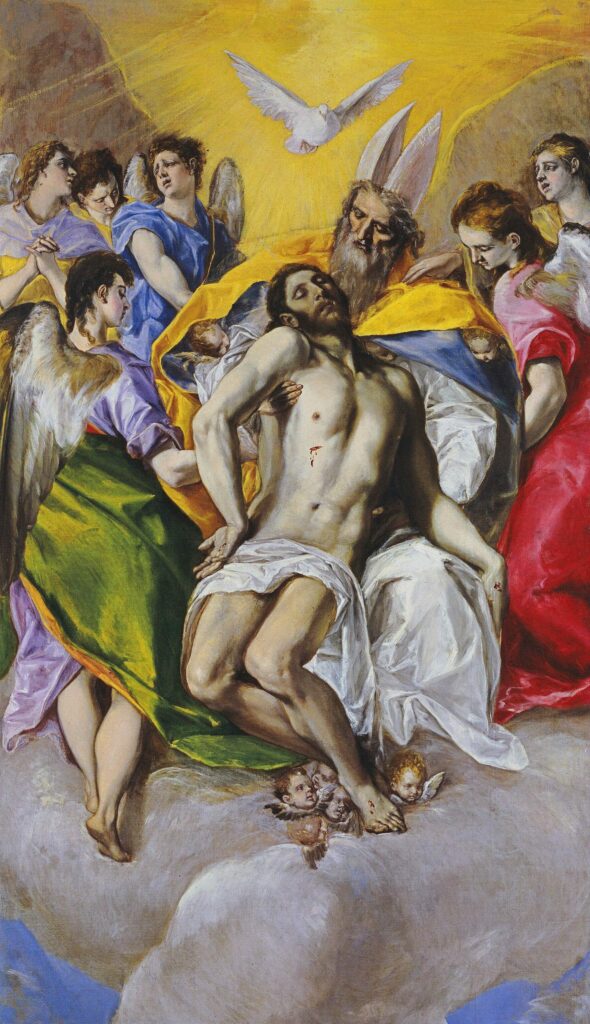
Artwork ex Wikimedia Commons