
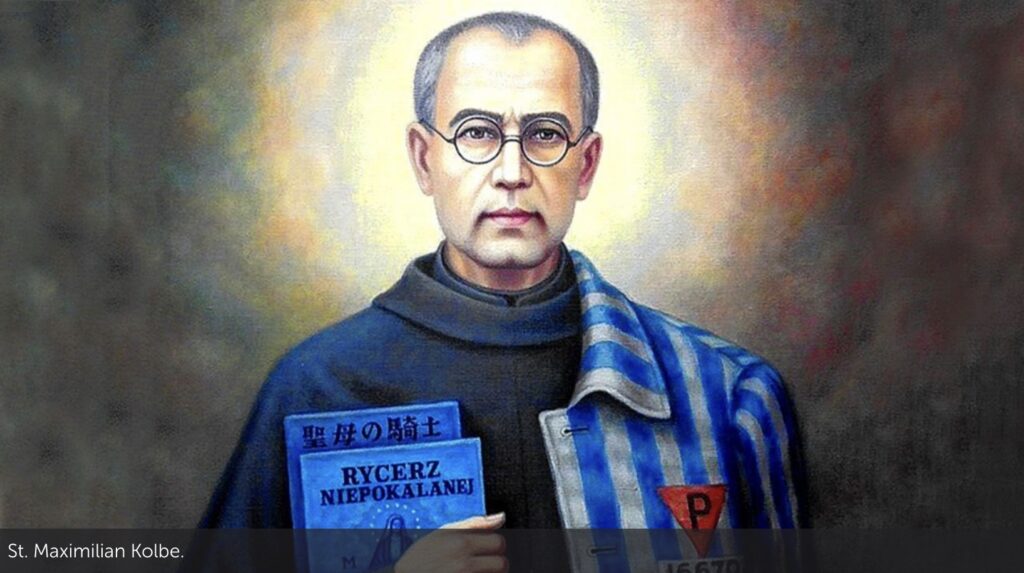
Gospel Reading : John 15:12-16
“This is my commandment, that you love one another as I have loved you. Greater love has no man than this, that a man lay down his life for his friends. You are my friends if you do what I command you.
No longer do I call you servants, for the servant does not know what his master is doing; but I have called you friends, for all that I have heard from my Father I have made known to you.
You did not choose me, but I chose you and appointed you that you should go and bear fruit and that your fruit should abide; so that whatever you ask the Father in my name, he may give it to you.
What do the Fathers say?
Pope St JOHN PAUL II . (Canonization Homily of St. Maximilian Kolbe on October 10 1982)
Greater love has no man than this, that a man lay down his life for his friends.
“From today on, the Church desires to address as ‘Saint’ a man who was granted the grace of carrying out these words of the Redeemer in an absolutely literal manner. For towards the end of July, 1941, when the camp commander ordered the prisoners destined to die of starvation to fall in line, this man-Maximilian Maria Kolbe-spontaneously came forward and declared himself ready to go to death in the place of one of them. This readiness was accepted and, after more than two weeks of torment caused by starvation, Father Maximilian’s life was ended with a lethal injection on August 14, 1941”.
“All this happened in the concentration camp at Auschwitz where during the last war some four million people were put to death, including the Servant of God, Saint Edith Stein (the Carmelite Sister Teresa Benedicta of the Cross).
Disobedience to God-the Creator of life who said, “Thou shalt not kill”-caused in that place the immense holocaust of so many innocent persons. And so at the same time, our age has thus been horribly stigmatized by the slaughter of the innocent”.
Father Maximilian Kolbe, himself a prisoner of the concentration camp, defended in that place of death an innocent man’s right to life. Father Kolbe defended his right to life, declaring that he was ready to go to death in the man’s place, because he was the father of a family and his life was necessary for his dear ones.
Father Kolbe thus reaffirmed the Creator’s exclusive right over innocent human life. He bore witness to Christ and to love. For the Apostle John writes: “By this we know love, that he laid down his life for us. And we ought to lay down our lives for the brethren” (1 John 3:16).
Pope St GREGORY the Great. But when all our Lord’s sacred discourses are full of His commandments, why does He give this special commandment respecting love? Love and love only is the fulfilment of every thing that is required.
As all the branches of a tree proceed from one root, so all the virtues are produced from one love: nor has the branch, i. e. the good work, any life, unless it abides in the root of love.
The highest, the only proof of love, is to love our adversary; as did the Truth Himself.
Greater love has no man than this, that a man lay down his life for his friends. Our Lord came to die for His enemies, but He says that He is going to lay down His life for His friends, to show us that by loving, we are able to gain over our enemies, so that they who persecute us are by anticipation our friends.
But whoso in time of tranquillity will not give up his time to God, how in persecution will he give up his soul? Let the virtue of love then, that it may be victorious in tribulation, be nourished in tranquillity by deeds of mercy.
St AUGUSTINE. But this love is distinguished from men’s love for each other, by adding, As I have loved you.
They who love one another for the sake of having God within them, they truly love one another.
Having said, This is My commandment, that you love one another, even as I have loved you, it follows, as John says in his Epistle, that as Christ laid down His life for us, so we should lay down our lives for the brethren. (1 John 3) This the martyrs have done with ardent love. And therefore in commemorating them at Christ’s table, we do not pray for them, as we do for others, but we rather pray that we may follow their steps. For they have shown the same love for their brother, that has been shown them at the Lord’s table.
Sources:
Bible readings from the Revised Standard Version of the Bible, Second Catholic Edition, copyright © 2006 National Council of the Churches of Christ in the USA
Quotes of the Fathers from :
Thomas Aquinas’ Catena Aurea Translated by St John Henry Newman
Canonization Homily of St. Maximilian Kolbe by Pope John Paul II on October 10 1982 ; www.vatican.va
Artwork ex Wikimedia Commons