
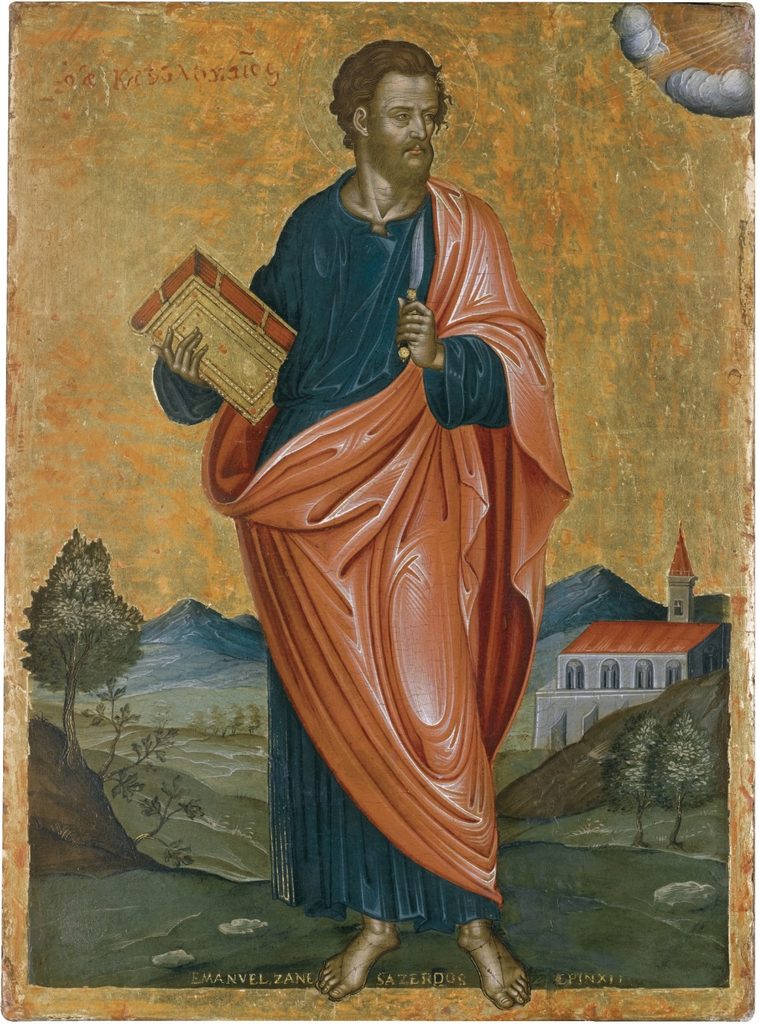
Gospel Reading : John 1:45-51
Philip found Nathan′a-el, and said to him, “We have found him of whom Moses in the law and also the prophets wrote, Jesus of Nazareth, the son of Joseph.”
Nathan′a-el said to him, “Can anything good come out of Nazareth?” Philip said to him, “Come and see.” Jesus saw Nathan′a-el coming to him, and said of him, “Behold, an Israelite indeed, in whom is no guile!”
Nathan′a-el said to him, “How do you know me?” Jesus answered him, “Before Philip called you, when you were under the fig tree, I saw you.”
Nathan′a-el answered him, “Rabbi, you are the Son of God! You are the King of Israel!” Jesus answered him, “Because I said to you, I saw you under the fig tree, do you believe? You shall see greater things than these.”
And he said to him, “Truly, truly, I say to you, you will see heaven opened, and the angels of God ascending and descending upon the Son of man.”
What do the Fathers say?
St John CHRYSOSTOM. Observe, He did not call them, before some had of their own accord joined Him: for had He invited them, before any had joined Him, perhaps they would have started back: but now having determined to follow of their own free choice, they remain firm ever after. He calls Philip, however, because he would be known to him, from living in Galilee. But what made Philip follow Christ? Andrew heard from John the Baptist, and Peter from Andrew; he had heard from no one; and yet on Christ saying, Follow Me, was persuaded instantly. It is not improbable that Philip may have heard John: and yet it may have been the mere voice of Christ which produced this effect.
St THEOPHYLACT. For the voice of Christ sounded not like a common voice to some, that is, the faithful, but kindled in their inmost soul the love of Him. Philip having been continually meditating on Christ, and reading the books of Moses, so confidently expected Him, that the instant he saw, he believed. Perhaps too he had heard of Him from Andrew and Peter, coming from the same district; an explanation which the Evangelist seems to hint at, when he adds, Now Philip was of Bethsaida, the city of Andrew and Peter.
St John CHRYSOSTOM. The power of Christ appears by His gathering fruit out of a barren country. For from that Galilee, out of which there had arisen no prophet, He takes His most distinguished disciples.
Philip is not persuaded himself, but begins preaching to others: Philip finds Nathanael, and says to him, We have found Him of whom Moses in the Law, and the Prophets, did write, Jesus of Nazareth, the Son of Joseph. See how zealous he is, and how constantly he is meditating on the books of Moses, and looking for Christ’s coming. That Christ was coming he had known before; but he did not know that this was the Christ, of whom Moses and the Prophets did write: He says this to give credibility to his preaching, and to show his zeal for the Law and the Prophets, and how he had examined them attentively. Be not disturbed at his calling our Lord the Son of Joseph; this was what He was supposed to be.
And Nathanael said unto him, Can there any good thing come out of Nazareth.
St AUGUSTINE. However you may understand these words, Philip’s answer will suit. You may read it either as affirmatory, Something good can come out of Nazareth; to which the other says, Come and see: or you may read it as a question, implying doubt on Nathanael’s part, Can any good thing come out of Nazareth? Come and see. Since either way of reading agrees equally with what follows, we must inquire the meaning of the passage.
Nathanael was well read in the Law, and therefore the word Nazareth (Philip having said that he had found Jesus of Nazareth) immediately raises his hopes, and he exclaims, Something good can come out of Nazareth. He had searched the Scriptures, and knew, what the Scribes and Pharisees could not, that the Saviour was to be expected thence.
St John CHRYSOSTOM. OR Nathanael knew from the Scriptures, that Christ was to come from Bethlehem, according to the prophecy of Micah. On hearing of Nazareth, then, he doubted, and was not able to reconcile Philip’s tidings with prophecy.
Observe, however, the discretion and gentleness with which he communicates his doubts.
Philip said to him, Come and see. He takes him to Christ, knowing that when he had once tasted of His words and doctrine, he will make no more resistance.
Nathanael, in difficulty as to Christ coming out of Nazareth, showed the care with which he had read the Scriptures: his not rejecting the tidings when brought him, showed his strong desire for Christ’s coming. He thought that Philip might be mistaken as to the place. It follows, Jesus saw Nathanael coming to Him, and said of him, Behold an Israelite indeed, in whom is no guile! There was no fault to be found with him, though he had spoken like one who did not believe, because he was more deeply read in the Prophets than Philip. He calls him guileless, because he had said nothing to gain favour, or gratify malice.
St AUGUSTINE. What does this mean, In whom is no guile? Had he no sin? Was no physician necessary for him? Far from it. No one was ever born, of a temper not to need the Physician. It is guile, when we say one thing, and think another. How then was there no guile in him? Because, if he was a sinner, he confessed his sin; whereas if a man, being a sinner, pretends to be righteous, there is guile in his mouth. Our Lord then commended the confession of sin in Nathanael; He did not pronounce him not a sinner.
St John CHRYSOSTOM. That our Lord had penetrated into his mind, had not blamed but praised his hesitation, proved to Nathanael that He was the true Christ: Nathanael answered and said to Him, Rabbi, You are the Son of God, You are the King of Israel: as if he said, You are He who was expected, You are He who was sought for. Sure proof being obtained, he proceeds to make confession; herein showing his devotion, as his former hesitation had shewn his diligence.
Many when they read this passage, are perplexed at finding that, whereas Peter was pronounced blessed for having, after our Lord’s miracles and teaching, confessed Him to be the Son of God, Nathanael, who makes the same confession before, has no such benediction. The reason is this. Peter and Nathanael both used the same words, but not in the same sense. Peter confessed our Lord to be the Son of God, in the sense of very God; the latter in the sense of mere man; for after saying, You are the Son of God, he adds, You are the King of Israel; whereas the Son of God was not the King of Israel only, but of the whole world.
This is manifest from what follows. For in the case of Peter Christ added nothing, but, as if his faith were perfect, said, that he would build the Church upon his confession; whereas Nathanael, as if his confession were very deficient, is led up to higher things: Jesus answered and said unto him, “Because I said to you, I saw you under the fig tree, do you believe? You shall see greater things than these.” As if He said, What I have just said has appeared a great matter to you, and you have confessed Me to be King of Israel; what will you say when you see greater things than these?
What that greater thing is He proceeds to show: And he said to him, “Truly, truly, I say to you, you will see heaven opened, and the angels of God ascending and descending upon the Son of man.” See how He raises him from earth for a while, and forces him to think that Christ is not a mere man: for how could He be a mere man, whom angels ministered to? It was, as it were, saying, that He was Lord of the Angels; for He must be the King’s own Son, on whom the servants of the King descended and ascended; descended at His crucifixion, ascended at His resurrection and ascension. Angels too before this came and ministered to Him, and angels brought the glad tidings of His birth. Our Lord made the present a proof of the future. After the powers He had already shown, Nathanael would readily believe that much more would follow.
Sources:
Bible readings from the Revised Standard Version of the Bible, Second Catholic Edition, copyright © 2006 National Council of the Churches of Christ in the USA
Quotes of the Fathers from :
Thomas Aquinas’ Catena Aurea Translated by St John Henry Newman
Artwork ex Wikimedia Commons