First Reading : Proverbs 30:5-9
Every word of God proves true;
he is a shield to those who take refuge in him.
Do not add to his words,
lest he rebuke you, and you be found a liar.
Two things I ask of thee;
deny them not to me before I die:
Remove far from me falsehood and lying;
give me neither poverty nor riches;
feed me with the food that is needful for me
lest I be full, and deny thee,
and say, “Who is the Lord?”
or lest I be poor, and steal,
and profane the name of my God.
Gospel Reading : Luke 9:1-6
And he called the twelve together and gave them power and authority over all demons and to cure diseases, and he sent them out to preach the kingdom of God and to heal.
And he said to them, “Take nothing for your journey, no staff, nor bag, nor bread, nor money; and do not have two tunics.
And whatever house you enter, stay there, and from there depart.
And wherever they do not receive you, when you leave that town shake off the dust from your feet as a testimony against them.”
And they departed and went through the villages, preaching the gospel and healing everywhere.
What do the Fathers say?
About the First Reading:
St AMBROSE. The poor man and the rich man should therefore take heed, because there are temptations for the man of poverty as well as for the man of wealth. And so the wise man says, “Give me neither beggary nor riches.” He tells you how this can be obtained. Man has enough when he has a sufficiency, because a wealthy man tends to distend his mind with cares and anxieties, just as he gorges his stomach with rich food. For that reason the wise man prays that he may have what is necessary and adequate.… Shun and avoid, therefore, the temptations of the world, so that the poor may not despair and the rich may not grow proud.
St BASIL the Great. Solomon says, “Give me neither beggary nor riches; give me only what is necessary and sufficient,” lest being filled I should deny and say, Who sees me? Or being poor, I should steal and forswear the name of my God; thus representing riches as satiety, poverty as a complete lack of the necessities of life, and sufficiency as a state both free from want and without superfluity. Sufficiency varies, however, according to physical condition and present need.… In every case, care must be taken for a good table, yet without overstepping the limits of the actual need.
About the Gospel Reading:
St CYRIL OF ALEXANDRIA. It was fitting that those who were appointed the ministers of holy teaching should be able to work miracles, and by these very acts themselves be believed to be the ministers of God.
Mark here the divine power of the Son, which belongs not to a fleshly nature. For it was in the power of the saints to perform miracles not by nature, but by participation of the Holy Spirit; but it was altogether out of their power to grant this authority to others. For how could created natures possess dominion over the gifts of the Spirit? But our Lord Jesus Christ, as by nature God, imparts graces of this kind to whomsoever He will, not invoking upon them a power which is not His own, but infusing it into them from Himself.
St GREGORY NAZIANZEN. Now in sending His disciples to preach, our Lord enjoined many things on them, the chief of which are, that they should be so virtuous, so constant, so temperate, and, so heavenly, that no less through their manner of living than their words, the teaching of the Gospel might be spread abroad.
St AMBROSE. Of what kind then he ought to be who preaches the Gospel of the kingdom of God is marked out by these Gospel precepts; that is, he must not require the supports of secular aid; and clinging wholly to faith, he must believe that the less he requires those things, the more they will be supplied to him.
St THEOPHYLACT. For He sends them out as very beggars, so that He would have them neither carry bread, nor any thing else of which men are generally in want.
St AUGUSTINE. Or, the Lord did not wish the disciples to possess and carry with them these things, not that they were not necessary to the support of this life, but because He sent them thus to show that these things were due to them from those believers to whom they announced the Gospel, that so they might neither possess security, nor carry about with them the necessaries of this life, either great or little.
EUSEBIUS. But when the Lord had girded His disciples as soldiers of God with divine virtue and wise admonitions, sending them to the Jews as teachers and physicians, they went forth through the towns preaching the gospel, and healing everywhere.
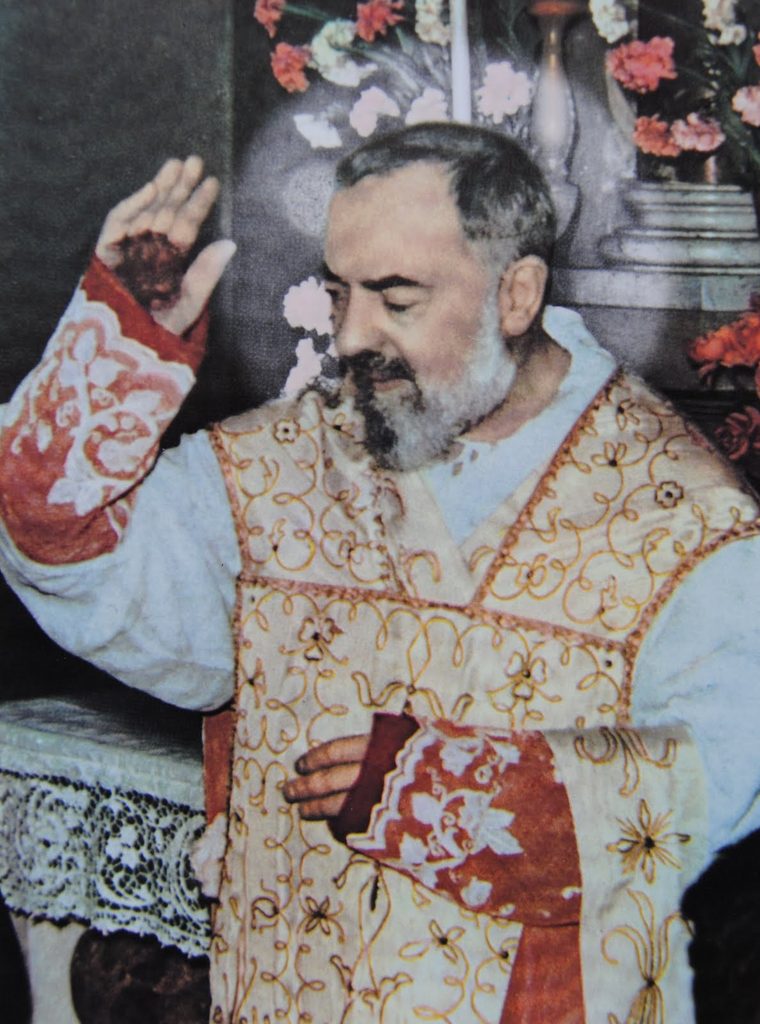
From the official Vatican Biography of Saint Pio of Pietrelcina published for his 2002 canonization:
Like the Apostle Paul, Padre Pio of Pietrelcina placed at the centre of his life and apostolic work the Cross of his Lord as his strength, his wisdom and his glory. Inflamed by love of Jesus Christ, he became like him in the sacrifice of himself for the salvation of the world. In his following and imitation of the Crucified Christ he was so generous and perfect that he could have said: “I have been crucified with Christ; it is no longer I who live, but Christ who lives in me” (Gal 2:20). And the treasures of grace which God had granted him so lavishly and unceasingly he passed on through his ministry, serving the men and women who came to him in ever greater numbers, and bringing to birth an immense host of spiritual sons and daughters.
This worthy follower of Saint Francis of Assisi was born on 25 May 1887 at Pietrelcina in the Archdiocese of Benevento, the son of Grazio Forgione and Maria Giuseppa De Nunzio. He was baptized the next day and given the name Francesco. At the age of twelve he received the Sacrament of Confirmation and made his First Holy Communion.
On 6 January 1903, at the age of sixteen, he entered the novitiate of the Capuchin Friars at Morcone, where on 22 January he took the Franciscan habit and the name Brother Pio. At the end of his novitiate year he took simple vows, and on 27 January 1907 made his solemn profession.
After he was ordained priest on 10 August 1910 at Benevento, he stayed at home with his family until 1916 for health reasons. In September of that year he was sent to the friary of San Giovanni Rotondo and remained there until his death.
Filled with love of God and love of neighbour, Padre Pio lived to the full his vocation to work for the redemption of man, in accordance with the special mission which marked his entire life and which he exercised through the spiritual direction of the faithful: the sacramental reconciliation of penitents and the celebration of the Eucharist. The pinnacle of his apostolic activity was the celebration of Holy Mass. The faithful who took part witnessed the summit and fullness of his spirituality.
For Padre Pio, faith was life: he willed everything and did everything in the light of faith. He was assiduously devoted to prayer. He passed the day and a large part of the night in conversation with God. He would say: “In books we seek God, in prayer we find him. Prayer is the key which opens God’s heart”. Faith led him always to accept God’s mysterious will.
He was always immersed in supernatural realities. Not only was he himself a man of hope and total trust in God, but by word and example he communicated these virtues to all who approached him.
He demonstrated to the full his love of neighbour by welcoming, for more than fifty years, countless people who had recourse to his ministry and his confessional, his counsel and his consolation. He was almost besieged: they sought him in church, in the sacristy, in the friary. And he gave himself to everyone, rekindling faith, dispensing grace, bringing light. But especially in the poor, the suffering and the sick he saw the image of Christ, and he gave himself particularly to them.
He exercised to an exemplary degree the virtue of prudence, acting and counselling in the light of God.
His concern was the glory of God and the good of souls. He treated everyone with justice, frankness and great respect.
The virtue of fortitude shone in him. He understood very early in life that his would be the way of the Cross, and he accepted it at once with courage and out of love. For many years, he experienced spiritual sufferings. For years he endured the pains of his wounds with admirable serenity.
When he had to submit to investigations and restrictions in his priestly ministry, he accepted everything with profound humility and resignation. In the face of unjust accusations and calumnies he remained silent, trusting always in the judgement of God, of his immediate superiors and of his own conscience.
His obedience was supernatural in intention, universal in its scope and complete in its execution. He lived the spirit of poverty with total detachment from self, from earthly goods, from his own comfort and from honours. He always had a great love for the virtue of chastity. His behaviour was modest in all situations and with all people.
He sincerely thought of himself as useless, unworthy of God’s gifts, full of weakness and infirmity, and at the same time blessed with divine favours. Amid so much admiration around him, he would say: “I only want to be a poor friar who prays”.
Sister Death took him well-prepared and serene on 23 September 1968 at the age of eighty-one.
Sources:
Bible readings from the Revised Standard Version of the Bible, Second Catholic Edition, copyright © 2006 National Council of the Churches of Christ in the USA
Quotes of the Fathers from :
Thomas Aquinas’ Catena Aurea Translated by St John Henry Newman
Catena Bible
Extract on St Padre Pio from the official Vatican Biography of Saint Pio of Pietrelcina published for his 2002 canonization.
Artwork ex Wikimedia Commons