6 October
Gospel Reading : Luke 9:57-62
As they were going along the road, a man said to him, “I will follow you wherever you go.”
And Jesus said to him, “Foxes have holes, and birds of the air have nests; but the Son of man has nowhere to lay his head.”
To another he said, “Follow me.” But he said, “Lord, let me first go and bury my father.” But he said to him, “Leave the dead to bury their own dead; but as for you, go and proclaim the kingdom of God.”
Another said, “I will follow you, Lord; but let me first say farewell to those at my home.” Jesus said to him, “No one who puts his hand to the plough and looks back is fit for the kingdom of God.”
What do the Fathers say?
Although the Almighty Lord is bountiful, He does not grant to every one absolutely and indiscriminately heavenly and divine gifts, but to those only who are worthy to receive them, who free themselves and their souls from the stains of wickedness. And this we are taught by the force of the angelic words, And it came to pass, that, us they went in the way, a certain man said unto him, Lord, I will follow thee. First indeed there is much tardiness implied in the manner of his coming. It is next shewn that he is filled with too great presumption. For he sought not to follow Christ simply as several others of the people, but rather caught at the honour of the Apostleship. Whereas Paul says, No one taketh the honour to himself but he that is called of God. (Heb. 5:4.)
In another respect also our Lord deservedly refuses them, for He taught that to follow the Lord, a man must take up his cross, and renounce the affection of this present life. And our Lord finding this lacking in him does not blame him, but corrects him.
The man’s father was probably borne down with years, and he thought he was doing an honourable act in proposing to pay the kind offices which were due to him, according to Exodus, Honour thy father and thy mother. (Exod. 20:12.)
Hence when calling him to the ministry of the Gospel, our Lord said, Follow me, he sought for a time of respite, which should suffice for the support of his decrepit father, saying, Permit me first to go and bury my father, not that he asked to bury his deceased father, for Christ would not have hindered the wish to do this, but he said, Bury, that is, support in old age even until death.
But the Lord said to him, Let the dead bury their dead. For there were other attendants also bound by the same tie of relationship,
but these I consider dead, because they had not yet believed Christ. Learn from this, that our duty to God is to be preferred to our love for our parents, to whom we show reverence, because through them have we been born.
But the God of all, when as yet we were not, brought us into being, our parents were made the ministers of our introduction.
Now this promise is worthy of our admiration and full of all praise, but to bid farewell to those who are at home, to get leave from them, shows that he was still somehow divided from the Lord, in that he had not yet resolved, to make this venture with his whole heart. For to wish to consult relations who would not agree to his proposal betokens one somewhat wavering. Wherefore our Lord condemns this, saying, No man, having put his hand to the plough, and looking back, is fit for the kingdom of God. He puts his hand to the plough who is ambitious to follow, yet looks back again who seeks an excuse for delay in returning home, and consulting with his friends.
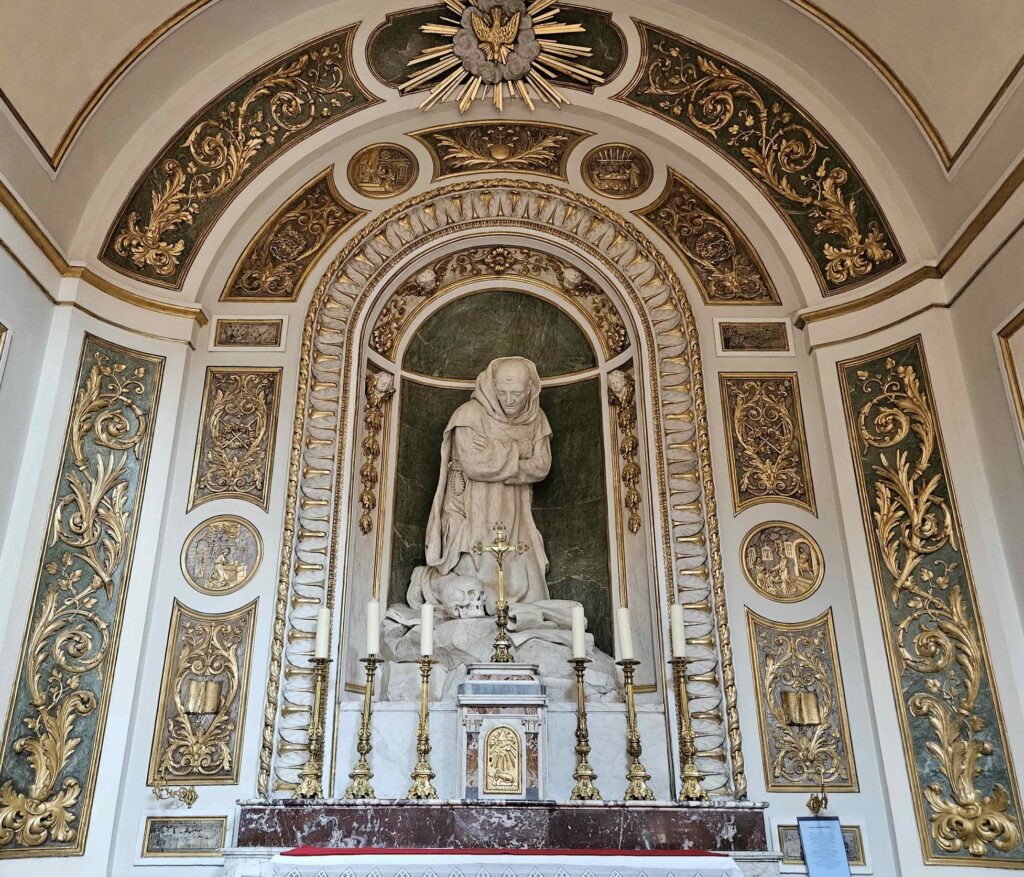
Saint Bruno of Cologne
Saint Bruno of Cologne (c. 1030 – October 6, 1101) was a medieval German priest, distinguished theologian, and the founder of the Carthusian Order (Ordo Cartusiensis). Renowned for combining absolute solitude with communal life, Bruno established one of the most austere and enduring contemplative traditions in Christian monasticism.
Early Life & Career at Reims (c. 1030–1080)
- Origins & Education: Born into a prominent family in Cologne (Holy Roman Empire), Bruno studied the liberal arts and theology at the cathedral school of Reims in France.
- Master of the School: Around 1056, he was appointed rector (scholasticus) of the Cathedral School of Reims, where he taught for nearly two decades. His students included prominent ecclesiastical figures, most notably Odo of Châtillon (the future Pope Urban II).
- Conflict with Archbishop Manasses: In 1075, Bruno was named chancellor of the Archdiocese of Reims. He soon came into direct conflict with the newly appointed Archbishop Manasses I, who was accused of simony and corruption. Bruno spoke out against Manasses, leading to the confiscation of Bruno’s offices and his temporary exile until Manasses was deposed by Pope Gregory VII in 1080.
- Renunciation of Worldly Honors: Offered the prestigious position of Archbishop of Reims following Manasses’s removal, Bruno declined the appointment, having already resolved to renounce academic and ecclesiastical honors in favor of a life of solitary prayer.
The Foundation of the Grande Chartreuse (1084)
Seeking true solitude, Bruno and six companions (four clerics and two laymen) traveled to the Diocese of Grenoble in southeastern France.
- Vision of Saint Hugh: According to Carthusian tradition, Bishop Hugh of Grenoble had a dream of seven stars guiding pilgrims to a wilderness. When Bruno and his six companions arrived, Hugh recognized the fulfillment of his vision and granted them a secluded site high in the Chartreuse Mountains.
- The First Monastery: In 1084, Bruno established the Grande Chartreuse. They constructed small individual cells connected by a cloister, with a church and refectory for shared liturgical services on feast days—creating a unique blend of eremitical (hermit) and cenobitic (community) monasticism.
Advisor to the Papacy & Calabrian Exile (1090–1101)
- Called to Rome: In 1090, Pope Urban II—Bruno’s former pupil—summoned Bruno to Rome to serve as a papal advisor amidst the turmoil of the Investiture Controversy. Bruno obeyed out of duty, leaving the Grande Chartreuse under the care of his companion Landuin.
- Refusal of the Archbishopric: Deeply unhappy in the papal court and yearning for contemplative silence, Bruno turned down an appointment as Archbishop of Reggio Calabria.
- Santo Stefano del Bosco: In 1091, Urban II allowed Bruno to return to the eremitical life in southern Italy. Count Roger I of Sicily granted him land in Calabria, where Bruno founded the monastery of Santo Stefano del Bosco (near modern Serra San Bruno).
Death & Unique Canonization Status
- Death: Bruno spent his final decade at Santo Stefano del Bosco, where he died in the presence of his brethren on October 6, 1101.
- Equipollent Canonization: True to the Carthusian spirit of humility and avoiding public acclaim, the order never formally pushed for a grandiose canonization process. In 1514, Pope Leo X granted the Carthusians permission to celebrate his feast day. In 1623, Pope Gregory XV extended his feast to the universal Church calendar via equivalent (equipollent) canonization.
Motto
- The Carthusian Motto: Stat crux dum volvitur orbis (“The Cross stands firm while the world turns”). It reflects the order’s focus on the unchangeable stability of Christ’s redemption amidst a chaotic world.
- Core Charism: Strict enclosure, silence, solitude, perpetual abstinence, and continuous prayer. The Carthusians famously hold the distinction in monastic history of never having required a major reform (“Cartusia nunquam reformata, quia nunquam deformata” — “The Chartreuse was never reformed because it was never deformed”).
Statutes of the Carthusian Order
The Carthusian Order is governed by the Statutes of the Carthusian Order, a collection of customs first compiled around 1121–1128 by Guigo I, the fifth prior of the Grande Chartreuse, under the title Consuetudines Cartusiae (Customs of the Chartreuse). Saint Bruno of Cologne left no written rule when founding the order in 1084; instead, the Statutes codify a unique semi-eremitic lifestyle—combining the solitude of desert hermits with a minimal communal framework.
Core Pillars of the Statutes
- Solitude and Enclosure: The cell is the center of Carthusian life. Monks spend the majority of their day alone in individual two-story hermitages (cells) containing a study, bedroom, workshop, and small walled garden. Monks do not leave the monastery enclosure except for a weekly communal walk.
- Continuous Silence: Silence is observed at almost all times to foster unbroken interior prayer. Speech is permitted only when strictly necessary for work, during emergency situations, or during designated communal recreation.
- Total Abstinence from Meat: Carthusians maintain a lifelong prohibition against eating any meat or poultry under any circumstances, even during sickness.
- Rejection of Pastoral Work: The order does not engage in active apostolates—such as parish ministry, teaching, or preaching—focusing exclusively on contemplative prayer and intercession for the world.
Division of Monastic Life
The Statutes divide the monastery into two complementary vocations:
- Choir Monks (Fathers): Priests or men preparing for the priesthood. They live almost entirely in their cells, devoting their time to the Divine Office, mental prayer, spiritual reading (lectio divina), study, and manual labor inside their cell’s workshop or garden.
- Lay Brothers (Brothers): Non-clerical monks who handle the physical upkeep, cooking, agricultural work, and maintenance of the monastery. While they also live in individual cells and observe strict silence, their day includes more manual labor outside the cell.
Daily Rhythm and Prayer Life
- The Midnight Office: Monks rise around 11:30 PM to pray the Office in their cells, then gather in the unheated church at midnight for Matins and Lauds. Sung in total or near-total darkness using traditional, unadorned Carthusian plainchant without musical instruments, this liturgy lasts between two and three hours.
- Offices in the Cell: The minor canonical hours (Prime, Terce, Sext, None, and Compline) are recited individually inside each monk’s cell at the sound of the monastery bells.
- Conventual Mass & Vespers: The monks gather daily in the church for the celebration of Conventual Mass and Vespers.
- Work and Study: Manual labor is mandatory to balance spiritual contemplation. Choir monks perform solitary work inside their cells (e.g., woodworking, bookbinding, gardening, translating), while brothers perform crafts and maintenance in the workshops (correrie).
Diet, Fasting, and Mortification
- The Turn (Guichet): On standard weekdays, meals are prepared by the lay brothers and delivered directly to each monk’s cell through a two-sided wooden turn in the wall, ensuring the monk does not see or speak to the person delivering food.
- Seasonal Fasting: From September 14 (Feast of the Exaltation of the Holy Cross) until Easter, monks eat only one full meal a day, plus a light collation of bread and drink in the evening.
- Friday Abstinence: Every Friday, monks fast on bread, water, and salt.
- Visitors and Family: Monks receive visits from immediate family members only once or twice a year for a couple of days. They do not use radio, television, or internet, receiving news of the outside world only through the Prior when necessary.
Sources:
Bible readings from the Revised Standard Version of the Bible, Second Catholic Edition, copyright © 2006 National Council of the Churches of Christ in the USA
Quotes of the Fathers from :
Thomas Aquinas’ Catena Aurea Translated by St John Henry Newman
Life of St Bruno:
Wikipedia
Artwork ex Wikimedia Commons