
5 October
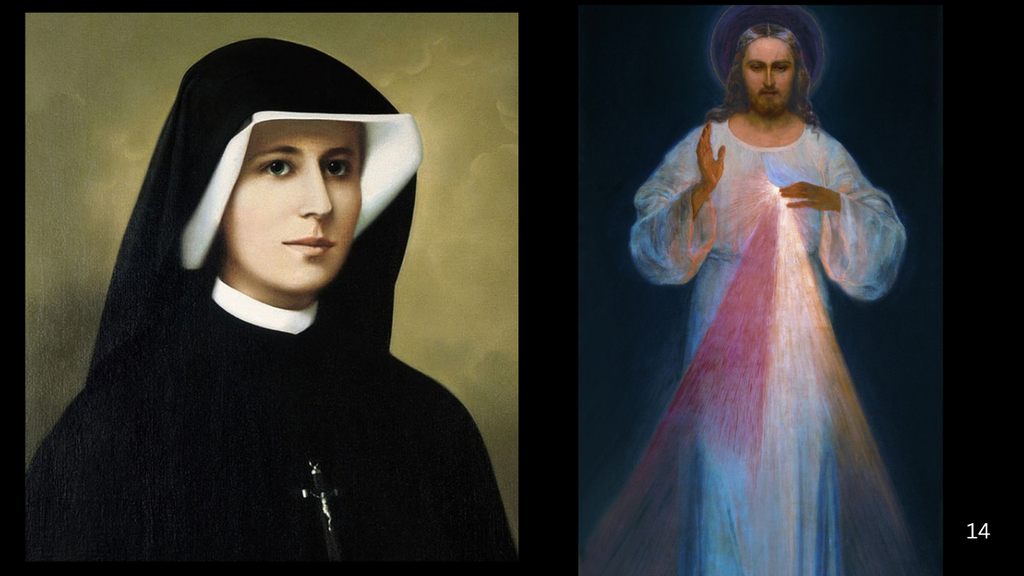
From the Diary of Saint Maria Faustina Kowalska
O Jesus, eternal Truth, our Life, I call upon You and I beg Your mercy for poor sinners.
O sweetest Heart of my Lord, full of pity and unfathomable mercy, I plead with You for poor sinners.
O Most Sacred Heart, Fount of Mercy from which gush forth rays of inconceivable graces upon the entire human race, I beg of You light for poor sinners.
O Jesus, be mindful of Your own bitter Passion and do not permit the loss of souls redeemed at so dear a price of Your most precious Blood.
O Jesus, when I consider the great price of Your Blood, I rejoice at its immensity,
for one drop alone would have been enough for the salvation of all sinners.
Although sin is an abyss of wickedness and ingratitude, the price paid for us can never be equalled. Therefore, let every soul trust in the Passion of the Lord, and place its hope in His mercy.
God will not deny His mercy to anyone.
Heaven and earth may change, but God’s mercy will never be exhausted.
Oh, what immense joy burns in my heart when I contemplate Your incomprehensible goodness, O Jesus!
I desire to bring all sinners to Your feet that they may glorify Your mercy throughout endless ages.
Gospel Reading : Matthew 11:25-30
At that time Jesus declared, “I thank thee, Father, Lord of heaven and earth, that thou hast hidden these things from the wise and understanding and revealed them to babes; yea, Father, for such was thy gracious will.
All things have been delivered to me by my Father; and no one knows the Son except the Father, and no one knows the Father except the Son and any one to whom the Son chooses to reveal him.
Come to me, all who labour and are heavy laden, and I will give you rest. Take my yoke upon you, and learn from me; for I am gentle and lowly in heart, and you will find rest for your souls. For my yoke is easy, and my burden is light.”
What do the Fathers say?
St JEROME. He gives thanks that His coming has opened to the Apostles sacraments, which the Scribes and Pharisees knew not, who seemed to themselves wise, and understanding in their own eyes.
St John CHRYSOSTOM. When He says, The wise, He does not speak of true wisdom, but of that which the Scribes and Pharisees seemed to have by their speech.
He did not say, ‘And have revealed them to the foolish,’ but, to babes, that is, the uneducated, or the simple; teaching us in all things to keep ourselves from pride, and to seek humility.
St HILARY. The hidden things of heavenly words and their power are hid from the wise, and revealed to babes; babes, that is, in malice, not in understanding; hid from the wise because of their presumption of their own wisdom, not because of true wisdom.
Pope St GREGORY the Great. Here we have a lesson in humility, that we should not rashly presume to discuss the counsels of heaven concerning the calling of some, and the rejection of others showing that that cannot be unrighteous which is willed by Him that is righteous.
Saint Maria Faustina Kowalska of the Blessed Sacrament (born Helena Kowalska; August 25, 1905 – October 5, 1938) was a Polish religious sister and mystic whose personal visions of Jesus Christ gave rise to the modern Catholic devotion to the Divine Mercy. Known as the “Secretary of Divine Mercy,” her writings and spiritual experiences form one of the most widely practiced devotions in the Catholic Church today.
Early Life & Call to Vocation (1905–1925)
- Origins: Born in the village of Głogowiec (near Łódź, Poland) as the third of ten children in a poor, deeply religious peasant family.
- Early Piety: She felt a call to religious life from the age of seven, but her parents initially refused permission due to a lack of funds for her convent dowry. She worked as a domestic servant for several years to support herself and her family.
- The Łódź Vision: In 1924, while at a dance park in Łódź, she experienced a vision of a suffering Jesus covered in wounds, who asked her: “How long shall I put up with you and how long will you keep putting Me off?” She immediately left for Warsaw to seek entrance into a religious community.
- Religious Profession: On August 1, 1925, she was accepted into the Congregation of the Sisters of Our Lady of Mercy in Warsaw. She took her final vows on May 1, 1933, receiving the name Sister Maria Faustina.
Revelations of the Divine Mercy (1931–1938)
Serving as a cook, gardener, and doorkeeper in various convents (primarily in Płock, Vilnius, and Kraków), Faustina lived an outwardly simple life while experiencing profound mystical visions, locutions, stigmata (hidden), and interior trials.
- The Płock Vision (1931): On February 22, 1931, while in her cell at the convent in Płock, Jesus appeared to her wearing a white garment, with two large rays radiating from His heart—one red (symbolizing blood and the life of souls) and one pale (symbolizing water and justification). He instructed her to paint an image according to this vision with the signature: “Jesus, I Trust in You” (Jezu, ufam Tobie).
- Fr. Michał Sopoćko: In 1933, she met Father Michał Sopoćko in Vilnius, who became her spiritual director and confessor. Sopoćko commissioned the Polish painter Eugeniusz Kazimirowski to paint the first version of the Divine Mercy image in 1934, based on Faustina’s direct descriptions. Sopoćko also instructed her to record her visions and interior dialogues in a notebook.
Core Pillars of the Devotion
Through Saint Faustina, four key elements of the Divine Mercy devotion were established:
- The Divine Mercy Image: A visual embodiment of Christ’s mercy flowing from the Sacred Heart, meant to be venerated as a channel of grace.
- The Feast of Divine Mercy: A request that the First Sunday after Easter (Divine Mercy Sunday) be solemnly dedicated to God’s mercy, with the promise of complete forgiveness of sins and punishment for those who go to Confession and receive Holy Communion on that day.
- The Chaplet of Divine Mercy: A prayer offered using standard rosary beads, focusing on offering the Body, Blood, Soul, and Divinity of Christ to the Father in atonement for the sins of the whole world.
- The Hour of Great Mercy: Veneration of Christ’s Passion at 3:00 PM daily, the hour of His death on the Cross.
Illness, Spiritual Diary, & Death
- Suffering: Faustina suffered severely from pulmonary and intestinal tuberculosis. She accepted her illness as a sacrificial offering for the salvation of sinners and the renewal of the Church.
- Diary: Divine Mercy in My Soul: Written under obedience between 1934 and 1938, her 600-page Diary documents her spiritual journey, mystical experiences, and theological reflections on the infinite nature of God’s mercy.
- Death: She died at the convent infirmary in Kraków-Łagiewniki on October 5, 1938, at the age of 33.
Canonization & Universal Legacy
- Intervention of Karol Wojtyła: As Archbishop of Kraków, Cardinal Karol Wojtyła (later Pope John Paul II) initiated the informative process into her life in 1965. In 1978, the Vatican lifted an earlier temporary prohibition on her writings that had resulted from faulty Italian translations of her Diary.
- Beatification & Canonization: Beatified on April 18, 1993, and canonized on April 30, 2000, by Pope John Paul II in Rome. She became the first canonized saint of the 21st century.
- Divine Mercy Sunday: During her canonization Mass, Pope John Paul II officially instituted the Feast of Divine Mercy on the General Roman Calendar for the universal Church on the Second Sunday of Easter.
- Liturgical Feast: Celebrated on October 5 (Optional Memorial). Her shrine in Kraków-Łagiewniki remains one of the premier international pilgrimage destinations in Europe.
From the Homily of Pope St John Paul II at the canonization mass of Saint Faustina on 30 April 2000 :
Today my joy is truly great in presenting the life and witness of Sr Faustina Kowalska to the whole Church as a gift of God for our time. By divine Providence, the life of this humble daughter of Poland was completely linked with the history of the 20th century, the century we have just left behind. In fact, it was between the First and Second World Wars that Christ entrusted his message of mercy to her. Those who remember, who were witnesses and participants in the events of those years and the horrible sufferings they caused for millions of people, know well how necessary was the message of mercy.
Jesus told Sr Faustina: “Humanity will not find peace until it turns trustfully to divine mercy” (Diary, p. 132). Through the work of the Polish religious, this message has become linked for ever to the 20th century, the last of the second millennium and the bridge to the third. It is not a new message but can be considered a gift of special enlightenment that helps us to relive the Gospel of Easter more intensely, to offer it as a ray of light to the men and women of our time.
What will the years ahead bring us? What will man’s future on earth be like? We are not given to know. However, it is certain that in addition to new progress there will unfortunately be no lack of painful experiences. But the light of divine mercy, which the Lord in a way wished to return to the world through Sr Faustina’s charism, will illumine the way for the men and women of the third millennium.
However, as the Apostles once did, today too humanity must welcome into the upper room of history the risen Christ, who shows the wounds of his Crucifixion and repeats: Peace be with you! Humanity must let itself be touched and pervaded by the Spirit given to it by the risen Christ. It is the Spirit who heals the wounds of the heart, pulls down the barriers that separate us from God and divide us from one another, and at the same time, restores the joy of the Father’s love and of fraternal unity.
Sr Faustina Kowalska wrote in her Diary: I feel tremendous pain when I see the sufferings of my neighbours. All my neighbours’ sufferings reverberate in my own heart; I carry their anguish in my heart in such a way that it even physically destroys me. I would like all their sorrows to fall upon me, in order to relieve my neighbour”
This is the degree of compassion to which love leads, when it takes the love of God as its measure!
It is this love which must inspire humanity today, if it is to face the crisis of the meaning of life, the challenges of the most diverse needs and, especially, the duty to defend the dignity of every human person. Thus the message of divine mercy is also implicitly a message about the value of every human being. Each person is precious in God’s eyes; Christ gave his life for each one; to everyone the Father gives his Spirit and offers intimacy.
This consoling message is addressed above all to those who, afflicted by a particularly harsh trial or crushed by the weight of the sins they committed, have lost all confidence in life and are tempted to give in to despair. To them the gentle face of Christ is offered; those rays from his heart touch them and shine upon them, warm them, show them the way and fill them with hope. How many souls have been consoled by the prayer “Jesus, I trust in you”, which Providence intimated through Sr Faustina! This simple act of abandonment to Jesus dispels the thickest clouds and lets a ray of light penetrate every life.
And you, Faustina, a gift of God to our time, a gift from the land of Poland to the whole Church, obtain for us an awareness of the depth of divine mercy; help us to have a living experience of it and to bear witness to it among our brothers and sisters. May your message of light and hope spread throughout the world, spurring sinners to conversion, calming rivalries and hatred and opening individuals and nations to the practice of brotherhood. Today, fixing our gaze with you on the face of the risen Christ, let us make our own your prayer of trusting abandonment and say with firm hope: Christ Jesus, I trust in you! Jezu, ufam tobie!
Sources:
Bible readings from the Revised Standard Version of the Bible, Second Catholic Edition, copyright © 2006 National Council of the Churches of Christ in the USA
Quotes of the Fathers from :
Thomas Aquinas’ Catena Aurea Translated by St John Henry Newman
Extracts from the Canonisation mass for St Faustina by St Pope John Paul II on 30 April 2000
Life and quotes of St Faustina –
The diary of St Faustina and
Wikipedia
Wikipedia
Artwork ex Wikimedia Commons