
4 October
Saint of the day:
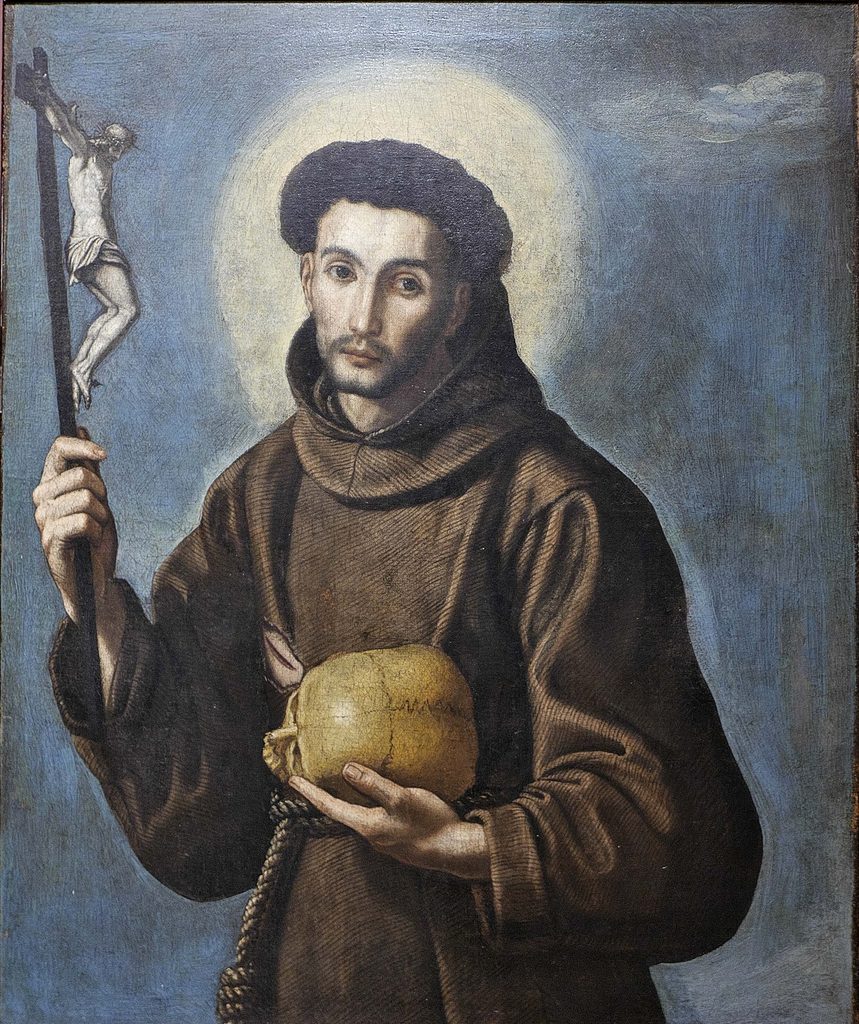
Saint Francis of Assisi
First Reading : Isaiah 5:1-7
Let me sing for my beloved
a love song concerning his vineyard:
My beloved had a vineyard
on a very fertile hill.
He dug it and cleared it of stones,
and planted it with choice vines;
he built a watchtower in the midst of it,
and hewed out a wine vat in it;
and he looked for it to yield grapes,
but it yielded wild grapes.
And now, O inhabitants of Jerusalem
and men of Judah,
judge, I pray you, between me
and my vineyard.
What more was there to do for my vineyard,
that I have not done in it?
When I looked for it to yield grapes,
why did it yield wild grapes?
And now I will tell you
what I will do to my vineyard.
I will remove its hedge,
and it shall be devoured;
I will break down its wall,
and it shall be trampled down.
I will make it a waste;
it shall not be pruned or hoed,
and briers and thorns shall grow up;
I will also command the clouds
that they rain no rain upon it.
For the vineyard of the Lord of hosts
is the house of Israel,
and the men of Judah
are his pleasant planting;
and he looked for justice,
but behold, bloodshed;
for righteousness,
but behold, a cry!
Psalm 80
Thou didst bring a vine out of Egypt;
thou didst drive out the nations and plant it.
Thou didst clear the ground for it;
it took deep root and filled the land.
Why then hast thou broken down its walls,
so that all who pass along the way pluck its fruit?
The boar from the forest ravages it,
and all that move in the field feed on it.
Turn again, O God of hosts!
Look down from heaven, and see;
have regard for this vine,
the stock which thy right hand planted.
They have burned it with fire,
they have cut it down;
may they perish at the rebuke of thy countenance!
Then we will never turn back from thee;
give us life,
and we will call on thy name!
Restore us, O Lord God of hosts!
let thy face shine, that we may be saved!
Gospel Reading :Matthew 21:33-43
“Hear another parable. There was a householder who planted a vineyard, and set a hedge around it, and dug a wine press in it, and built a tower, and let it out to tenants, and went into another country.
When the season of fruit drew near, he sent his servants to the tenants, to get his fruit; and the tenants took his servants and beat one, killed another, and stoned another. Again he sent other servants, more than the first; and they did the same to them.
Afterward he sent his son to them, saying, ‘They will respect my son.’
But when the tenants saw the son, they said to themselves, ‘This is the heir; come, let us kill him and have his inheritance.’
And they took him and cast him out of the vineyard, and killed him.
When therefore the owner of the vineyard comes, what will he do to those tenants?”
They said to him, “He will put those wretches to a miserable death, and let out the vineyard to other tenants who will give him the fruits in their seasons.”
Jesus said to them, “Have you never read in the scriptures:
‘The very stone which the builders rejected
has become the head of the corner;
this was the Lord’s doing,
and it is marvellous in our eyes’?
Therefore I tell you, the kingdom of God will be taken away from you and given to a nation producing the fruits of it.
What do the Fathers say?
St JEROME. He has planted a vine of which Isaiah speaks, The vine of the Lord of Hosts is the house of Israel. (Isa. 5:7.) And hedged it round about; i. e. either the wall of the city, or the guardianship of Angels.
PSEUDO-CHRYSOSTOM. Or, by the hedge understand the protection of the holy fathers, who were set as a wall round the people of Israel.
ORIGEN. Or, the hedge which God set round his people was His own Providence; and the winepress was the place of offerings.
St HILARY. Or, He set forth the Prophets as it were winepresses, into which an abundant measure of the Holy Spirit, as of new wine, might flow in a teeming stream.
St John CHRYSOSTOM. He calls the Prophets servants, who as the Lord’s Priests offer the fruits of the people, and the proofs of their obedience in their works. But the tenants took his servants, and beat one, and killed another, and stoned another.
St JEROME. Beat them, as Jeremiah, killed them, as Isaiah, stoned them, as Naboth and Zacharias, whom they slew between the temple and the altar.
PSEUDO-CHRYSOSTOM. At each step of their wickedness the mercy of God was increased, and at each step of the Divine mercy the wickedness of the Jews increased; thus there was a strife between human wickedness and Divine goodness.
St HILARY. By the Son sent at last, is denoted the advent of our Lord.
PSEUDO-CHRYSOSTOM. He did not send Him as the bearer of a sentence of punishment against the guilty, but of an offer of repentance; He sent Him to put them to shame, not to punish them.
St John CHRYSOSTOM. Or He speaks as declaring what ought to be; they ought to reverence Him; thus shewing that their sin was great, and void of all excuse.
ORIGEN. ‘This is the heir; come, let us kill him and have his inheritance.’, was fulfilled in those who saw Christ, and knew Him to be the Son of God, yet crucified Him.
St RABANUS. This manifestly proves that the rulers of the Jews crucified the Son of God, not through ignorance, but through jealousy. For they understood that it was He to whom the Father speaks by the Prophet, Ask of me, and I shall give thee the heathen for thine inheritance (Ps. 2:8.)
The inheritance given to the Son is the holy Church; an inheritance not left Him by His Father when dying, but wonderfully purchased by His own death.
Or, The Jews endeavoured by putting Him to death to seize upon the inheritance, when they strove to overthrow the faith which is through Him, and to substitute their own righteousness which is by the Law, and therewith to imbue the Gentiles. It follows, And they caught him, and cast him out of the vineyard, and slew him.
St HILARY. Christ was cast out of Jerusalem, as out of the vineyard, to His sentence of punishment.
ORIGEN. Or, what He says, And cast him out of the vineyard, seems to me to be this; As far as they were concerned they judged Him a stranger both to the vineyard, and the tenants. When therefore the Lord of the vineyard comes, what will he do to those tenants?
St JEROME. The Lord asks them not as though He did not know what they would answer, but that they might be condemned by their own answer.
ORIGEN. Like Caiaphas (John 11:49) so did they, not from themselves, prophesy against themselves, that the oracles of God were to he taken from them, and given to the Gentiles, who could bring forth fruit in due season.
St GREGORY Nazianzen. Far be it from me that I should ever, among other chastisements, be thus reproached by Him Who is good, because of my own contrariness: May I not become the vine of the beloved, which after being planted and entrenched, and made sure with a fence and tower and every means which was possible, when it ran wild, was consequently despised, and had its tower broken down and its fence taken away, and was not pruned nor dug, but was devoured and laid waste and trodden down by all! Isaiah 5:1
Sources:
Bible readings from the Revised Standard Version of the Bible, Second Catholic Edition, copyright © 2006 National Council of the Churches of Christ in the USA
Quotes of the Fathers from :
Thomas Aquinas’ Catena Aurea Translated by St John Henry Newman
Select Orations of Saint Gregory Nazianzen.
Artwork ex Wikimedia Commons