
17 October
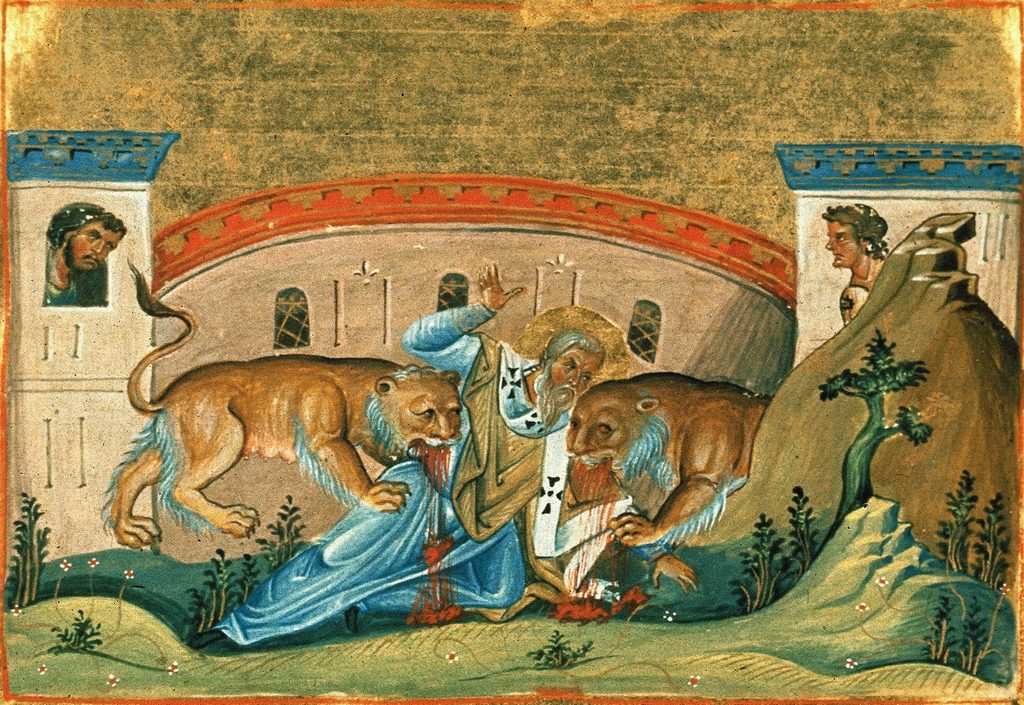
Ignatius of Antioch
Despite his central role in early Christianity, virtually nothing is known about the early life, family, or personal background of Saint Ignatius of Antioch (c. 35–108 AD). The primary historical details regarding his life focus almost entirely on his tenure as the Bishop of Antioch and the final months leading to his martyrdom in Rome.
Name and Origins
- The Name “Theophorus”: In all seven of his surviving epistles, Ignatius introduces himself as Ignatios ho kai Theophoros (“Ignatius, who is also called Theophorus”). This epithet translates to “God-bearer” or “one who carries God,” reflecting his deep personal desire to bear Christ within himself.
- Early Syrian Origins: He was born in the Roman province of Syria around the middle of the 1st century (c. 35–50 AD). However, a pious medieval legend claimed he was the small child Jesus placed in the midst of the disciples in Matthew 18:2–4.
Episcopate in Antioch
- Successor of the Apostles: Early Church historians—most notably Eusebius of Caesarea (Historia Ecclesiastica) and Saint Jerome (De Viris Illustribus)—record that Ignatius served as the third Bishop of Antioch, following Saint Peter and his immediate successor, Evodius.
- Apostolic Tradition: According to Saint John Chrysostom and Theodoret, Ignatius was personally acquainted with and ordained by the Apostles themselves, specifically Saint Peter and Saint John.
- Leading the Syrian Church: He governed the church in Antioch during a period when the community was navigating persecution from the Roman authorities as well as internal theological friction regarding Docetism and Judaizing tendencies.
Arrest, Journey, and Martyrdom
Almost everything known about Ignatius’s personality and theology comes from the short period between his arrest in Antioch and his execution in Rome during the reign of Emperor Trajan (c. 98–117 AD).
- Condemnation and Custody: Condemned to death in Antioch for refusing to sacrifice to Roman gods, Ignatius was placed under guard by a unit of ten Roman soldiers—whom he colorfully described as “leopards” (Letter to the Romans, 5:1)—to be transported overland across Asia Minor to Rome.
- Journey to Rome: His military escort traveled through Asia Minor, stopping at ports such as Smyrna and Troas. Along the way, representatives from nearby Christian communities came to meet him. During these stops, Ignatius penned his Seven Epistles (six addressed to the churches of Ephesus, Magnesia, Tralles, Rome, Philadelphia, and Smyrna, and one personal letter to Saint Polycarp).
- Martyrdom: Upon arriving in Rome around 107–108 AD, Ignatius was brought into the arena (traditionally believed to be the Flavian Amphitheater / Colosseum) and torn apart by wild beasts (damnatio ad bestias).
- Feast Day: Celebrated on October 17 in the Roman Rite and December 20 in the Eastern Orthodox Tradition.
Ignatius of Antioch according to Pope Benedict XVI
The list of his letters, have come down to us from the Church of the first century as a precious treasure. In reading these texts one feels the freshness of the faith of the generation which had still known the Apostles. In these letters, the ardent love of a saint can also be felt.
No Church Father has expressed the longing for union with Christ and for life in him with the intensity of Ignatius. We therefore read the Gospel passage on the vine, which according to John’s Gospel is Jesus. In fact, two spiritual “currents” converge in Ignatius, that of Paul, straining with all his might for union with Christ, and that of John, concentrated on life in him. In turn, these two currents translate into the imitation of Christ, whom Ignatius several times proclaimed as “my” or “our God”.
One can perceive in these words on fire with love, the pronounced Christological “realism” typical of the Church of Antioch, more focused than ever on the Incarnation of the Son of God and on his true and concrete humanity: “Jesus Christ”, St Ignatius wrote to the Smyrnaeans, “was truly of the seed of David”, “he was truly born of a virgin”, “and was truly nailed [to the Cross] for us”.
Ignatius’ irresistible longing for union with Christ was the foundation of a real “mysticism of unity”.
For Ignatius unity was first and foremost a prerogative of God, who, since he exists as Three Persons, is One in absolute unity. Ignatius often used to repeat that God is unity and that in God alone is unity found in its pure and original state. Unity to be brought about on this earth by Christians is no more than an imitation as close as possible to the divine archetype.
Overall, it is possible to grasp in the Letters of Ignatius a sort of constant and fruitful dialectic between two characteristic aspects of Christian life: on the one hand, the hierarchical structure of the Ecclesial Community, and on the other, the fundamental unity that binds all the faithful in Christ.
Ignatius of Antioch from his letter to the Romans
For it is not my desire to act towards you as a man-pleaser, but as pleasing God, even as also you please Him. For neither shall I ever have such [another] opportunity of attaining to God; nor will you, if you shall now be silent, ever be entitled to the honour of a better work. For if you are silent concerning me, I shall become God’s; but if you show your love to my flesh, I shall again have to run my race. Pray, then, do not seek to confer any greater favour upon me than that I be sacrificed to God while the altar is still prepared; that, being gathered together in love, you may sing praise to the Father, through Christ Jesus, that God has deemed me, the bishop of Syria, worthy to be sent for from the east unto the west. It is good to set from the world unto God, that I may rise again to Him.
Ignatius of Antioch from Eusebius’ History of the Church
Chapter 36. Ignatius and His Epistles.
1. At that time Polycarp, a disciple of the apostles, was a man of eminence in Asia, having been entrusted with the episcopate of the church of Smyrna by those who had seen and heard the Lord.
2. And at the same time Papias, bishop of the parish of Hierapolis, became well known, as did also Ignatius, who was chosen bishop of Antioch, second in succession to Peter, and whose fame is still celebrated by a great many.
3. Report says that he was sent from Syria to Rome, and became food for wild beasts on account of his testimony to Christ.
4. And as he made the journey through Asia under the strictest military surveillance, he fortified the parishes in the various cities where he stopped by oral homilies and exhortations, and warned them above all to be especially on their guard against the heresies that were then beginning to prevail, and exhorted them to hold fast to the tradition of the apostles. Moreover, he thought it necessary to attest that tradition in writing, and to give it a fixed form for the sake of greater security.
5. So when he came to Smyrna, where Polycarp was, he wrote an epistle to the church of Ephesus, in which he mentions Onesimus, its pastor; and another to the church of Magnesia, situated upon the Mæander, in which he makes mention again of a bishop Damas; and finally one to the church of Tralles, whose bishop, he states, was at that time Polybius.
6. In addition to these he wrote also to the church of Rome, entreating them not to secure his release from martyrdom, and thus rob him of his earnest hope. In confirmation of what has been said it is proper to quote briefly from this epistle.
7. He writes as follows: From Syria even unto Rome I fight with wild beasts, by land and by sea, by night and by day, being bound amidst ten leopards that is, a company of soldiers who only become worse when they are well treated. In the midst of their wrongdoings, however, I am more fully learning discipleship, but I am not thereby justified.
8. May I have joy of the beasts that are prepared for me; and I pray that I may find them ready; I will even coax them to devour me quickly that they may not treat me as they have some whom they have refused to touch through fear. And if they are unwilling, I will compel them. Forgive me.
9. I know what is expedient for me. Now do I begin to be a disciple. May nothing of things visible and things invisible envy me; that I may attain unto Jesus Christ. Let fire and cross and attacks of wild beasts, let wrenching of bones, cutting of limbs, crushing of the whole body, tortures of the devil — let all these come upon me if only I may attain unto Jesus Christ.
10. These things he wrote from the above-mentioned city to the churches referred to. And when he had left Smyrna he wrote again from Troas to the Philadelphians and to the church of Smyrna; and particularly to Polycarp, who presided over the latter church. And since he knew him well as an apostolic man, he commended to him, like a true and good shepherd, the flock at Antioch, and besought him to care diligently for it.
11. And the same man, writing to the Smyrnæans, used the following words concerning Christ, taken I know not whence: But I know and believe that he was in the flesh after the resurrection. And when he came to Peter and his companions he said to them, Take, handle me, and see that I am not an incorporeal spirit. And immediately they touched him and believed.
12. Irenæus also knew of his martyrdom and mentions his epistles in the following words: As one of our people said, when he was condemned to the beasts on account of his testimony unto God, I am God’s wheat, and by the teeth of wild beasts am I ground, that I may be found pure bread.
13. Polycarp also mentions these letters in the epistle to the Philippians which is ascribed to him. His words are as follows: I exhort all of you, therefore, to be obedient and to practice all patience such as you saw with your own eyes not only in the blessed Ignatius and Rufus and Zosimus, but also in others from among yourselves as well as in Paul himself and the rest of the apostles; being persuaded that all these ran not in vain, but in faith and righteousness, and that they are gone to their rightful place beside the Lord, with whom also they suffered. For they loved not the present world, but him that died for our sakes and was raised by God for us.
14. And afterwards he adds: You have written to me, both you and Ignatius, that if any one go to Syria he may carry with him the letters from you. And this I will do if I have a suitable opportunity, either I myself or one whom I send to be an ambassador for you also.
15. The epistles of Ignatius which were sent to us by him and the others which we had with us we sent to you as you gave charge. They are appended to this epistle, and from them you will be able to derive great advantage. For they comprise faith and patience, and every kind of edification that pertains to our Lord.
Sources:
Catholic Encyclopaedia
Wikipedia
Pope Benedict XVI General audience of 14/03/2007
Eusebius’ History of the Church
Letters of St Ignatius
Artwork ex Wikimedia Commons