
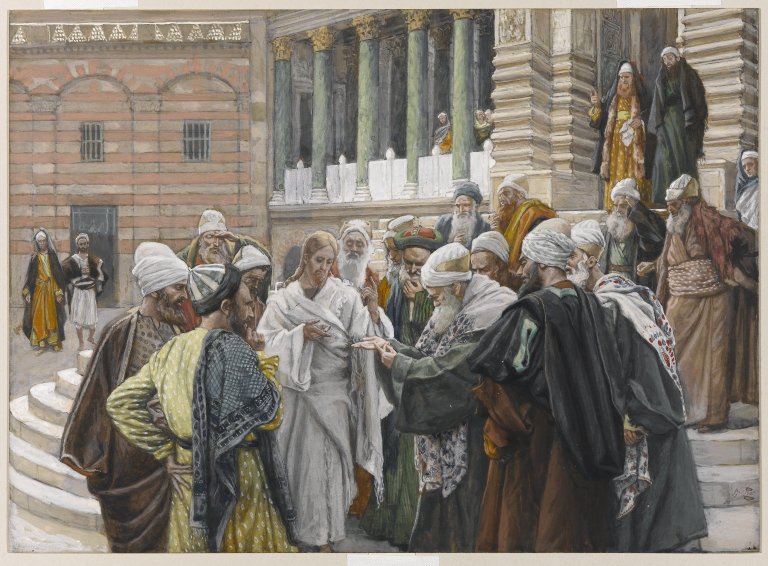
Gospel Reading : Matthew 22:15-21
Then the Pharisees went and took counsel how to entangle him in his talk.
And they sent their disciples to him, along with the Hero′di-ans, saying, “Teacher, we know that you are true, and teach the way of God truthfully, and care for no man; for you do not regard the position of men.
Tell us, then, what you think. Is it lawful to pay taxes to Caesar, or not?”
But Jesus, aware of their malice, said, “Why put me to the test, you hypocrites? Show me the money for the tax.”
And they brought him a coin.
And Jesus said to them, “Whose likeness and inscription is this?”
They said, “Caesar’s.”
Then he said to them, “Render therefore to Caesar the things that are Caesar’s, and to God the things that are God’s.” When they heard it, they marvelled; and they left him and went away.
What do the Fathers say?
Cornelius a Lapide’s in his Great Commentary explains this passage:
“They laid a plot by means of a dilemma,” says St. Augustine that whichever He should choose of its two horns, He might be caught. If He answered that it was lawful, (to pay the taxes) He would be a traitor to the people of God; but if He said it was not lawful, He would be punished as an enemy to Cæsar.
The Herodians were a Jewish sect, who favoured the Roman Cæsar, and the payment of tribute to him. They were named from the first Herod of Ascalon(the Great)of the infanticide, who was entirely devoted to Cæsar, inasmuch as he had been made king of Judea by Augustus Cæsar and the Roman Senate.
St. Jerome These Herodians were Jewish sectaries, or heretics, who held that Herod of Ascalon was the Messiah or Christ promised by the prophets, because they saw that in him the sceptre had failed from Judah. Herod eagerly encouraged these flatterers. And the reason why he slew the infants at Bethlehem was that he might kill Christ, that no one but himself might be accounted Christ. For the same reason, he built a most magnificent temple for the Jews, vieing with that of Solomon.
St John Chrysostom. “By means of flattery they hope to urge Him on to boldness, that He might say something against the existing institutions, and the existing state of things;” “that He might come into collision with Cæsar on a charge of rebellion.”
About this time one Judas, of Galilee, had taught that it was not lawful for the Jews to be in subjection to the Romans, and pay them taxes. Now Christ and the Apostles were regarded as Galilæans; and the Jews professed to look upon them as upholders of this teaching of Judas the Galilæan, as being their countryman.
St. Jerome “I think,” says he, “this precept was given by the Apostle, because at that time the teaching of Judas the Galilæan was still in vogue, and had many followers. Among their other tenets, they held it probable that, according to the law, no one ought to be called lord, except God only; and that those who paid tithes to the Temple ought not to render tribute to Cæsar. This sect increased to so great an extent as to influence a great part of the Pharisees as well as the rest of the people, so that they referred this question about the lawfulness of paying tribute to Cæsar to our Lord, who answered prudently and cautiously.
“The prime virtue,” says St. Jerome, “in one who gives an answer is to know the mind of him who asks the question.”
the Romans were in the habit of striking off coins of such weight and value as they required to be paid in the way of tribute, and of greater or less value, according to the necessity of times and requirements. The coins are wont to be stamped with the name and image of the prince who coins them.
Then Jesus replies- As though He said, “Since ye, O ye Jews, are now subject to Cæsar, and use his coins, do ye not so much give or restore to him the denarius which is due to him as tribute. But spiritual things, that is to say, worship and piety, give ye to God. For this God exacts as what is rightly His due. So shall it come to pass that you will offend neither against God nor Cæsar.”
Observe: that Christ is here unwilling to enter into the question whether the Jews were justly or unjustly subjects and tributaries of the Romans.
For this was a doubtful question. For prima facie, the negative, that they were not justly subject, would seem the more correct. For Pompey, who first reduced the Jews under the Roman yoke, was only called in by Hyrcanus and Aristobulus, the grandsons of Simon the high priest, to decide between them which of the two was to succeed to the Jewish sovereignty and high-priesthood. By what right then did Pompey pass them over, and transfer the sovereign power over Judea to the Romans? For this is Turkish justice. For when the Turk is called in to aid them by Christian princes quarrelling between themselves, he seizes upon and enslaves both. And yet, if we examine what happened more carefully, we shall perceive that the contrary proposition is the more probable, namely, that Pompey seized upon Judea by the right of a just war. For when Pompey had justly decided in favour of Hyrcanus, as being the elder, his younger brother, Aristobulus, atacked Jerusalem, and filled it with his soldiers, who fought against both Pompey and Hyrcanus. Then Pompey took Jerusalem by storm, and made it subject, with the consent of Hyrcanus, to the Roman yoke. Hyrcanus being unable to keep it by himself, delivered it to Pompey, with the consent of the elders and nobles of the Jews, who preferred to be subject to the Romans rather than to Hyrcanus and Aristobulus. For they saw that without the Romans, the Jewish state would be annihilated by schisms and seditions.
Prescription was on the side of the Romans, for they had been in peaceful possession of Judea for about a hundred years, with at least the tacit assent of the Jewish people. And without doubt the position of the possessor is the stronger.
For the Pharisees, in propounding this question about the payment of tribute to the Romans, did not put forward the plea of justice, but of religion and piety; that is to say, that it was neither lawful nor becoming that they, who were the alone people of God, should pay tribute to Cæsar, a Gentile and a heathen. They do not ask, “Are we bound to pay tribute to Cæsar?” but, “Is it lawful to pay tribute to Cæsar?” And they imply that to do so was contempt of God, a disgrace to the Jews, and an injury to their religion. Christ answers, on the contrary, that it was not an injury to God and the faith, nor an indignity to a faithful nation, if the people of God were subject to Cæsar, a Gentile; and that the Jews themselves might both profitably and honourably obey both God and a Gentile prince, if they would but render to both their due; and if they would do this with prudence, so as to arouse against them neither God nor Cæsar, and so destroy their whole nation, as they did not long afterwards. For it is better to pay money than to lose life and everything.
Give to Cæsar the tribute which he rightly exacts from you to sustain the burdens of the state, and especially to maintain soldiers to defend you against the attacks of enemies. But give God also the tribute — tithes, oblations, victims, as St Jerome says, such as are prescribed in Leviticus, which He, by the right of supreme dominion, demands of you as His creatures, and as faithful to Him. “Because,” says Origen, “a man renders to Cæsar what belongs to Cæsar, it is not a hindrance to him in rendering to God what belongs to God.” The rights which belong to Cæsar are different from those which belong to God. Political obligations are not adverse to religion; neither is religion adverse to political duties.
St. Augustine rightly applies these words to vows, and those who make vows. “Whosoever thinks well of what he may vow to God, and what vowing pay, let him vow and render himself. This is required, and this is due. Let Cæsar’s image be rendered to Cæsar, God’s image to God.
They marvelled at the wisdom of Christ, who thus easily extricated Himself from the snare which to the Pharisees seemed so impossible of escape, and twisted it round their own necks, who had laid it, according to the words of the Psalm, “In their own net which they laid privily is their foot taken.”
Sources:
Bible readings from the Revised Standard Version of the Bible, Second Catholic Edition, copyright © 2006 National Council of the Churches of Christ in the USA
Quotes of the Fathers from
Cornelius à Lápide’s Great Commentary Translated By Thomas W. Mossman, Assisted By Various Scholars, London 1887
Artwork ex Wikimedia Commons