
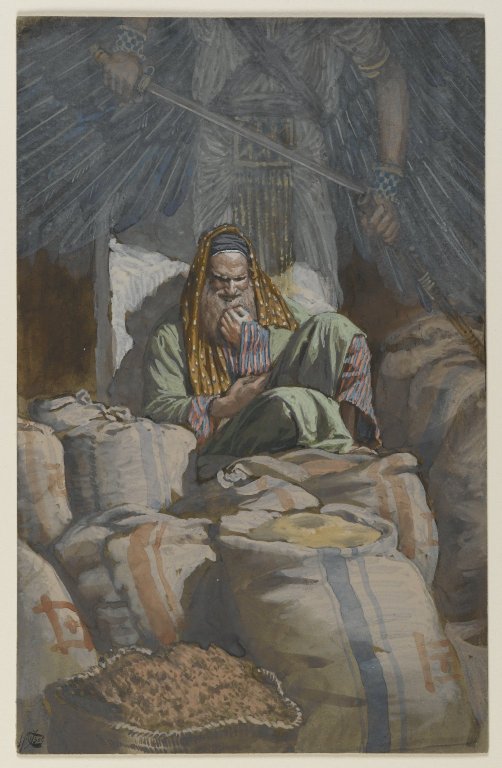
Gospel Reading : Luke 12:13-21
One of the multitude said to him, “Teacher, bid my brother divide the inheritance with me.” But he said to him, “Man, who made me a judge or divider over you?”
And he said to them, “Take heed, and beware of all covetousness; for a man’s life does not consist in the abundance of his possessions.”
And he told them a parable, saying, “The land of a rich man brought forth plentifully; and he thought to himself, ‘What shall I do, for I have nowhere to store my crops?’ And he said, ‘I will do this: I will pull down my barns, and build larger ones; and there I will store all my grain and my goods. And I will say to my soul, Soul, you have ample goods laid up for many years; take your ease, eat, drink, be merry.’
But God said to him, ‘Fool! This night your soul is required of you; and the things you have prepared, whose will they be?’ So is he who lays up treasure for himself, and is not rich toward God.”
What do the Fathers say?
The Venerable BEDE. He takes occasion from this foolish petitioner to fortify both the multitudes and His disciples alike by precept and example against the plague of covetousness.
He said to them, Take heed, and beware of all covetousness; and he says, of all, because some things seem to be honestly done, but the internal judge decides with what intention they are done.
St BASIL the Great. Not indeed about to reap any good from his plenty of fruits, but that the mercy of God might the more appear, which extends its goodness even to the bad; sending down His rain upon the just and the unjust.
But what are the things wherewith this man repays his Benefactor? He remembered not his fellow-creatures, nor deemed that he ought to give of his superfluities to the needy. His barns indeed bursting from the abundance of his stores, yet was his greedy mind by no means satisfied.
His complaint is like that of the poor. Does not the man oppressed with want say, What shall I do, whence can I get food, whence clothing? Such things also the rich man utters. For his mind is distressed on account of his fruits pouring out from his storehouse, lest perchance when they have come forth they should profit the poor; like the glutton who had rather burst from eating, than give any thing of what remains to the starving.
It was easy for him to say, I will open my barn, I will call together the needy, but he has no thought of want, only of amassing; Pull down your barns, from which no one receives comfort.
He adds, I will build greater. But when you have completed these, will you again destroy them? What is more foolish than labouring on for ever.
But you will say, Whom do I wrong by keeping what is my own?
Tell me what is yours, where did you get it and bring it into life?
For if every one receiving what is sufficient for his own necessity would leave what remains to the needy, there would be no rich or poor.
But if you confess that those things have come to you from God, is God then unjust in distributing to us unequally. Why do you abound while another begs? unless that you should gain the rewards of a good stewardship.
Are you not a robber, for counting as your own what you have received to distribute? It is the bread of the famished which you have received, the garment of the naked which rots in your possession, the money of the pennyless which you have buried in the earth.
You are so careless with respect to the goods of the soul, that you ascribe the things of the body to the soul. But because you are altogether carnal and subject to the passions, you speak from your belly, not from your soul.
He was permitted to deliberate in every thing, and to manifest his purpose, that he might receive a sentence such as his inclinations deserved.
But while he speaks in secret, his words are weighed in heaven, from whence the answers come to him. For it follows, But God said to him, ‘Fool! This night your soul is required of you. Hear the name of folly, which most properly belongs to you which not man has imposed, but God Himself.
Sources:
Bible readings from the Revised Standard Version of the Bible, Second Catholic Edition, copyright © 2006 National Council of the Churches of Christ in the USA
Quotes of the Fathers from
Thomas Aquinas’ Catena Aurea Translated by St John Henry Newman
Artwork ex Wikimedia Commons