
Second Reading : Philippians 2:1-11
So if there is any encouragement in Christ, any incentive of love, any participation in the Spirit, any affection and sympathy, complete my joy by being of the same mind, having the same love, being in full accord and of one mind.
Do nothing from selfishness or conceit, but in humility count others better than yourselves.
Let each of you look not only to his own interests, but also to the interests of others.
Have this mind among yourselves, which was in Christ Jesus, who, though he was in the form of God, did not count equality with God a thing to be grasped, but emptied himself, taking the form of a servant, being born in the likeness of men.
And being found in human form he humbled himself and became obedient unto death, even death on a cross.
Therefore God has highly exalted him and bestowed on him the name which is above every name, that at the name of Jesus every knee should bow, in heaven and on earth and under the earth, and every tongue confess that Jesus Christ is Lord, to the glory of God the Father.
Gospel Reading : Matthew 21:28-32
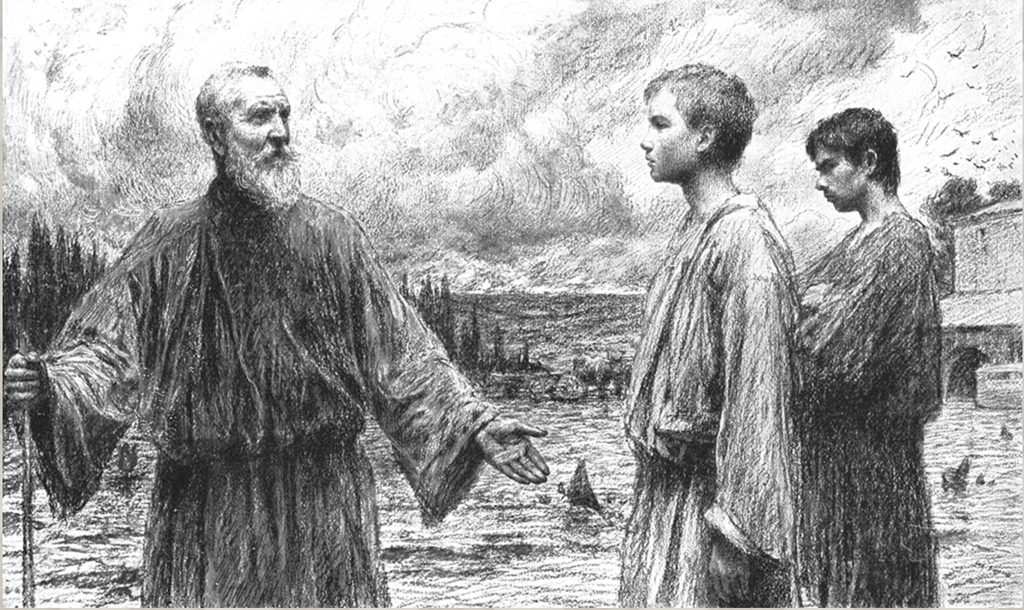
“What do you think? A man had two sons; and he went to the first and said, ‘Son, go and work in the vineyard today.’ And he answered, ‘I will not’; but afterward he repented and went.
And he went to the second and said the same; and he answered, ‘I go, sir,’ but did not go. Which of the two did the will of his father?” They said, “The first.” Jesus said to them, “Truly, I say to you, the tax collectors and the harlots go into the kingdom of God before you.
For John came to you in the way of righteousness, and you did not believe him, but the tax collectors and the harlots believed him; and even when you saw it, you did not afterward repent and believe him.
What do the Fathers say?
About the Second Reading:
St John Chrysostom. Our Lord Jesus Christ, when exhorting His disciples to great actions, places before them Himself, and the Father, and the Prophets, as examples.
This too the blessed Paul did; in exhorting them to humility, he brought forward Christ.
Attend, I entreat you, and rouse yourselves. For as a sharp two-edged sword, wheresoever it falls, though it be among ten thousand phalanxes, easily cuts through and destroys, because it is sharp on every side, and nought can bear its edge; so are the words of the Spirit.
Rouse yourselves then to behold so great a spectacle, so many armies falling by one stroke, lest the pleasure of such a sight should escape you.
How much greater will the pleasure be here, when by the grace of God we overthrow at once and in a body the combinations and devilish machinations of all heresies?
About the Gospel Reading:
PSEUDO-CHRYSOSTOM. Those who are to be judged in this cause, He applies to as judges, that condemning themselves they might be shown to be unworthy. It is high confidence of the justness of a cause, that will entrust it to the decision of an adversary. But He veils the allusion to them in a parable, that they might not perceive that they were passing sentence upon themselves;
A certain man had two sons. Who is He but God, who created all men, who being by nature Lord of all, yet would rather be loved as a father, than feared as a Lord.
The elder son was the Gentile people, the younger the Jews.
St JEROME. But when, at the coming of the Saviour, the Gentile people, having done penitence, laboured in God’s vineyard, and atoned by their labour for the obstinacy of their refusal, this is what is said, But afterward he repented, and went. The second son is the Jewish people who made answer to Moses, All that the Lord hath said unto us we will do. (Exod. 24:3.)
PSEUDO-CHRYSOSTOM. But afterwards turning their backs, they lied to God. The Lord asks which of them did the will of his father? They say, The first. See how they have passed sentence upon themselves, saying, that the elder son, that is, the Gentile people, did the will of his father. For it is better not to promise righteousness before God, and to do it, than to promise, and to fail.
ORIGEN. We may gather, that in this parable the Lord spoke to such as promise little or nothing, but in their works shine forth; and against those who promise great things but do none of these things that they have promised.
St RABANUS. The kingdom of God may be understood of the Gentiles, or of the present Church, in which the Gentiles go before the Jews, because they were more ready to believe.
John came preaching the way of righteousness, because he pointed to Christ, who is the fulfilling of the Law.
St JEROME. Others think that the parable does not relate to Gentiles and Jews, but simply to the righteous and to sinners. These by their evil deeds had rejected God’s service, but after received from John the baptism of repentance; while the Pharisees who made a show of righteousness, and boasted that they did the law of God, despising John’s baptism, did not follow his precepts.
Sources:
Bible readings from the Revised Standard Version of the Bible, Second Catholic Edition, copyright © 2006 National Council of the Churches of Christ in the USA
Quotes of the Fathers from :
Thomas Aquinas’ Catena Aurea Translated by St John Henry Newman
Artwork ex Wikimedia Commons