28 September
Saints of the Day:
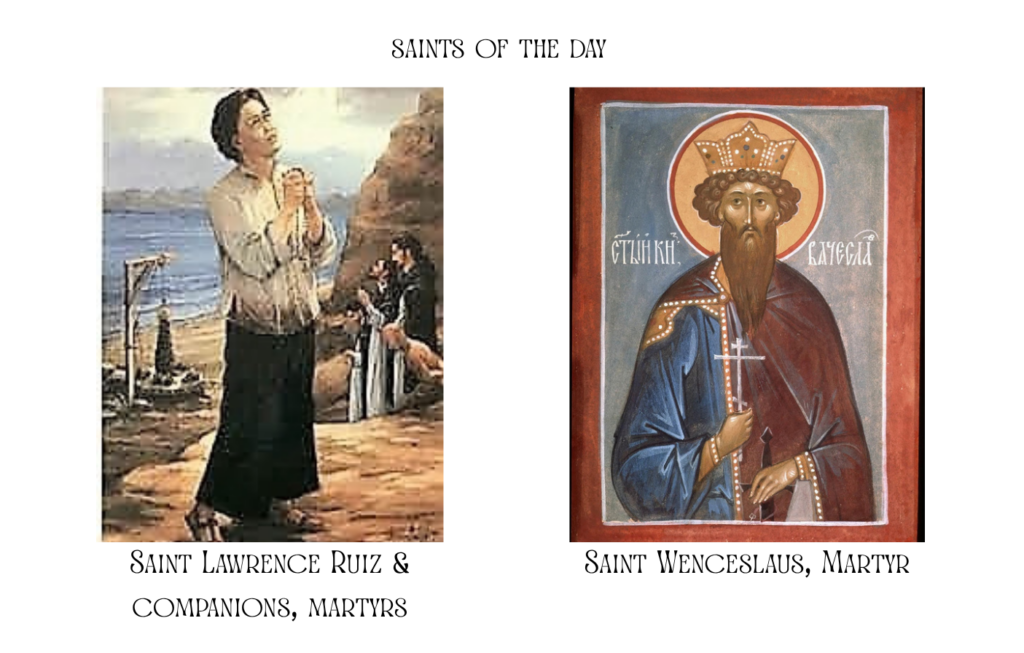
Saint Lawrence Ruiz and companions, Martyrs
Saint Wenceslaus, Martyr
Gospel Reading : Luke 9:46-50
And an argument arose among them as to which of them was the greatest.
But when Jesus perceived the thought of their hearts, he took a child and put him by his side, and said to them, “Whoever receives this child in my name receives me, and whoever receives me receives him who sent me; for he who is least among you all is the one who is great.”
John answered, “Master, we saw a man casting out demons in your name, and we forbade him, because he does not follow with us.”
But Jesus said to him, “Do not forbid him; for he that is not against you is for you.”
What do the Fathers say?
St CYRIL OF ALEXANDRIA. The devil lays plots of various kinds for them that love the best way of life. And if indeed by carnal allurements he can gain possession of a man’s heart, He sharpens his love of pleasure; but if a man has escaped these snares, he excites in him a desire of glory, and this passion for vain-glory had seized some of His apostles.
For to have such thoughts, belongs to him who desires to be superior to the rest; but I think it improbable that all the disciples gave way to this weakness; and therefore suppose that the Evangelist, not to seem to lay the charge to any individual, expresses himself indefinitely, saying, that there arose an argument among them.
St THEOPHYLACT. Now it seems that this feeling was excited by the circumstance of their not being able to cure the demoniac. And while they were disputing thereupon, one said, It was not owing to my weakness, but another’s, that he could not be cured; and so thereby was kindled a strife among them, which was the greatest.
The Venerable BEDE. Or, because they saw Peter, James, and John, taken apart to the mount, and the keys of the kingdom of heaven promised to Peter, they were angry that these three, or Peter, should have precedence over all.
St CYRIL OF ALEXANDRIA. But our Lord, Who knew how to save, seeing in the hearts of the disciples the thought that had risen up plucks it up by the roots before it received growth. For when passions first begin in us, they are easily subdued; but having gained strength, they are with difficulty eradicated. Let him who thinks Jesus to be mere man, know that he has erred; for the Word, although made flesh, remained God. For it is God alone Who is able to search into the heart . But in taking a child, and placing it beside Him, He did it for the Apostles’ sake and ours. For the disease of vain-glory feeds generally on those who have the preeminence among other men.
But a child has a pure mind and unspotted heart, and abides in simplicity of thought; he courts not honours, nor knows the limits of each one’s power, nor shuns seeming to be inferior to others, bearing no moroseness in his mind or heart. Such the Lord embraces and loves, and thinks them worthy to be near Him, as those who had chosen to taste of the things which are His; for He says, Learn of me, for I am meek and lowly of heart. Hence it follows, And he says unto them, Whosoever shall receive a child in my name, receiveth me. As if He were to say, Seeing that there is one and the same reward to those that honour the saints, whether perchance such an one be the least, or one distinguished for honours and glory, for in him is Christ received, how vain is it to seek to have the preeminence?
Now He still more plainly conveys the meaning of the preceding words, saying, For he that is least among you all, the same shall be great; in which He speaks of the modest man who from honesty thinks nothing high of himself.
But we ought to consider not so much the worker of the miracles, as the grace which was in him, who, by the power of Christ, performed miracles. But what if there should be both those which be numbered together with the Apostles, and those who are crowned with the grace of Christ; there are many diversities in Christ’s gifts. But because the Saviour had given the Apostles power to cast out evil spirits, (Matt. 10:8.) they thought no one else but themselves alone was permitted to have this privilege granted to him, and therefore they come to enquire if it were lawful for others also to do this.
Saints of the Day:
Saint Wenceslaus (Václav, c. 907 – September 28, 935/936 AD) was the Duke of Bohemia, a devout Christian monarch, and a martyr who became the primary patron saint of the Czech nation.
Early Life & Reign
- Christian Upbringing: Raised primarily by his pious grandmother, Saint Ludmila, Wenceslaus was educated in Latin and Old Church Slavonic and developed a deep personal devotion to the Eucharist and works of mercy.
- Accession to Power: After his father, Duke Vratislaus I, died in battle, in 921, Wenceslaus’s mother, Drahomíra, assumed regency. Opposed to the growing Christian influence, Drahomíra ordered the assassination of Saint Ludmila.
- The Assumption of Power: Following Saint Ludmila’s assassination in September 921, Drahomíra ruled as regent for nearly three years. In early 924, Wenceslaus officially came of age, dissolved the regency, and assumed full ducal authority over Bohemia.
- The Banishment: As one of his first official acts, Wenceslaus held his mother accountable for the murder of his grandmother Ludmila. He banished Drahomíra from the ducal court in Prague, exiling her to the stronghold of Budeč.
- Subsequent Reconciliation: True to his Christian devotion and desire for domestic stability, Wenceslaus eventually recalled his mother from exile a few years later. She was permitted to return to court in an honorable capacity, but was permanently stripped of all political authority and state influence.
- Charitable Rule: Known for personal humility, he frequently visited prisons, paid the ransoms of enslaved debt-slaves, planted vineyards to make altar wine, and founded the original Church of St. Vitus at Prague Castle.
- Foreign Policy: To protect Bohemia from German invasion, he submitted to King Henry the Fowler of East Francia, securing peace and establishing alliances that favored further Christianization.
Martyrdom
Wenceslaus’s submission to Henry the Fowler and his Christian policies generated severe opposition among anti-Christian Bohemian nobles and his ambitious younger brother, Boleslaus “the Cruel.”
- The Plot: In September 935 (or 936), Boleslaus invited Wenceslaus to his estate at Stará Boleslav under the pretense of celebrating the Feast of Saints Cosmas and Damian.
- The Assassination: On the morning of September 28, as Wenceslaus was walking to morning mass, Boleslaus attacked him. After Wenceslaus disarmed his brother, Boleslaus’s co-conspirators rushed in and struck down the Duke at the church doors. His final words were reported as: “In God’s hands I commit my spirit.”
Liturgical Veneration & Patronage
- Feast Day: September 28 (Optional Memorial in the General Roman Calendar; State Holiday and Solemnity in the Czech Republic).
- Repentance & Relics: Grief and public outrage followed Wenceslaus’s death. Boleslaus later repented, converted, and translated Wenceslaus’s body to St. Vitus Cathedral in Prague, where his tomb remains a major pilgrimage site.
- Patronage: Patron saint of the Czech Republic, Bohemia, Prague, brewers, and peacemakers.
Cultural Significance: “Good King Wenceslas”
Although he held the title of Duke during his lifetime, Holy Roman Emperor Otto I posthumously conferred the title of King upon him. His legacy of generosity inspired the famous 1853 English Christmas carol “Good King Wenceslas” (written by John Mason Neale), which recounts a legendary tale of the king braving a harsh winter blizzard to deliver food, wine, and wood to a poor peasant on the Feast of St. Stephen.
Saint Lorenzo Ruiz is the first canonized Filipino saint. He and his 15 companions—collectively known as the Martyrs of Japan or Lorenzo Ruiz and Companions—were executed in Nagasaki, Japan, for refusing to renounce the Christian faith during the Tokugawa shogunate’s persecution.
Historical & Biographical Background
Saint Lorenzo Ruiz (c. 1600 – September 29, 1637)
- Early Life: Born in Binondo, Manila, to a Chinese father and a Tagalog mother. He was educated by the Dominican Fathers, served as an altar server and calligrapher (escribano), married a woman named Rosario, and raised three children.
- Flight to Japan: In 1636, after being falsely accused of involvement in a homicide, Ruiz sought refuge on a boat carrying Dominican missionaries heading to Japan, unaware that the Tokugawa regime was executing Christians.
- Martyrdom: Arrested upon arrival in Okinawa, Ruiz was brought to Nagasaki and subjected to severe torture, including water torture and needle-piercing under the fingernails. Finally, he was subjected to ana-tsurushi (hanging upside down over a pit while bound).
- Famous Declaration: When asked if he would renounce his faith to save his life, he famously replied:“I am a Catholic and whole-heartedly do accept death for God; Had I a thousand lives, all these to Him shall I offer.”
The 15 Companion Martyrs
The group consists of men and women of diverse origins and states of life who suffered martyrdom around the same period (1633–1637):
- 9 Dominican Priests: Including St. Domingo Ibáñez de Erquicia (Spanish mission leader) and St. Antonio Gonzalez (superior of the mission).
- 2 Dominican Lay Brothers: St. Mateo Kohioye of Rosario (Japanese) and St. Francis Shoyemon (Japanese).
- 2 Laymen: St. Lorenzo Ruiz (Filipino) and St. Lázaro of Kyoto (Japanese leper who aided the mission).
- 3 Dominican Tertiaries / Consecrated Laywomen: Including St. Magdalene of Nagasaki, a young Japanese woman who endured 13 days of pit torture before drowning.
Sources:
Bible readings from the Revised Standard Version of the Bible, Second Catholic Edition, copyright © 2006 National Council of the Churches of Christ in the USA
Quotes of the Fathers from :
Thomas Aquinas’ Catena Aurea Translated by St John Henry Newman
Artwork ex Wikimedia Commons
Biographies: Wikipedia