
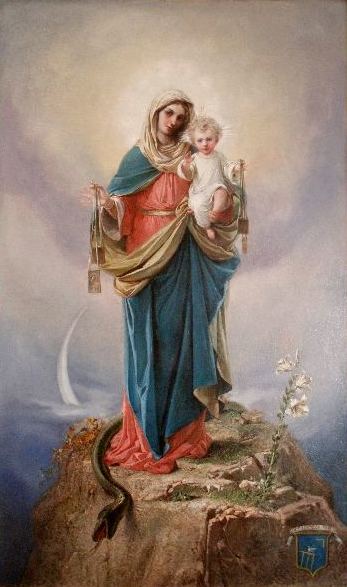
Gospel Reading : Matthew 12:46-50
While he was still speaking to the people, behold, his mother and his brethren stood outside, asking to speak to him.
But he replied to the man who told him, “Who is my mother, and who are my brethren?”
And stretching out his hand toward his disciples, he said, “Here are my mother and my brethren!
For whoever does the will of my Father in heaven is my brother, and sister, and mother.”
What do the Fathers say?
St JEROME. But now it should be known that in divine Scripture men are said to be brethren in four different ways, by nature, by nation, by kindred, and by affection.
By nature, as Esau and Jacob. By nation, as all Jews are called brethren, as in Deuteronomy, Thou shalt not set over thee a foreigner who is not thy brother. (Deut. 17:15)
They are called brethren by kindred who are of one family, as in Genesis, Abraham said unto Lot, Let there not be strife between thee and me, for we are brethren. (Gen. 13:8) Also men are called brethren by affection, which is of two kinds, special and general. Special, as all Christians are called brethren, as the Saviour says, Go tell my brethren. General, inasmuch as all men are born of one father, we are bound together by a tie of consanguinity, as in that, Say unto them that hate you, Ye are our brethren. (Is. 66:5 sec. LXX.)
I ask then, after which manner these are called the Lord’s brethren in the Gospel? According to nature? But Scripture saith not, neither calling them sons of Mary nor of Joseph. By nation? But it is absurd that some few out of all the Jews should be called brethren, seeing that all the Jews who were there might have thus been called brethren. By affection, either of a human sort, or of the Spirit? If that be true, yet how were they more His brethren than the Apostles, whom He instructed in the inmost mysteries. Or if because they were men, and all men are brethren, it was foolish to say of them in particular, Behold, thy brethren seek thee. It only remains then that they should be His brethren by kindred, not by affection, not by privilege of nation, not by nature.
We understand by the brethren of the Lord, cousins of the Saviour, sons of a sister of Mary, an aunt of Our Lord, who is said to be the mother of James the Less, and Joseph, and Jude, whom in another place of the Gospel we find called the brethren of the Lord. (Mark 6:3) And that cousins are called brethren, appears from every part of Scripture.
St AUGUSTINE. But whatever may be decided concerning these brethren, yet concerning the holy Virgin Mary, (for the honour of Christ,) when sin in her is in question, I would not have it brought into doubt. For from this only we might know that more abundant grace was conferred upon her that she should overcome sin on all sides, because she merited to conceive and bring forth Him Who it is clear had no sin.
St JEROME. He that delivers this message, seems to me not to do it casually and without meaning, but as setting a snare for Him, as to whether He would prefer flesh and blood to the spiritual work; and thus the Lord refused to go out, not because He disowned His mother and His brethren, but that He might confound him that had laid this snare for Him.
St HILARY. And He cannot be held to have thought meanly of His mother, seeing that in His passion He displayed the most extreme care for her.
Sources:
Bible readings from the Revised Standard Version of the Bible, Second Catholic Edition, copyright © 2006 National Council of the Churches of Christ in the USA
Quotes of the Fathers from :
Thomas Aquinas’ Catena Aurea Translated by St John Henry Newman
Artwork ex Wikimedia Commons