
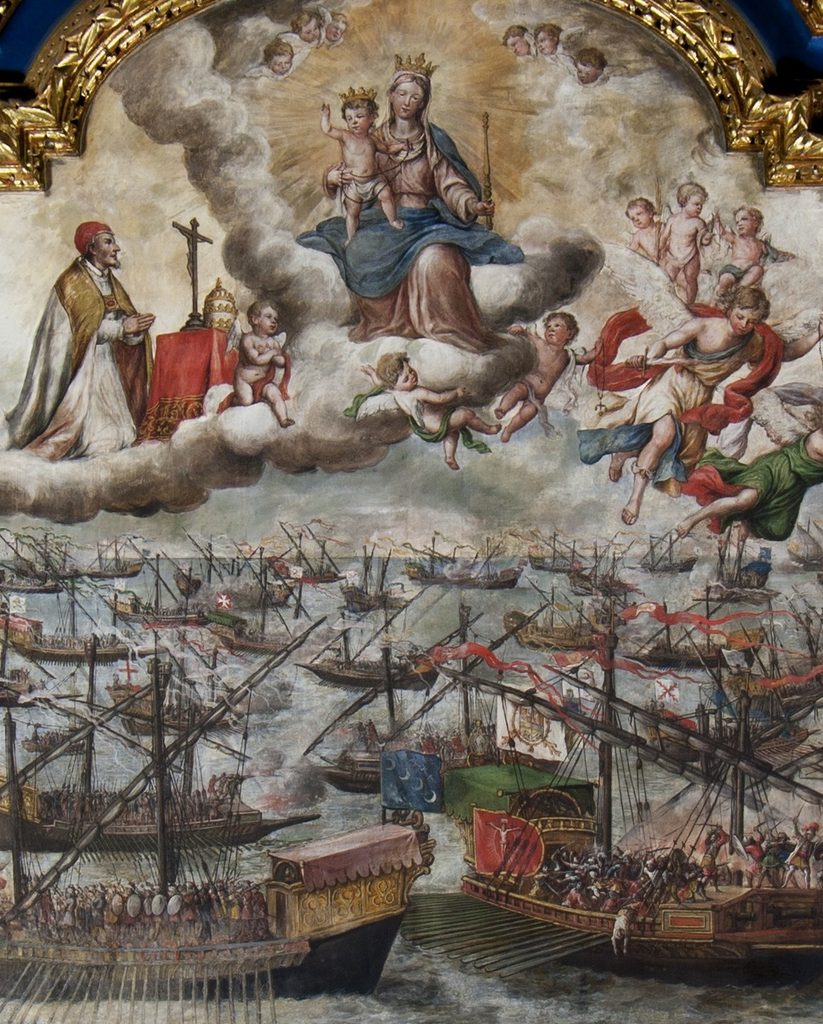
Gospel Reading : Luke 1:26-38
In the sixth month the angel Gabriel was sent from God to a city of Galilee named Nazareth, to a virgin betrothed to a man whose name was Joseph, of the house of David; and the virgin’s name was Mary.
And he came to her and said, “Hail, full of grace, the Lord is with you!” But she was greatly troubled at the saying, and considered in her mind what sort of greeting this might be.
And the angel said to her, “Do not be afraid, Mary, for you have found favor with God. And behold, you will conceive in your womb and bear a son, and you shall call his name Jesus.
He will be great, and will be called the Son of the Most High; and the Lord God will give to him the throne of his father David, and he will reign over the house of Jacob for ever; and of his kingdom there will be no end.”
And Mary said to the angel, “How can this be, since I have no husband?”
And the angel said to her,“The Holy Spirit will come upon you,and the power of the Most High will overshadow you; therefore the child to be born will be called Holy, the Son of God.”
And behold, your kinswoman Elizabeth in her old age has also conceived a son; and this is the sixth month with her who was called barren. For with God nothing will be impossible.”
And Mary said, “Behold, I am the handmaid of the Lord; let it be to me according to your word.” And the angel departed from her.
What do the Fathers say?
About the angel’s greeting :
St. BONAVENTURE. Mary was full of grace, and a sea of graces; for as all rivers run into the sea, so all graces which angels, patriarchs, apostles, martyrs, confessors, virgins possessed, came together in her.
St. AMBROSE. This signifies.—1. That the Blessed Virgin had a gift of grace bestowed upon her by God, and that, in a full measure of excellence beyond other just and holy persons, for this epithet is applied solely to the Blessed Virgin, to the end that she might be made worthy to become in time the Mother of God.
2. That she by means of this gift of grace was wonderfully well-pleasing in the sight of God and of all His angels, and in their eyes altogether lovely and beautiful, so that Christ chose her before all others for His mother.
St. AUGUSTINE. Mary is filled with grace, and Eve is made clear from guilt; the curse of Eve is changed into the blessing of Mary.
TOLETUS. The Blessed Virgin was full of all grace, both in body and soul. For she was free from concupiscence so that in her the flesh was subject to the reason and the spirit, as was the case with Adam in Paradise through original righteousness. He adds that in her, nature conspired with grace and co-operated with it in every respect.
St JEROME. It is well said that she was full of grace, because on others grace is bestowed partially, but the fulness of grace in complete treasure was infused into Mary.
The entire fulness of grace, which is in Christ, came upon Mary, although in a different way.
SUAREZ. shows that the grace possessed by the Blessed Virgin in the first instant of her conception was greater than the grace which the highest angel possesses, who by one or two acts has perfected all his merits, and therefore she merited more than thousands of men merit through their whole life. Wherefore the Blessed Virgin in this first instant loved and praised God with such earnestness of intention that she exceeded the love, and consequently also the merit, of the highest angel.
St. BERNARD. is in all creatures by power, in rational beings by knowledge, in the good by love, and therefore He is with them by concord of the will, for it is by means of this that they unite themselves to God. Then he adds, “But since He is in this way with all the saints, yet He was in an especial manner with Mary, between whom and Himself there was such a consent that He joined not only her will, but her flesh to Himself, and of His own and the Virgin’s substance made one Christ; who although He is not wholely of God nor wholely of the Virgin, yet He is wholely God’s and wholely the Virgin’s, and not two sons, but the one son of both.” Then he shows that the whole Trinity was with the Blessed Virgin.
“Not only is the Lord the Son with thee whom thou art clothing with thy flesh, but also the Lord the Spirit by Whom thou art conceiving, and the Lord the Father who begat Him whom thou art conceiving.”
PETER CHRYSOLOGUS. She was truly blessed, for she was greater than the heaven, stronger than the earth, wider than the world; she by herself alone contained God, whom the world contains not; she bore Him Who bears the world; she brought forth Him by Whom she had been begotten, she gives nourishment to the Nourisher of all living things.
About Devotion to the Rosary:
Excerpts from Pope LEO XIII’s encyclical, Apostolatus Officio,
commonly referred to as “On Devotion of the Rosary”, is the first of a number of encyclicals of Pope Leo XIII on the Rosary. It was issued on 1 September 1883, encouraging the practice.
This devotion, so great and so confident, to the august Queen of Heaven, has never shone forth with such brilliancy as when the militant Church of God has seemed to be endangered by the violence of heresy spread abroad, or by an intolerable moral corruption, or by the attacks of powerful enemies. Ancient and modern history and the more sacred annals of the Church bear witness to public and private supplications addressed to the Mother of God, to the help she has granted in return, and to the peace and tranquillity which she had obtained from God. Hence her illustrious titles of helper, consoler, mighty in war, victorious, and peace-giver.
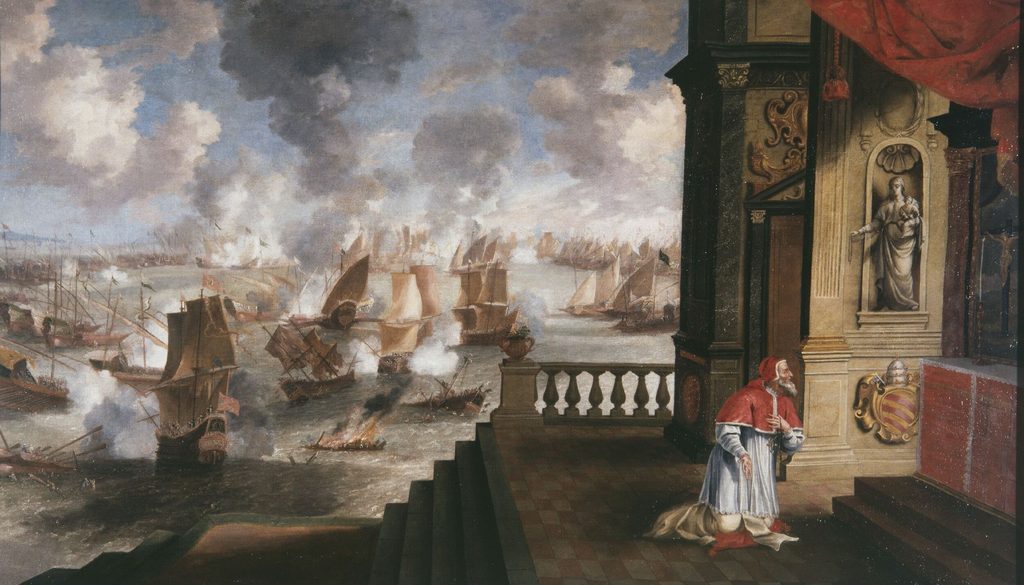
The efficacy and power of this devotion was also wondrously exhibited in the sixteenth century, when the vast forces of the Turks threatened to impose on nearly the whole of Europe the yoke of superstition and barbarism. At that time the Supreme Pontiff, St. Pius V., after rousing the sentiment of a common defense among all the Christian princes, strove, above all, with the greatest zeal, to obtain for Christendom the favour of the most powerful Mother of God. So noble an example offered to heaven and earth in those times rallied around him all the minds and hearts of the age. And thus Christ’s faithful warriors, prepared to sacrifice their life and blood for the salvation of their faith and their country, proceeded undauntedly to meet their foe near the Gulf of Corinth, while those who were unable to take part formed a pious band of supplicants, who called on Mary, and unitedly saluted her again and again in the words of the Rosary, imploring her to grant the victory to their companions engaged in battle.
Our Sovereign Lady did grant her aid; for in the naval battle by the Echinades Islands, the Christian fleet gained a magnificent victory, with no great loss to itself, in which the enemy were routed with great slaughter. And it was to preserve the memory of this great boon thus granted, that the same Most Holy Pontiff desired that a feast in honor of Our Lady of Victories should celebrate the anniversary of so memorable a struggle, the feast which Gregory XIII. dedicated under the title of “The Holy Rosary.”
Similarly, important successes were in the last century gained over the Turks at Temeswar, in Pannonia, and at Corfu; and in both cases these engagements coincided with feasts of the Blessed Virgin and with the conclusion of public devotions of the Rosary. And this led our predecessor, Clement XI., in his gratitude, to decree that the Blessed Mother of God should every year be especially honoured in her Rosary by the whole Church.
Sources:
Bible readings from the Revised Standard Version of the Bible, Second Catholic Edition, copyright © 2006 National Council of the Churches of Christ in the USA
Quotes of the Fathers from
Cornelius à Lápide’s Great Commentary
Pope Leo XIII’s Supremi apostolatus officio – encyclical On Devotion to the Rosary written in 1883
Artwork ex Wikimedia Commons