
John 6:35-40
“I am the bread of life; he who comes to me shall not hunger, and he who believes in me shall never thirst.”
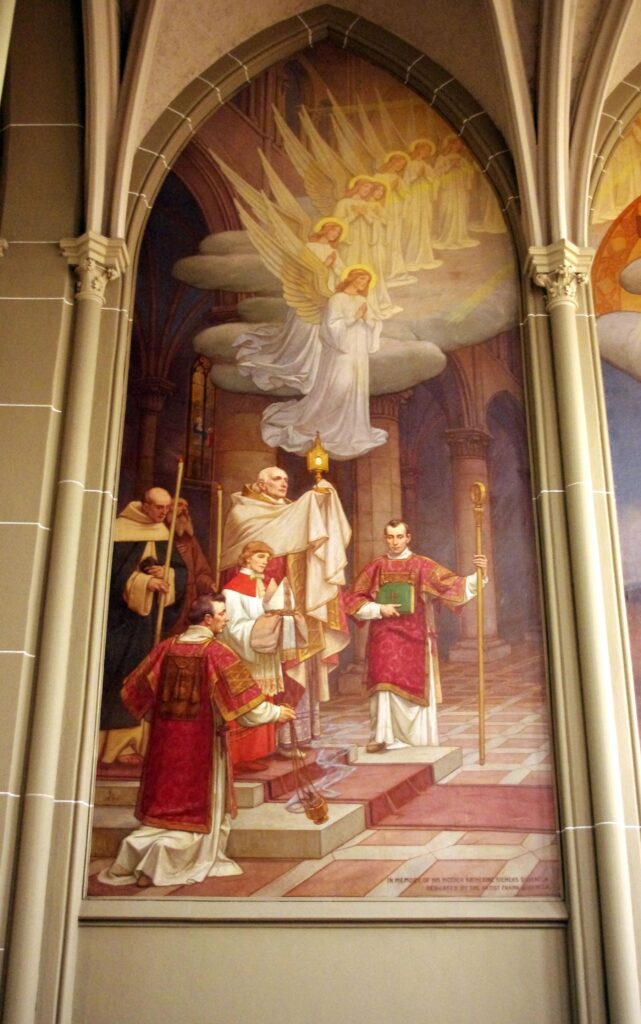
Jesus said to them, “I am the bread of life; he who comes to me shall not hunger, and he who believes in me shall never thirst.
But I said to you that you have seen me and yet do not believe. All that the Father gives me will come to me; and him who comes to me I will not cast out.
For I have come down from heaven, not to do my own will, but the will of him who sent me; and this is the will of him who sent me, that I should lose nothing of all that he has given me, but raise it up at the last day.”
What do the Fathers say?
St AUGUSTINE. He that comes to Me, i. e. that believes in Me, shall never hunger, and shall never thirst; signifying that eternal society, where there is no want.
Our Lord tells them – you desire bread from heaven: but, although you have it before you, you eat it not. This is what I told you: that you also have seen Me, and believe not.
St ALCUIN. Whomsoever therefore the Father draws to belief in Me, he, by faith, shall come to Me, that he may be joined to Me.
And those, who in the steps of faith and good works, shall come to Me, I will in no wise cast out; i. e. in the secret habitation of a pure conscience, he shall dwell with Me, and at the last I will receive him to everlasting felicity.
St AUGUSTINE. That inner place, from whence there is no casting out, is a great sanctuary, a secret chamber, where is neither weariness, or the bitterness of evil thoughts, or the cross of pain and temptation: of which it is said, Enter thou into the joy of thy Lord. (Mat. 25)
St John CHRYSOSTOM. The expression, “All that the Father gives me will come to me”, shows that it is no accident whether a man believes or not, and that belief is not the work of human cogitation, but requires a revelation from on high, and a mind devout enough to receive the revelation.
Not that they are free from blame, whom the Father does not give, for they are deficient even in that which lies in their own power, the will to believe.
This is a virtual rebuke to their unbelief, as it shows that whoever does not believe in Him, transgresses the Father’s will.
St AUGUSTINE. This is the reason why He does not cast out those who come to Him. For I came down from heaven not to do My own will, but the will of Him that sent Me.
The soul departed from God, because it was proud. Pride casts us out, humility restores us. When a physician in the treatment of a disease, cures certain outward symptoms, but not the cause which produces them, his cure is only temporary. As long as the cause remains, the disease may return. That the cause then of all diseases, i. e. pride, might be eradicated, the Son of God humbled Himself.
Why are you proud, O man? The Son of God humbled Himself for you. It might shame you, perhaps, to imitate a humble man; but imitate at least a humble God.
And this is the proof of His humility: I came not to do My own will, but the will of Him that sent Me. Pride does its own will; humility the will of God.
They therefore who by God’s unerring providence are foreknown, and predestined, called, justified, glorified, even before their new birth, or before they are born at all, are already the sons of God, and cannot possibly perish; these are they who truly come to Christ. By Him there is given also perseverance in good unto the end; which is given only to those who will not perish. Those who do not persevere will perish.