
John 6:52-59
“This is the bread which came down from heaven, not such as the fathers ate and died; he who eats this bread will live for ever.”
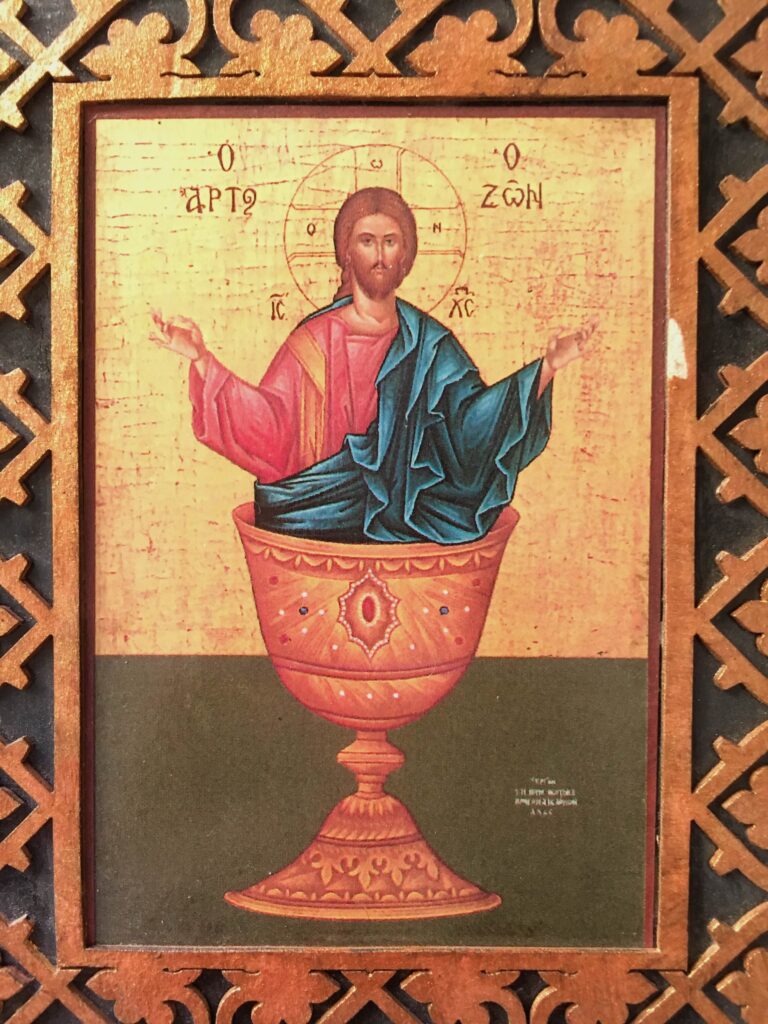
The Jews then disputed among themselves, saying, “How can this man give us his flesh to eat?”
So Jesus said to them, “Truly, truly, I say to you, unless you eat the flesh of the Son of man and drink his blood, you have no life in you; he who eats my flesh and drinks my blood has eternal life, and I will raise him up at the last day.
For my flesh is food indeed, and my blood is drink indeed. He who eats my flesh and drinks my blood abides in me, and I in him.
As the living Father sent me, and I live because of the Father, so he who eats me will live because of me. This is the bread which came down from heaven, not such as the fathers ate and died; he who eats this bread will live for ever.”
This he said in the synagogue, as he taught at Caper′na-um.
What do the Fathers say?
St THEOPHYLACT. For it is not the flesh of man simply, but of God: and it makes man divine, by inebriating him, as it were, with divinity.
For we do not just eat God, God being impalpable and incorporeal; nor again, just the flesh of man, which would not profit us. But God having taken flesh into union with Himself, that flesh is enlivening.
Not that it has changed its own for the Divine nature; but, just as heated iron remains iron, with the action of the heat in it; so our Lord’s flesh is enlivening, as being the flesh of the Word of God.
St AUGUSTINE. By this meat and drink then, He would have us understand the society of His body, and His members, which is the Church, in the predestined, and called, and justified, and glorified saints and believers. The Sacrament whereof, i. e. the unity of the body and blood of Christ, is administered from the Lord’s Table: and from the Lord’s Table it is received by some to their salvation, by others to their condemnation.
To prevent us supposing that those who, by virtue of that meat and drink, were promised eternal life, would not die in the body, He adds, And I will, raise him up at the last day; i. e. to that eternal life, a spiritual rest, which the spirits of the Saints enter into. But neither shall the body be defrauded of eternal life, but shall be endowed with it at the resurrection of the dead in the last day.
Our Lord has chosen for the types of His body and blood, things which become one out of many. Bread is a quantity of grains united into one mass, wine a quantity of grapes squeezed together. Then He explains what it means to eat His body and drink His blood: He that eats My flesh, and drinks My blood, dwells in Me, and I in him. So then to partake of that meat and that drink, is to dwell in Christ and Christ in you. He that does not dwell in Christ, and in whom Christ does not dwell, neither eats His flesh, nor drinks His blood: but rather eats and drinks the sacrament of it to his own damnation.
As for those, as indeed there are many, who either eat that flesh and drink that blood hypocritically, or, who having eaten, become apostates, do they dwell in Christ, and Christ in them? Nay, but there is a proper mode of eating that flesh, and drinking that blood, in which he that eats and drinks, dwells in Christ, and Christ in him.
That is to say, one who eats the body and drinks the blood of Christ not in the sacramental sense, but in reality.
St HILARY. Of the truth then of the body and blood of Christ, no room for doubting remains: for, by the declaration of our Lord Himself, and by the teaching of our own faith, the flesh is really flesh, and the blood really blood. This then is our principle of life. While we are in the flesh, Christ dwells in us by His flesh.
St John CHRYSOSTOM. For if it was possible without harvest or fruit of the earth, or any such thing, to preserve the lives of the Israelites of old for forty years, much more will He be able to do this with that spiritual food, of which the manna is the type. He knew how precious a thing life was in men’s eyes, and therefore repeats His promise of life often; just as the Old Testament had done; except that it only offered length of life; He offered life without end.
This promise was an abolition of that sentence of death, which sin had brought upon us.
These things said He in the synagogue, as He taught in Capernaum; where many displays of His power took place. He taught in the synagogue and in the temple, with the view of attracting the multitude, and as a sign that He was not acting in opposition to the Father.