
“The knot of Eve’s disobedience was untied by Mary’s obedience; what the virgin Eve bound through her unbelief, the virgin Mary set free through her faith.”
— St Iraneus of Lyons (c. 130–202 AD)
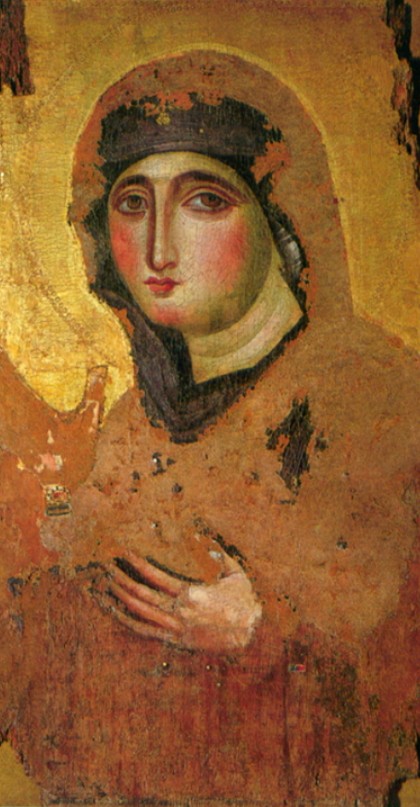
John 14:27-31
Peace I leave with you; my peace I give to you; not as the world gives do I give to you. Let not your hearts be troubled, neither let them be afraid. You heard me say to you, ‘I go away, and I will come to you.’
If you loved me, you would have rejoiced, because I go to the Father; for the Father is greater than I.
And now I have told you before it takes place, so that when it does take place, you may believe.
I will no longer talk much with you, for the ruler of this world is coming. He has no power over me; but I do as the Father has commanded me, so that the world may know that I love the Father.
What do the fathers say?
St AUGUSTINE. Although He was only going for a time, their hearts would be troubled and afraid for what might happen before He returned; lest in the absence of the Shepherd the wolf might attack the flock:
You have heard how I said to you, I go away, and come again to you. In that He was man, He went: in that He was God, He stayed. Why then be troubled and afraid, when He left the eye only, not the heart?
To make them understand that it was as man that He said, I go away, and come again to you; He adds, If you loved Me you would rejoice, because I said, I go to My Father; for My Father is greater than I.
In that the Son then is unequal with the Father, through that inequality He went to the Father, from Him to come again to judge the quick and dead: in that He is equal to the Father, He never goes from the Father, but is everywhere together with Him in that Godhead, which is not confined to place.
The Son Himself, because of being equal to the Father in the form of God, He emptied Himself, not losing the form of God, but taking that of a servant, is greater even than Himself: the form of God which is not lost, is greater than the form of a servant which was put on.
In this form of a servant, the Son of God is inferior not to the Father only, but to the Holy Ghost; in this the Child Christ was inferior even to His parents; to whom we read, He was subject.
Let us acknowledge then the twofold substance of Christ, the divine, which is equal to the Father, and the human, which is inferior. But Christ is both together, not two, but one Christ: else the Godhead is a quaternity, not a Trinity.
Wherefore He says, If you loved Me, you would rejoice, because I said, I go to the Father; for human nature should exult at being thus taken up by the Only Begotten Word, and made immortal in heaven; at earth being raised to heaven, and dust sitting incorruptible at the right hand of the Father.
Who, that loves Christ, will not rejoice at this, seeing, as he does, his own nature immortal in Christ, and hoping that He Himself will be so by Christ.
Bible readings from the Revised Standard Version of the Bible, Second Catholic Edition, copyright © 2006 National Council of the Churches of Christ in the USA
Quotes of the Fathers from Thomas Aquinas’ Catena Aurea Translated by St John Henry Newman
Artwork ex Wikimedia Commons