Sub Tuum Praesidium is the oldest known prayer to Our Lady. The oldest version of this prayer is written in Greek on an Egyptian papyrus dating back to the 3rd century. The Latin version dates from the 11th century and was most likely translated from the Greek.
We fly to thy protection,
O holy Mother of God.
Despise not our petitions in our necessities,
but deliver us always from all dangers,
O glorious and blessed Virgin.
Latin:
Sub tuum praesidium confugimus,
Sancta Dei Genetrix.
Nostras deprecationes ne despicias in necessitatibus,
sed a periculis cunctis libera nos semper,
Virgo gloriosa et benedicta.
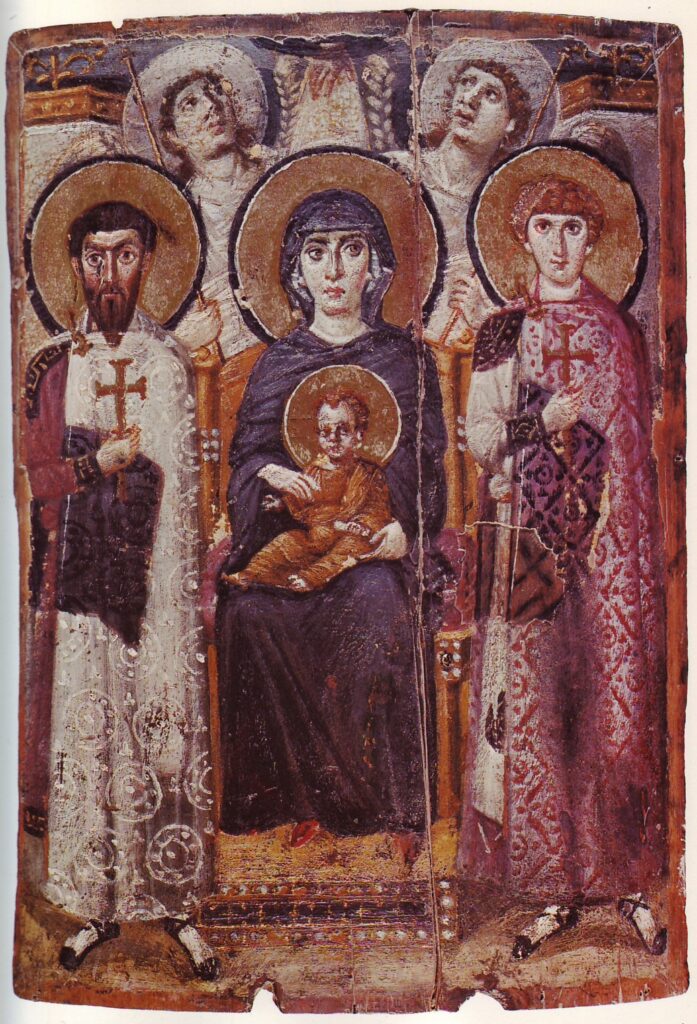
Image is a 6th century Icon of the enthroned Virgin and Child with saints and angels, with the Hand of God above, – in Saint Catherine’s Monastery, Sinai.
John 15:1-8
“I am the true vine, and my Father is the vinedresser. Every branch of mine that bears no fruit, he takes away, and every branch that does bear fruit he prunes, that it may bear more fruit.
You are already made clean by the word which I have spoken to you. Abide in me, and I in you. As the branch cannot bear fruit by itself, unless it abides in the vine, neither can you, unless you abide in me.
I am the vine, you are the branches. He who abides in me, and I in him, he it is that bears much fruit, for apart from me you can do nothing. If a man does not abide in me, he is cast forth as a branch and withers; and the branches are gathered, thrown into the fire and burned.
If you abide in me, and my words abide in you, ask whatever you will, and it shall be done for you. By this my Father is glorified, that you bear much fruit, and so prove to be my disciples.
What do the Fathers say?
St AUGUSTINE. For we cultivate God, and God cultivates us. But our culture of God does not make Him better: our culture is that of adoration, not of ploughing: His culture of us makes us better. His culture consists in extirpating all the seeds of wickedness from our hearts, in opening our heart to the plough, as it were, of His word, in sowing in us the seeds of His commandments, in waiting for the fruits of piety.
As the branch cannot bear fruit of itself, except it abide in the vine, no more can you, except you abide in Me. What a Great display of grace!
He strengthens the hearts of the humble and stops the mouth of the proud. They who hold that God is not necessary for the doing of good works, the subverters, not the assertors, of free will, contradict this truth. For he who thinks that he bears fruit of himself, is not in the vine; he who is not in the vine, is not in Christ.
And who is there in this world so clean, that he cannot be more and more changed? Here, if we say that we have no sin, we deceive ourselves. He cleans then the clean, i. e. the fruitful, that the cleaner they be, the more fruitful they may be.
Then He calls Himself the cleanser of the branches: Now you are clean through the word, which I have spoken to you. He performs the part of the vinedresser then, as well as of the vine.
But why does He not say, you are clean by reason of the baptism wherewith you are washed? Because it is the word in the water which cleans. Take away the word, and what is the water, but water?
Add the word to the element, and you have a sacrament. How has the water such virtue as that by touching the body, it cleans the heart, but by the power of the word, not spoken only, but believed?
For in the word itself, the passing sound is one thing, the abiding virtue another. This word of faith is of such avail in the Church of God, that by Him who believes, presents, blesses, sprinkles the infant, it cleanseth that infant, although it is unable to believe.
St John CHRYSOSTOM. And inasmuch as even the best of men require the work of the vinedresser, He adds, And every branch that bears fruit, He purges it, that it may bring forth more fruit. He alludes here to the tribulations and trials which were coming upon them, the effect of which would be to purge, and so to strengthen them. By pruning the branches we make the tree shoot out the more.
You are clean through the word which I have spoken unto you, i. e. you have been enlightened by My doctrine, and been delivered from Jewish error.
Bible readings from the Revised Standard Version of the Bible, Second Catholic Edition, copyright © 2006 National Council of the Churches of Christ in the USA
Quotes of the Fathers from Thomas Aquinas’ Catena Aurea Translated by St John Henry Newman
Artwork ex Wikimedia Commons