
John 10:1-10
The Good Shepherd – Some Early depictions:
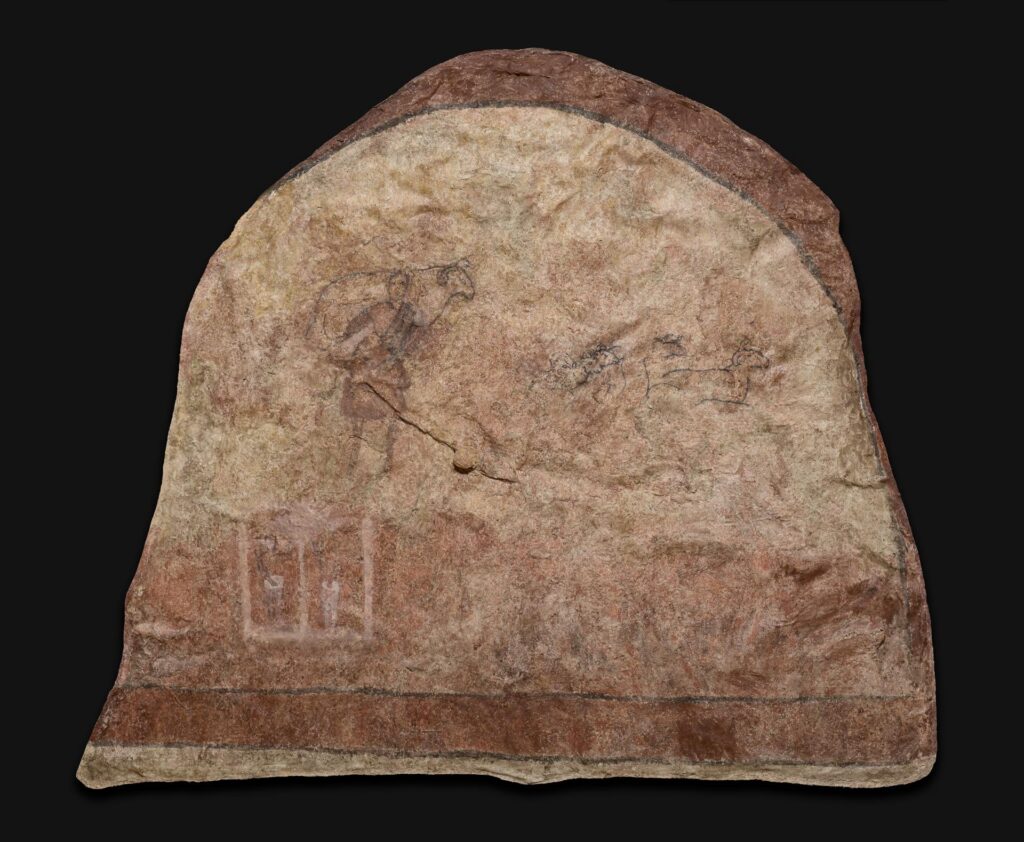
Dating to approximately 232–235 AD, this is part of the oldest identified Christian house church in the world.
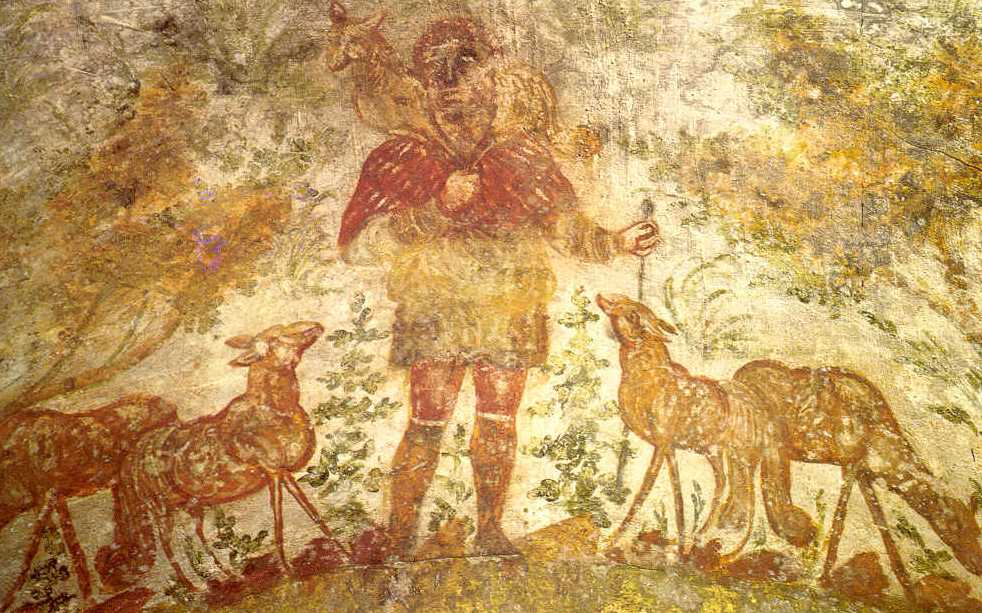
The Domitilla catacomb is unique because it is one of the oldest and largest in Rome, named after Flavia Domitilla, a noblewoman who was likely exiled for her faith.
The Shepherd is depicted in a pastoral landscape, surrounded by sheep. He is youthful and beardless—modeled after the classical Orpheus or Apollo—but with a new meaning.
For the early Christians buried here, the sheep on the Shepherd’s shoulders was the individual soul being carried through the dark wilderness of death into the green pastures of the Resurrection.
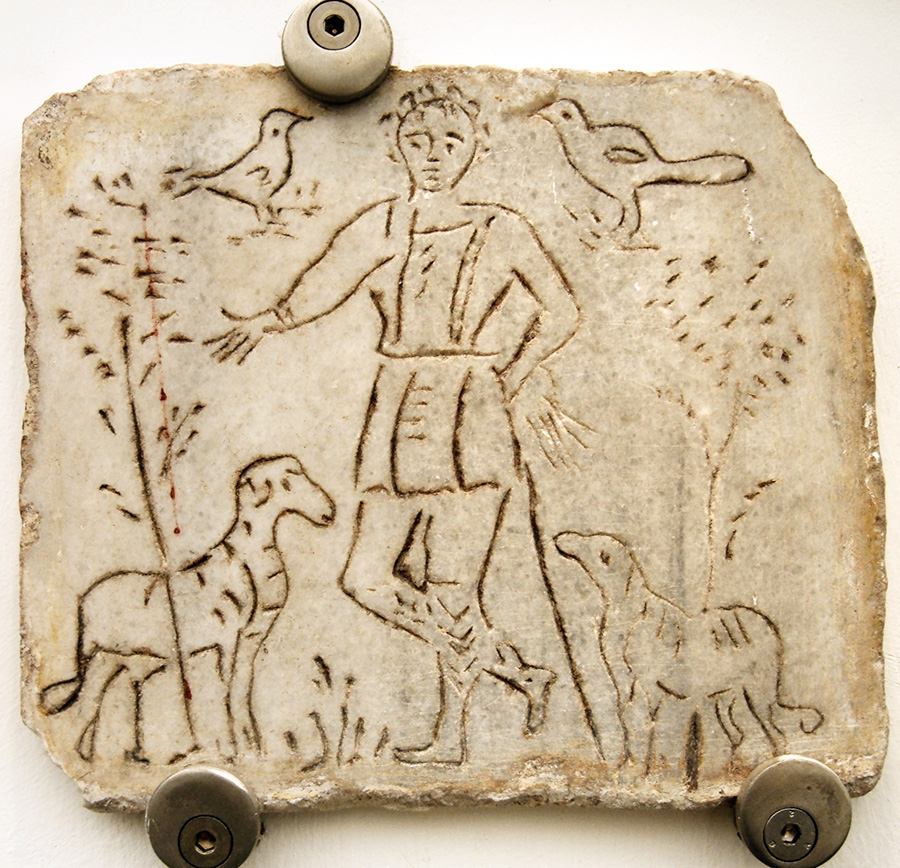
The composition is directly borrowed from the much older Greco-Roman figure of the Kriophoros (the “Ram-Bearer”), often associated with Hermes. By using a familiar pagan motif—early Christians could express their faith in public spaces (like cemeteries or bathhouses) without immediately provoking hostility.
For Christians, it transformed a simple pastoral scene into an illustration of John 10:11 (“I am the good shepherd”) and the Parable of the Lost Sheep.
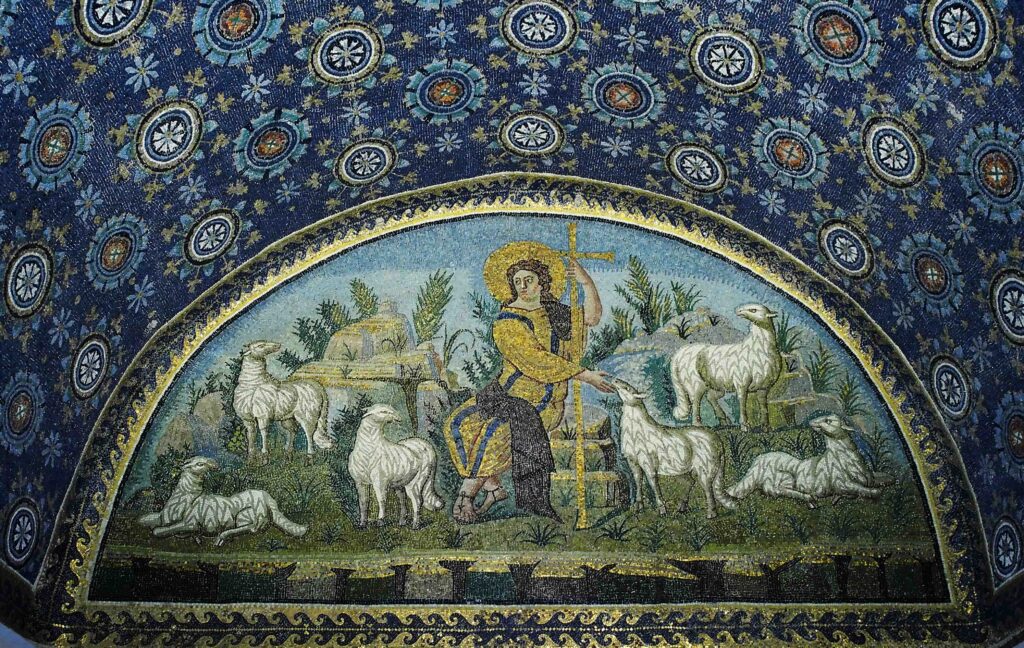
In this mosaic, the shift is undeniable. Unlike earlier depictions where the Shepherd was a simple peasant, this Shepherd is a ruler. Christ is dressed in the colors of the Roman Emperor, the golden tunic and purple mantle. This isn’t just a shepherd; it is the Rex Regum (King of Kings).
It is one of the earliest and most complete examples of Christ with a golden halo, signifying his divine nature. Also, instead of a shepherd’s crook, he holds a tall, golden Cruciform Staff. The six sheep are arranged in a perfectly balanced order—three on each side—symbolizing the order and peace of the Kingdom of God.
Gospel Reading : John 10:1-10
“Truly, truly, I say to you, he who does not enter the sheepfold by the door but climbs in by another way, that man is a thief and a robber; but he who enters by the door is the shepherd of the sheep. To him the gatekeeper opens; the sheep hear his voice, and he calls his own sheep by name and leads them out. When he has brought out all his own, he goes before them, and the sheep follow him, for they know his voice.
A stranger they will not follow, but they will flee from him, for they do not know the voice of strangers.”
This figure Jesus used with them, but they did not understand what he was saying to them.
So Jesus again said to them, “Truly, truly, I say to you, I am the door of the sheep. All who came before me are thieves and robbers; but the sheep did not heed them. I am the door; if any one enters by me, he will be saved, and will go in and out and find pasture. The thief comes only to steal and kill and destroy; I came that they may have life, and have it abundantly.
What do the Fathers say?
St John CHRYSOSTOM. Our Lord gives the marks which distinguish a robber and deceiver from a true shepherd. First come those of the deceiver and robber: Verily, verily, I say to you, He that does not enter by the door into the sheepfold, but climbs up some other way, the same is a thief and a robber. There is an allusion here to Antichrist, and to certain false Christs who had been, and were still to come.
The Scriptures He calls the door. They admit us to the knowledge of God, they protect the sheep, they shut out the wolves, they bar the entrance to heretics. He that does not use the Scriptures, but climbs up some other way, i. e. some self-chosen, unlawful way, is a thief.
When our Lord further on calls Himself the Door, we need not be surprised. According to the office which He bears, He is in one place the Shepherd, in another the Sheep. In that He introduces us to the Father, He is the Door; in that He takes care of us, He is the Shepherd.
St AUGUSTINE. Many go under the name of good men according to the standard of the world, and observe in some sort the commandments of the Law, but are not Christians. And these generally boast of themselves, as the Pharisees did; Are we blind also? Let them say, “We lead a good life;” but if they enter not by the door, what good is it? No one can hope for eternal life, who does not know Christ, who is the life, and by that door enters into the fold.
Whoso wishes to enter into the sheepfold, let him enter by the door; let him preach Christ; let him seek Christ’s glory, not his own.
Christ is a lowly door, and he who enters by this door must be lowly, if he would enter with his head whole. He that does not humble, but exalts himself; he who wishes to climb up over the wall, is exalted so that he may fall. Such men generally try to persuade others that they may live well, and not be Christians. Thus they climb up by some other way, that they may rob and kill.
He enters by the door, who enters by Christ, who imitates the suffering of Christ, who is acquainted with the humility of Christ, so as to feel and know, that if God became man for us, man should not think himself God, but man.
He who being man wishes to appear God, does not imitate Him, who being God, became man.
You are required to think less of yourself than you are, but to know what you are.
Our Lord feeds by plain words, exercises by obscure words. For when two persons, one godly, the other ungodly, hear the words of the Gospel, and they happen to be such that neither can understand them; one says, What He says is true and good, but we do not understand it: the other says, It is not worth attending to. The former, in faith, knocks, and, if he continues to knock, it shall be opened unto him.
Sources:
Bible readings from the Revised Standard Version of the Bible, Second Catholic Edition, copyright © 2006 National Council of the Churches of Christ in the USA
Quotes of the Fathers from Thomas Aquinas’ Catena Aurea Translated by St John Henry Newman
Artwork ex Wikimedia Commons