
John 10:11-18
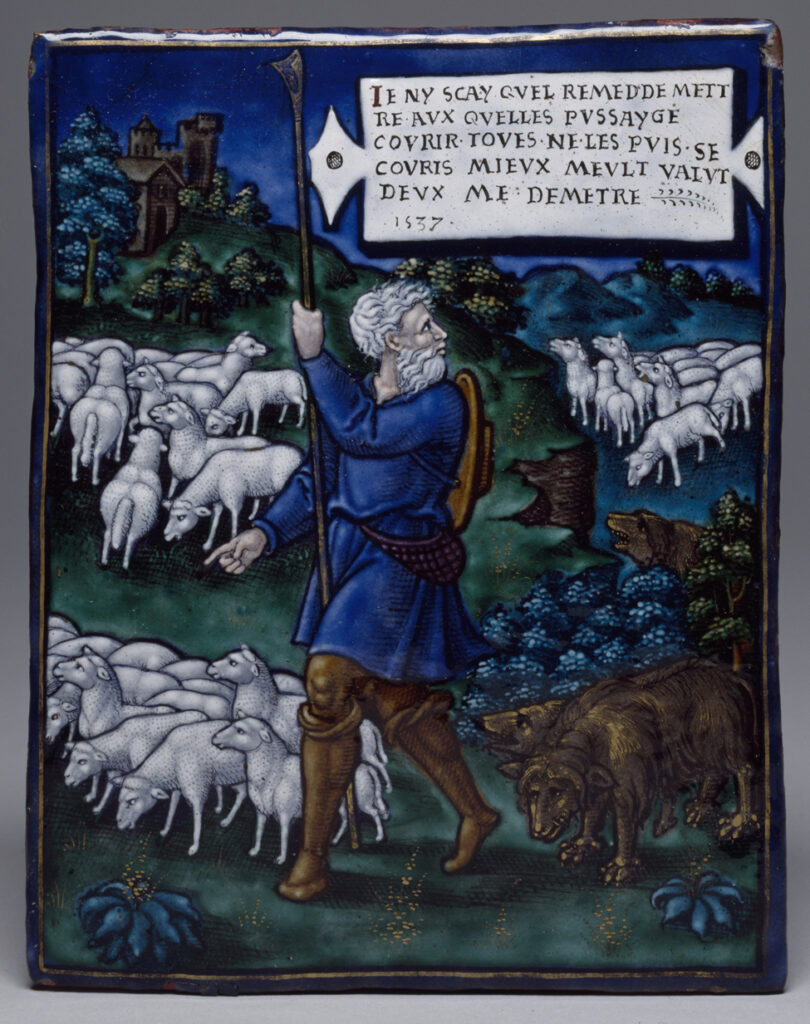
Inscription reads: “I know not what remedy to apply, or which ones I can protect. I cannot rescue them all; it would be better for me to withdraw.”
I am the good shepherd. The good shepherd lays down his life for the sheep. He who is a hireling and not a shepherd, whose own the sheep are not, sees the wolf coming and leaves the sheep and flees; and the wolf snatches them and scatters them.
He flees because he is a hireling and cares nothing for the sheep. I am the good shepherd; I know my own and my own know me, as the Father knows me and I know the Father; and I lay down my life for the sheep.
And I have other sheep, that are not of this fold; I must bring them also, and they will heed my voice. So there shall be one flock, one shepherd.
For this reason the Father loves me, because I lay down my life, that I may take it again. No one takes it from me, but I lay it down of my own accord. I have power to lay it down, and I have power to take it again; this charge I have received from my Father.”
What do the Fathers say?
Pope St GREGORY the Great. The good Shepherd gave His life for the sheep. He did what He asked, He set the example of what He commanded: He laid down His life for the sheep, that He might convert His body and blood in our Sacrament, and feed with His flesh the sheep He had redeemed.
A path is shown to us wherein to walk, despising death; a stamp is applied to us, and we must submit to the impression. Our first duty is to spend our outward possessions upon the sheep; our last, if it be necessary, is to sacrifice our life for the same sheep.
But whether a man is a shepherd or a hireling, cannot be told for certain, except in a time of trial. In tranquil times, the hireling generally stands watch like the shepherd. But when the wolf comes, then every one shows with what spirit he stood watch over the flock.
The wolf too comes upon the sheep, whenever any unjust person oppresses the humble believers. And he who seems to be shepherd, but leaves the sheep and flees, is he who dares not to resist violence, from fear of danger to himself. The hireling is inflamed with no zeal against this injustice. He only looks to outward comforts, and overlooks the internal suffering of his flock. The hireling flees, because he is a hireling, and does not care for the sheep. He cannot stand at the approach of danger, who does not love the sheep that he is set over, but seeks earthly gain. Such a one dares not face danger, for fear he should lose what he so much loves.
And I lay down My life for My sheep. As if to say, This is why I know My Father, and am known by the Father, because I lay down My life for My sheep; i. e. by My love for My sheep, I show how much I love My Father.
But as He came to redeem not only the Jews, but the Gentiles, He adds, And other sheep I have, which are not of this fold.
Of two flocks He makes one fold, uniting the Jews and Gentiles in His faith.
St AUGUSTINE. But if the Apostles were shepherds, not hirelings, why did they flee in time of persecution? And why did our Lord say, When they persecute you in this city, flee into another? (Mat. 10:23) Let us knock, then one will come who will explain.
A servant of Christ, and minister of His Word and Sacraments, may flee from city to city, when he is specially aimed at by the persecutors, apart from his brethren; so that his flight does not leave the Church destitute.
But when all, i. e. Bishops, Clerics, and Laity, are in danger, let not those who need assistance be deserted by those who should give it. Let all flee together if they can, to some place of security; but, if any are obliged to stay, let them not be forsaken by those who are bound to minister to their spiritual wants.
Then, under pressing persecution, Christ’s ministers may flee from the place where they are, when none of Christ’s people remain to be ministered to, or when that ministry may be fulfilled by others who have not the same cause for flight.
But when the people stay, and the ministers flee, and the ministry ceases, what is this but a damnable flight of hirelings, who care not for the sheep?
We must love the shepherd, beware of the wolf, tolerate the hireling. For the hireling is useful as long as he does not see the wolf, the thief, and the robber. When he sees them, he flees.
Sons wait patiently for the eternal inheritance of their father; the hireling looks eagerly for the temporal wages from his hirer; and yet the tongues of both speak abroad the glory of Christ. Many that seek temporal advantages in the Church, preach Christ, and through them Christ’s voice is heard; and the sheep follow not the hireling, but the voice of the Shepherd heard through the hireling.
St THEOPHYLACT. For there is one sign of baptism for all, and one Shepherd, even one Word of God.There is but one fold and one Shepherd set forth both in the Old and New Testaments.
The Father does not bestow His love on the Son as a reward for the death He suffered on our behalf; but He loves Him, because He beholds in the Begotten His own essence, from whence comes such great love for mankind.
St John CHRYSOSTOM. He says, in condescension to our weakness, Though there were nothing else which would have made Me love you, this would, that you are so loved by My Father, that, by dying for you, I shall win His love.
Not that He was not loved by the Father before, or that we are the cause of such love. For the same purpose He shows that He does not come to His Passion unwillingly: No man takes it from Me, but I lay it down of Myself.
Sources:
Bible readings from the Revised Standard Version of the Bible, Second Catholic Edition, copyright © 2006 National Council of the Churches of Christ in the USA
Quotes of the Fathers from Thomas Aquinas’ Catena Aurea Translated by St John Henry Newman
Artwork ex Wikimedia Commons